Review of Linear Systems Theory
I. Introduction
Physical optics is the study of the wave nature of light. Diffraction, polarization, coherence and interferometry are all physical optics effects, and play a key role in many modern optical systems. The first half of this course will be devoted to studying the key concepts of physical optics.
In the early 1960’s, the mathematics of linear systems was applied to physical optics, providing a new and powerful way of analyzing optical systems. This analysis technique is now known as Fourier optics. With the tools of Fourier optics we will be able to explain the intricacies of holography, understand how astronomers can get incredibly detailed images of distant galaxies using radio telescopes separated by thousands of kilometers (a technique called Very Long Baseline Interferometry), calculate the diffraction effects of microscopes which limit their resolution, understand Synthetic Aperture Radar, describe methods of “seeing through” a turbulent atmosphere, understand how optical pattern recognition machines work, and much more. Before we start, however, it is useful to review the most important aspects of linear systems theory.
II. Linear Systems
Many optical devices and effects can be described as linear
systems. A system is linear if we can apply superposition.
$$ \mathcal{L}\{a_1 s(\bar{x}) + a_2 t(\bar{x})\} = a_1 \mathcal{L}\{s(\bar{x})\} + a_2 \mathcal{L}\{t(\bar{x})\} $$The operator $\mathcal{L}$ describes the linear system. In electronics for example, this system could be a filter. In optics it may be an imaging system of some kind.
The operator $\mathcal{L}$ can be described in various ways. One particularly useful way is by its impulse response (often called a point spread function in optics). Physically, it is the response of the linear system to a single point at a particular location in a plane. Consider the point (expressed as delta function) located at $x_0$. The response of the linear system to this point is given by:
$$ \mathcal{L}\{\delta(\bar{x}_1 - \bar{x}_0)\} = h(\bar{x}_2; \bar{x}_0) $$$h(\bar{x}_2; \bar{x}_0)$ is the point spread function associated with the input point $\bar{x}_0$.
The semicolon notation indicates that h is also a function of where the point spread is placed in the input. For a general linear system, the shape of the response can change depending on input location.
The delta function is $\delta(\bar{x}_1 - \bar{x}_0)$ (the input point source). The $\mathcal{L}\{\cdot\}$ is the linear system operator applied to it, producing the PSF $h(\bar{x}_2; \bar{x}_0)$ as output.
The point spread function in optics is mathematically identical to the Green’s function in differential equations. Both describe the system’s response to a point source (impulse):
- Optics: Input a point of light $\delta(\bar{x} - \bar{x}_0)$ → output is the PSF $h(\bar{x}; \bar{x}_0)$
- PDEs: Apply a point source to a differential equation → output is the Green’s function $G(\bar{x}; \bar{x}_0)$
In both cases, the response to an arbitrary input is found by superposition (convolution with the source distribution). This unifies optical imaging theory with the mathematical framework of linear PDEs. In PDEs, the Green’s function $G(\bar{x}; \bar{x}_0)$ is the solution when the source is a delta function: $L\{G\} = \delta(\bar{x} - \bar{x}_0)$. The point spread function is the same concept—the system’s response to a point source, which lets you build up the response to any input via superposition.
Note that the input to the linear system can always be described by a weighted sum of delta functions:
$$ g_1(\bar{x}_1) = \int g_1(\bar{x}_0)\delta(\bar{x}_1 - \bar{x}_0)d\bar{x}_0 $$This is simply equivalent to treating the input $g_1(\bar{x}_1)$ as an infinite number of samples (delta functions) with varying strengths. By linear superposition, each one of these samples can be passed through the operator separately and added together at the output.
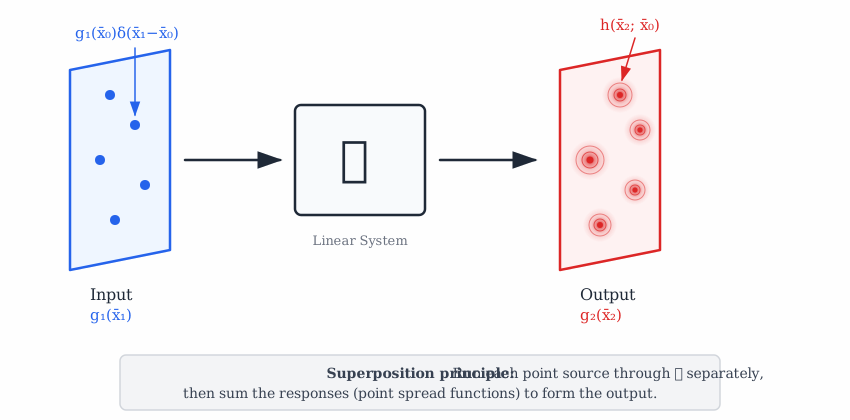
Input plane (blue): Point sources $g_1(\bar{x}_0)\delta(\bar{x}_1 - \bar{x}_0)$ represented as dots. Each point is a delta function weighted by the input function $g_1(\bar{x}_1)$.
Linear system $\mathcal{L}$: The operator that transforms input to output (e.g., an imaging lens).
Output plane (red): Each input point produces an Airy disk pattern — the point spread function $h(\bar{x}_2; \bar{x}_0)$. The concentric circles represent diffraction rings caused by the finite aperture:
- Central dot = bright central maximum
- Surrounding rings = diffraction fringes (intensity decreasing outward)
Key insight: The output image $g_2(\bar{x}_2)$ is formed by summing all individual PSF responses — this is the superposition integral (convolution). When PSFs overlap, fine details blur together, limiting resolution.
The sifting (or sampling) property of the delta function states:
$$ \int f(x) \delta(x - x_0) \, dx = f(x_0) $$The delta function “sifts out” the value of $f$ at $x_0$. In the integral above, each delta function $\delta(\bar{x}_1 - \bar{x}_0)$ is weighted by $g_1(\bar{x}_0)$, and integrating over all $\bar{x}_0$ reconstructs the original function $g_1(\bar{x}_1)$. This representation lets us treat any input as a continuous sum of impulses, which is the foundation for the superposition integral.
Superposition Integral
Input → Output:
$$ \mathcal{L}\{ g_1(\bar{x}_1) \} = g_2(\bar{x}_2) $$Substitute the delta function representation of the input:
$$ g_2(\bar{x}_2) = \mathcal{L}\left\{ \int g_1(\bar{x}_0)\,\delta(\bar{x}_1 - \bar{x}_0)\, d\bar{x}_0 \right\} $$By linearity, the operator moves inside the integral, and each delta function produces the PSF:
$$ = \int g_1(\bar{x}_0)\, h(\bar{x}_2; \bar{x}_0)\, d\bar{x}_0 $$This is the Superposition Integral - the response to a single input point of strength $g_1(\bar{x}_0)$ located at $\bar{x}_0$.
For $\mathcal{L}\{ g_1(\bar{x}_1) \} = g_2(\bar{x}_2)$, shift invariance implies
$$ \mathcal{L}\{ g_1(\bar{x}_1 - \bar{x}_0) \} = g_2(\bar{x}_2 - \bar{x}_0) $$In plain terms: if you shift the input, the output shifts by the same amount but otherwise looks identical. The system behaves the same way regardless of where the input is located.
$$ \Rightarrow \mathcal{L}\{ \delta(\bar{x}_1) \} = \underbrace{h(\bar{x}_2;\,0)}_{\text{PSF}} $$[!note] Apply to point spread function
$$ \mathcal{L}\{ \delta(\bar{x}_1 - \bar{x}_0) \} = h(\bar{x}_2 - \bar{x}_0;\,0) = \underbrace{h(\bar{x}_2 - \bar{x}_0)}_{\text{PSF}} $$Then, by shift invariance,
Plugging this back into the superposition integral gives the convolution integral:
$$ \underbrace{g_2(\bar{x}2)}{\text{output}}
\int \underbrace{g_1(\bar{x}0)}{\text{input}} ; \underbrace{h(\bar{x}_2 - \bar{x}0)}{\text{PSF}} ; d\bar{x}_0 $$
In optics we are often interested in a special kind of linear operator called a shift-invariant operator (completely analogous to the time-invariant operators in electronics).
If an operator is shift-invariant, then:
$$ \mathcal{L}\{g_1(\bar{x}_1)\} = g_2(\bar{x}_2) $$Shift invariance implies:
$$ \mathcal{L}\{g_1(\bar{x}_1 - \bar{x}_0)\} = g_2(\bar{x}_2 - \bar{x}_0) $$In other words, the behavior of the system is not a function of the independent variable (spatial position in this case).
Capacitors, resistors, etc. do not age - their behavior doesn’t depend on absolute position, only relative position.
Assume magnification is unity, and ignore inversion.
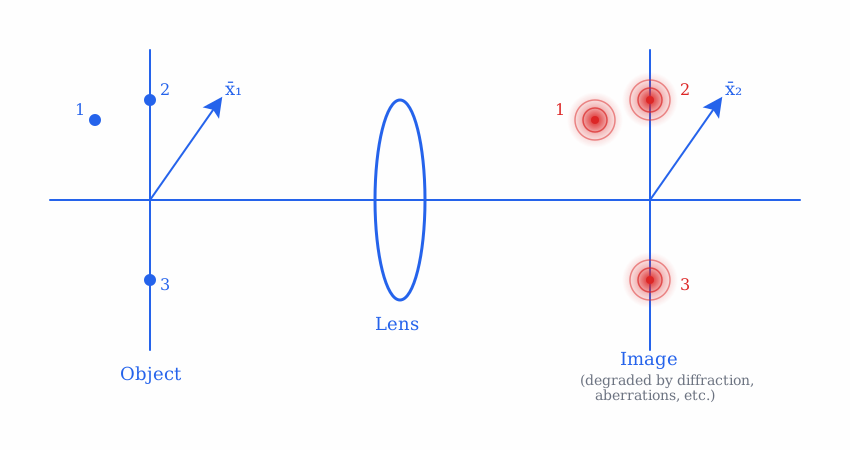
Point objects in the object plane (dots 1, 2, 3) are imaged through a lens onto the image plane. Due to diffraction and aberrations, each point does not map to a perfect point — instead it spreads into an Airy disk pattern (concentric rings). This spreading is described by the point spread function (PSF) of the system. The finite size of the PSF limits the system’s ability to resolve fine details.
Assume $\mathcal{L}\{g_1(x_1, y_1)\} = g_2(x_2, y_2)$, where $g_1(x_1, y_1)$ is the object, $g_2(x_2, y_2)$ is the image, and $\mathcal{L}$ represents the imaging process.
Shift invariance implies:
$$ \mathcal{L}\{g_1(x_1 - x_0, y_1 - y_0)\} = g_2(x_2 - x_0, y_2 - y_0) $$Physically, if we move the object around, the blurry image (from imperfect imaging) moves around also, but does not change appearance.
This is not always true in optical systems. If the center of the image is “better resolved” than the edges (as is usually the case), the system is not shift-invariant.
Several imaging effects are shift invariant:
- Diffraction
- Misfocussing
- Spherical aberration
Some are not:
- Coma
- Astigmatism
- Distortion
Point Spread Function of Linear Shift-Invariant Systems
Consider the point spread function of a linear shift-invariant (LSI) system. If we place a delta function at the origin, we have:
$$ \mathcal{L}\{\delta(\bar{x}_1)\} = h(\bar{x}_2; 0) $$But from the definition of shift-invariance, we also have:
$$ \mathcal{L}\{\delta(\bar{x}_1 - \bar{x}_0)\} = h(\bar{x}_2 - \bar{x}_0; 0) $$Thus, the entire system can be described by a single point spread function $h(\bar{x}_2)$. The superposition integral now becomes
Convolution Integral
$$ g_2(\bar{x}_2) = \int g_1(\bar{x}_0) \, h(\bar{x}_2 - \bar{x}_0) \, d\bar{x}_0 $$This is the familiar convolution integral. It will become apparent that many optical phenomena (imaging, diffraction, etc.) can be described in terms of point spread functions and convolutions in two dimensions.
$$ s(x,y) = \iint g(x',y') \, p(x-x', y-y') \, dx' \, dy' $$Correlation = convolution for symmetric functions
III. Fourier Transforms Applied to Linear Shift-Invariant Systems
In electronics, we know that a temporal Fourier transform is a useful device for studying the behavior of linear circuits. For example, filters are easily described by a transfer function $\tilde{H}(f)$, where $f$ is a temporal frequency variable. We shall see that optical propagation is conveniently described by a two-dimensional Fourier transform $\tilde{H}(f_x, f_y)$, where $f_x$ and $f_y$ are spatial frequencies.
$p(x,y)$ acts like a filter with impulse response $p(x,y)$ and transfer function $\mathcal{F}\{p(x,y)\}$. Convolutions in one domain = products in the other domain.
To understand why the Fourier transform is so useful for describing linear shift invariant systems, we recall that the superposition property allows us to:
- Express the input function as a weighted sum of simple waveforms (basis functions)
- Pass each waveform through the operator separately
- Sum the result at the end
Orthogonal: Basis functions should be mutually orthogonal (zero inner product between different basis functions). This makes finding coefficients easy — the inner product with each basis function extracts only that component’s weight, with no crosstalk from other components.
Complete: The basis should span the entire function space. Any function in the space must be expressible as a sum of basis functions. Completeness ensures no information is lost in the decomposition.
Complex exponentials $e^{j2\pi\bar{f}\cdot\bar{x}}$ satisfy both: they are orthogonal (different frequencies integrate to zero) and complete (any square-integrable function can be represented).
But what do we choose for these simple waveforms? Ideally, we would like to choose a waveform that is unaffected by the linear operator (except to be multiplied by a complex constant). Then, as each waveform is passed through the operator the effect of the operator is particularly easy to calculate.
Eigenfunctions of Linear Operators
The set of functions which are unaffected by a linear operator (except to be multiplied by a complex constant) are called the eigenfunctions of the operator.
$$ \mathcal{L}\{\psi(\bar{x}; \bar{f}_0)\} = H(\bar{f}_0)\psi(\bar{x}; \bar{f}_0) $$This is the Eigenfunction Equation.
Two ways to characterize a linear system:
Delta function input: A point source $\delta(\bar{x})$ contains all frequencies equally. The system responds with its impulse response (point spread function) — a complicated pattern mixing all the system’s frequency responses together. Useful for measuring the system, but the output shape bears no resemblance to the input.
Eigenfunction input: A complex exponential $e^{j2\pi\bar{f}\cdot\bar{x}}$ is a single pure frequency. The system responds with the same exponential, merely scaled by $H(\bar{f})$. The output shape is identical to the input — this is what makes eigenfunctions special.
Notation: Bar denotes vectors. $\bar{x} = (x, y)$ is the position vector, $\bar{f} = (f_x, f_y)$ is the spatial frequency vector, and $\bar{f} \cdot \bar{x} = f_x x + f_y y$.
Claim: The complex exponential $\exp[j 2\pi \bar{f}\cdot \bar{x}]$ is an eigenfunction of any LSI operator.
LSI System (Convolution Form): Let the LSI operator be defined by convolution with impulse response $h$:
$$ g_2(\bar{x}) = \int_{\mathbb{R}^n} h(\bar{x}_0)\, g_1(\bar{x}-\bar{x}_0)\, d\bar{x}_0 $$Choose a Complex Exponential Input: Let $g_1(\bar{x}) = \exp[j 2\pi \bar{f}_0 \cdot \bar{x}]$
Apply the Operator: Substitute $g_1$ into the convolution:
$$ g_2(\bar{x}) = \int h(\bar{x}_0)\, \exp[j 2\pi \bar{f}_0 \cdot (\bar{x}-\bar{x}_0)] \, d\bar{x}_0 = \int h(\bar{x}_0)\, \exp[j 2\pi \bar{f}_0 \cdot \bar{x}] \exp[-j 2\pi \bar{f}_0 \cdot \bar{x}_0] \, d\bar{x}_0 $$Factor out the $\bar{x}$-dependent term:
$$ g_2(\bar{x}) = \exp[j 2\pi \bar{f}_0 \cdot \bar{x}] \int h(\bar{x}_0)\, \exp[-j 2\pi \bar{f}_0 \cdot \bar{x}_0] \, d\bar{x}_0 $$Eigenfunction Form: Define $\lambda(\bar{f}_0) = \int h(\bar{x}_0)\, \exp[-j 2\pi \bar{f}_0 \cdot \bar{x}_0] \, d\bar{x}_0$. Then:
$$ g_2(\bar{x}) = \lambda(\bar{f}_0)\, g_1(\bar{x}) $$Conclusion:
- $\exp[j 2\pi \bar{f}_0 \cdot \bar{x}]$ is an eigenfunction of the LSI operator
- $\lambda(\bar{f}_0)$ is the eigenvalue, equal to the Fourier transform of $h$ evaluated at $\bar{f}_0$
Key Insight: Convolution in space corresponds to multiplication in frequency; Fourier modes diagonalize LSI systems.
The proof above used a fixed frequency $\bar{f}_0$. Letting $\bar{f}$ vary gives the family of eigenfunctions: $\exp[j2\pi \bar{f} \cdot \bar{x}]$ for all $\bar{f}$.
The transfer function $H(\bar{f})$ is defined as the Fourier transform of the impulse response:
$$ H(\bar{f}) = \int h(\bar{x}_0) \exp[-j2\pi \bar{f} \cdot \bar{x}_0] \, d\bar{x}_0 $$The general eigenfunction equation is:
$$ \mathcal{L}\{\exp[j2\pi \bar{f} \cdot \bar{x}]\} = H(\bar{f}) \exp[j2\pi \bar{f} \cdot \bar{x}] $$| Component | Interpretation |
|---|---|
| $\exp[j2\pi \bar{f} \cdot \bar{x}]$ | Input: a pure sinusoid at frequency $\bar{f}$ |
| $\mathcal{L}\{\cdot\}$ | Any LSI operator (lens, filter, propagation, etc.) |
| $H(\bar{f})$ | Eigenvalue: amplitude and phase change at that frequency |
| Output | Same sinusoid, scaled by $H(\bar{f})$ |
Why this matters: Any signal can be decomposed into complex exponentials (Fourier transform). Each exponential just gets multiplied by $H(\bar{f})$. To analyze what an LSI system does to any input:
- Decompose input into frequencies (Fourier transform)
- Multiply each frequency component by $H(\bar{f})$
- Recombine (inverse Fourier transform)
There are in general an infinite number of eigenfunctions associated with an operator. In the above, $\psi(\bar{x}; \bar{f}_0)$ is the $\bar{f}_0$th eigenfunction which is a function of $\bar{x}$. Thus, $\psi(\bar{x}; \bar{f})$ describes a family of eigenfunctions. The eigenfunction $\psi(\bar{x}; \bar{f}_0)$ can pass through the operator unchanged except that it is multiplied by the complex constant $H(\bar{f}_0)$. $H(\bar{f}_0)$ is the eigenvalue associated with the $\bar{f}_0$th eigenfunction.
Finding Eigenfunctions of Linear Shift-Invariant Operators
We are interested in finding the eigenfunctions associated with linear shift invariant operators. We shall show that the complex exponentials are the eigenfunctions we desire. Let
$$ \mathcal{L}\{\exp(j2\pi\bar{f}_0 \cdot \bar{x})\} = g(\bar{x}; \bar{f}_0) $$Now consider a shifted version of this
Complex Exponentials as Eigenfunctions
$$ \mathcal{L}\{\exp(j2\pi\bar{f}_0 \cdot (\bar{x} - \bar{x}_0))\} = \mathcal{L}\{\exp(-j2\pi\bar{f}_0 \cdot \bar{x}_0)\exp(j2\pi\bar{f}_0 \cdot \bar{x})\} $$$$ = \exp(-j2\pi\bar{f}_0 \cdot \bar{x}_0) \mathcal{L}\{\exp(j2\pi\bar{f}_0 \cdot \bar{x})\} $$$$ = \exp(-j2\pi\bar{f}_0 \cdot \bar{x}_0) g(\bar{x}; \bar{f}_0) $$But by shift-invariance:
$$ \mathcal{L}\{\exp(j2\pi \bar{f}_0 \cdot (\bar{x} - \bar{x}_0))\} = g(\bar{x} - \bar{x}_0; \bar{f}_0) $$Therefore:
$$ g(\bar{x} - \bar{x}_0; \bar{f}_0) = \exp(-j2\pi\bar{f}_0 \cdot \bar{x}_0) g(\bar{x}; \bar{f}_0) $$Now this is only true if $g(\bar{x}; \bar{f}_0)$ is of the form:
$$ g(\bar{x}; \bar{f}_0) = H(\bar{f}_0)\exp(j2\pi\bar{f}_0 \cdot \bar{x}) $$where $H(\bar{f}_0)$ = complex constant. This is the solution to the equation above.
Thus we conclude:
$$ \mathcal{L}\{\exp(j2\pi\bar{f}_0 \cdot \bar{x})\} = H(\bar{f}_0)\exp(j2\pi\bar{f}_0 \cdot \bar{x}) $$which satisfies the eigenfunction equation.
In general, the family of eigenfunctions is given by complex exponentials of all frequencies $\bar{f}$. They are orthonormal and complete.
- $|e^{j\theta}| = 1$ for all $\theta$
- Other orthonormal bases exist (Legendre, Laguerre, Hermite polynomials), but complex exponentials are special because they are eigenfunctions of shift-invariant operators
Isolating a Single Frequency Component
Start from the inverse Fourier representation of a signal:
$$ g(x) = \int G(f)\, e^{j2\pi f x}\, df $$To recover the spectrum $G(f')$, multiply both sides by $e^{-j2\pi f' x}$ and integrate over $x$:
$$ \int g(x)\, e^{-j2\pi f' x}\, dx = \int G(f)\left[\int e^{j2\pi (f - f')x}\, dx\right] df $$This step sets up an inner product between two complex exponentials. Whether this inner product vanishes or survives depends on the frequency difference $f - f'$.
Phasor (Unit-Circle) Interpretation and Orthogonality
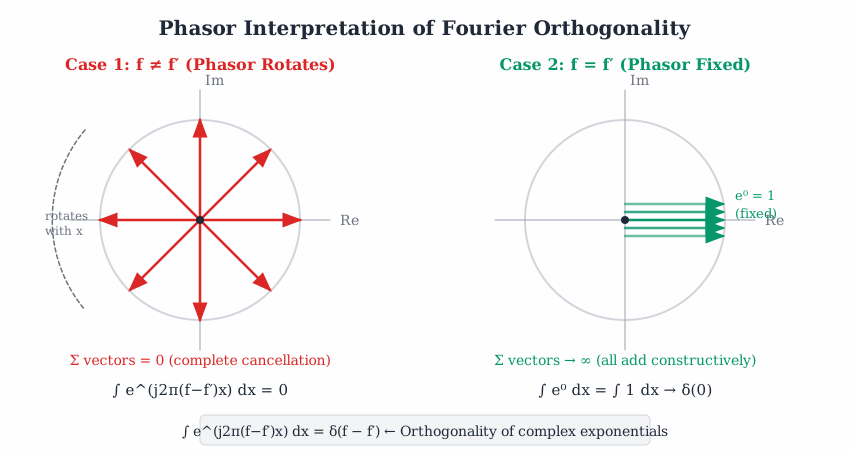
The exponential $e^{j2\pi (f - f')x}$ can be viewed as a phasor: a unit-length vector rotating in the complex plane as $x$ changes.
If $f \neq f'$: The phasor rotates continuously around the unit circle. Integrating over $x$ sums vectors pointing in all directions, producing complete cancellation.
If $f = f'$: The phasor does not rotate and remains fixed at 1 on the real axis. All contributions add in the same direction, yielding an unbounded result.
This behavior is captured mathematically by the Dirac delta function:
$$ \int e^{j2\pi (f - f')x}\, dx = \delta(f - f') $$The phasor diagram provides the geometric explanation for the orthogonality of complex exponentials and for the appearance of the delta function.
Consequence for LSI Systems: Diagonalization in Frequency
Let $\mathcal{L}$ be a linear, shift-invariant system and define the output:
$$ g_2(x) = \mathcal{L}\{g_1(x)\} $$Represent the input using its inverse Fourier transform:
$$ g_1(x) = \int G(f)\, e^{j2\pi f x}\, df $$By linearity, the operator passes through the integral:
$$ g_2(x) = \int G(f)\, \mathcal{L}\{e^{j2\pi f x}\}\, df $$Shift invariance implies that complex exponentials are eigenfunctions:
$$ \mathcal{L}\{e^{j2\pi f x}\} = H(f)\, e^{j2\pi f x} $$Substituting this result gives:
$$ g_2(x) = \int G(f)\, H(f)\, e^{j2\pi f x}\, df $$Thus, in the frequency domain:
$$ G_2(f) = G(f)\, H(f) $$Key Result: Convolution in space corresponds to multiplication in frequency. The Fourier transform diagonalizes LSI systems — each frequency component is processed independently by multiplying by the transfer function $H(f)$.
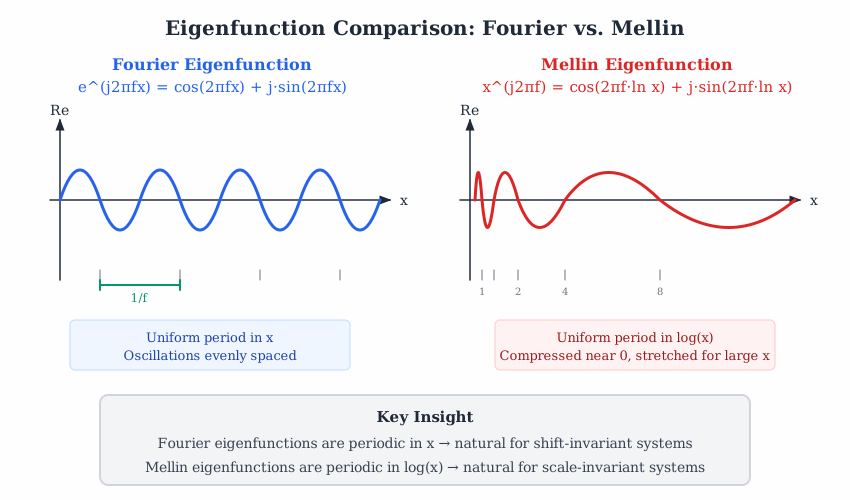
Just as the Fourier transform arises from analyzing shift-invariant systems, the Mellin transform arises from analyzing scale-invariant systems.
The Scaling Operator
The 2D scaling operator $\mathfrak{M}$ transforms a function by rescaling its arguments:
$$ g(x,y) \xrightarrow{\quad \mathfrak{M} \quad} g(ax, by) $$where $a$ and $b$ are the magnification factors along the $x$ and $y$ axes respectively.
Eigenfunctions of the Scaling Operator
The eigenfunctions of the scaling operator are complex power functions:
$$ x^{j2\pi f_x} \cdot y^{j2\pi f_y} $$where $f_x$ and $f_y$ are continuous parameters (the “scale-frequencies”).
Proof: Apply the scaling operator:
$$ \mathfrak{M}\left\{ x^{j2\pi f_x} \cdot y^{j2\pi f_y} \right\} = (ax)^{j2\pi f_x} \cdot (by)^{j2\pi f_y} $$Using $(ax)^n = a^n \cdot x^n$:
$$ = \underbrace{a^{j2\pi f_x} \cdot b^{j2\pi f_y}}_{\text{eigenvalue } \lambda(f_x, f_y)} \cdot \underbrace{x^{j2\pi f_x} \cdot y^{j2\pi f_y}}_{\text{original eigenfunction}} $$The function returns unchanged in form, multiplied by a constant. $\blacksquare$
The Mellin Transform Pair
Inverse Mellin Transform (Synthesis):
$$ g(x,y) = \iint G(f_x, f_y) \; x^{j2\pi f_x} \; y^{j2\pi f_y} \; df_x \, df_y $$Forward Mellin Transform (Analysis):
$$ G(f_x, f_y) = \iint g(x,y) \; x^{-j2\pi f_x - 1} \; y^{-j2\pi f_y - 1} \; dx \, dy $$Comparison: Fourier vs. Mellin
| Property | Shift-Invariant | Scale-Invariant |
|---|---|---|
| Operator | $g(x) \to g(x - x_0)$ | $g(x) \to g(ax)$ |
| Eigenfunctions | $e^{j2\pi fx}$ | $x^{j2\pi f}$ |
| Transform | Fourier | Mellin |
Connection to Fourier Transform
Via logarithmic substitution $x = e^t$:
$$ x^{j2\pi f} = e^{j2\pi f t} $$The Mellin transform in $(x, f)$ becomes a Fourier transform in $(\log x, f)$. This is why log-polar coordinates are useful for scale and rotation-invariant pattern recognition.
Why Fourier Transform is Useful
It is now clear why the Fourier transform is so useful in analyzing a linear shift-invariant system. The input function can be decomposed into a linear combination of eigenfunctions $\exp(j2\pi\bar{f} \cdot \bar{x})$.
The amount of each eigenfunction contained in the input is given by the Forward Fourier Transform:
$$ \tilde{G}(\bar{f}) = \int g_1(\bar{x})\exp(-j2\pi\bar{f} \cdot \bar{x})d\bar{x} $$Forward transform (analysis): To find the amplitude $\tilde{G}(\bar{f})$ of a particular frequency component, multiply the input by that frequency’s eigenfunction $e^{-j2\pi\bar{f}\cdot\bar{x}}$ and integrate over all space. The integral extracts how much of that frequency is present — all other frequencies integrate to zero (orthogonality).
Inverse transform (synthesis): To reconstruct $g(\bar{x})$ from its spectrum, sum all eigenfunctions weighted by their amplitudes $\tilde{G}(\bar{f})$. This is done by the inverse Fourier transform.
Each weighted eigenfunction is run through the linear shift invariant system. The effect of the system is to multiply each of the eigenfunctions by a complex number $H(\bar{f})$, where H takes on different values for each different eigenfunction. The function $H(\bar{f})$ is called the transfer function of the linear system.
After passing through the operator a single eigenfunction waveform becomes
Individual Eigenfunction Response
$$ \tilde{G}(\bar{f}_0) \cdot H(\bar{f}_0)\exp(j2\pi\bar{f}_0 \cdot \bar{x}) $$To calculate the output of the linear system we simply pass all weighted eigenfunctions through the operator and add up the result:
$$ g_2(\bar{x}) = \int \tilde{G}(\bar{f}) \cdot H(\bar{f})\exp(j2\pi\bar{f} \cdot \bar{x})d\bar{f} $$This is the Inverse Fourier Transform (sum of results).
The cochlea (inner ear) performs a physical Fourier transform on incoming sound. The basilar membrane varies in stiffness along its length:
- Base (stiff): Resonates at high frequencies
- Apex (flexible): Resonates at low frequencies
Each position along the membrane responds maximally to a specific frequency, mapping frequency → position. Hair cells at each location detect the local vibration amplitude, effectively measuring $|G(f)|$ at that frequency. The brain receives a spatially-encoded frequency spectrum — a biological spectrum analyzer.
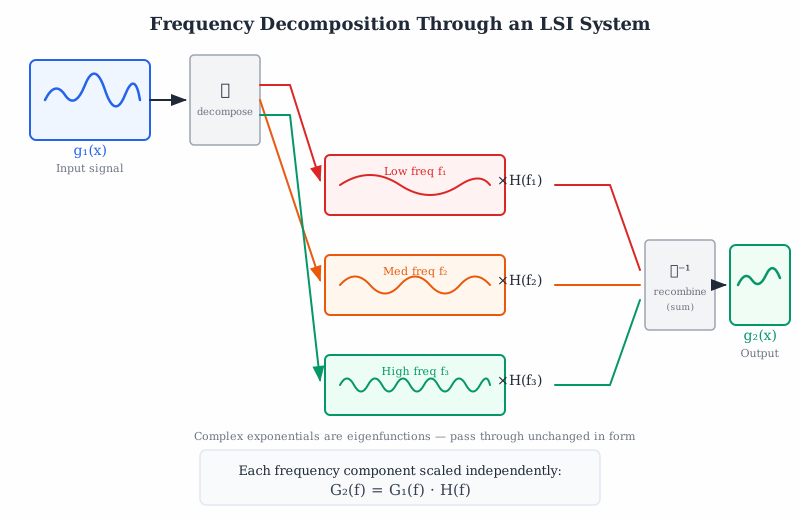
The input signal $g_1(x)$ is decomposed via Fourier transform into frequency components. Each component passes through the system independently — the LSI operator multiplies each by the transfer function $H(f)$ at that frequency:
$$ G_1(f)e^{j2\pi f x} \xrightarrow{\mathcal{L}} G_1(f)H(f)e^{j2\pi f x} $$The output is the inverse Fourier transform (recombination) of all modified components:
$$ g_2(\bar{x}) = \int \underbrace{G_1(\bar{f}) H(\bar{f})}_{G_2(\bar{f})} \exp[j 2\pi \bar{f}\cdot\bar{x}] \, d\bar{f} $$Key insights:
- Each spatial frequency passes through independently
- Frequencies are not mixed by the LSI system
- Each component is multiplied by $H(f)$ (the transfer function)
- Complex exponentials are eigenfunctions — they pass through unchanged in form, just scaled
IV. Properties of the Spatial Fourier Transform
A. Spatial Frequency
The spatial Fourier transform is similar to the more familiar temporal transform in many respects. Mathematically, the only difference is that it is two-dimensional as opposed to its one-dimensional temporal counterpart. However, there are several conceptual differences which are worth exploring.
The concept of frequency is well understood for temporal signals. If a voltage has a temporal behavior expressed by:
$$ V(t) = A\sin(2\pi f_0 t) $$we know that this corresponds to a sinusoid which repeats itself every $\frac{1}{f_0}$ seconds. The frequency has units of inverse seconds.
Equivalently, a spatial description of a particular image might be expressed as:
$$ A(x,y) = \sin(2\pi f_x x) \cdot \sin(2\pi f_y y) $$This corresponds to a two-dimensional distribution which repeats itself every $\frac{1}{f_x}$ cm in the x direction and $\frac{1}{f_y}$ cm in the y direction. The spatial frequency has components in two directions, and units of inverse centimeters.
The expression $\sin(2\pi f_x x) \cdot \sin(2\pi f_y y)$ above creates a grid pattern — a checkerboard of peaks and valleys aligned with the $x$ and $y$ axes.
But a true 2D spatial frequency component should be a tilted plane wave:
$$ \sin(2\pi(f_x x + f_y y)) $$representing wavefronts tilted at an angle determined by the ratio $f_y/f_x$.
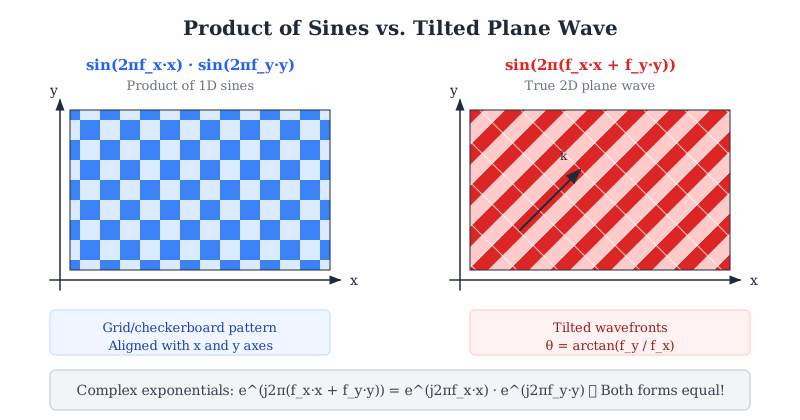
The Problem with Sines:
$$ \sin(2\pi f_x x) \cdot \sin(2\pi f_y y) \neq \sin(2\pi(f_x x + f_y y)) $$Products of sines do not give tilted plane waves. The sine function lacks the algebraic property needed for separability.
The Solution — Complex Exponentials:
Complex exponentials satisfy $e^{a+b} = e^a \cdot e^b$, therefore:
$$ \exp\left[j2\pi(f_x x + f_y y)\right] = \exp\left[j2\pi f_x x\right] \cdot \exp\left[j2\pi f_y y\right] $$- The left side is a tilted plane wave with 2D spatial frequency $(f_x, f_y)$
- The right side is a separable product of 1D functions
- Both are equal — unlike the sine case
| Sines/Cosines | Complex Exponentials | |
|---|---|---|
| Separability | $\sin(a)\sin(b) \neq \sin(a+b)$ | $e^a \cdot e^b = e^{a+b}$ |
| 2D product gives | Grid pattern | Tilted plane wave |
Complex exponentials are the natural basis for Fourier analysis because they are eigenfunctions of the shift operator and satisfy the separability property needed for multi-dimensional analysis.
Relationship Between Angular Plane Waves and Fourier Transform
This section introduces the connection between spatial frequencies and plane wave angles. For a complete worked example with propagation through an aperture, see Complete Example: Tilted Plane Wave Through Circular Aperture.
A solution to the Helmholtz equation for wave propagation is given by a plane wave:
$$ A \exp(j\phi)\exp(j\vec{k} \cdot \vec{r}) $$where $A$ and $\phi$ are the amplitude and phase of the plane wave. In rectangular coordinates this becomes:
$$ u(x,y,z) = A \exp(j\phi)\exp(jk_z \cdot z)\exp(j(k_x \cdot x + k_y \cdot y)) $$Now consider the field in a particular z plane $z = z_0$:
$$ u(x,y)_{z=z_0} = A \exp(j(\phi + k_z \cdot z_0))\exp(j(k_x \cdot x + k_y \cdot y)) $$Notice that the field is described by a complex exponential. When one moves along the x-axis (or y-axis), the phase of this complex exponential changes. The rate at which it changes (frequency) is given by:
$$ k_x = k\cos\theta $$Thus a complex spatial frequency component is physically equivalent to a plane wave, where the frequency of the component is proportional to the cosine of the propagation angle of the plane wave.
$$ \exp(j2\pi f_x x) $$$$ f_x = \frac{\cos\theta}{\lambda} = \text{spatial freq.} $$- Radian frequency: $k_x = k\cos\theta = \frac{2\pi}{\lambda}\cos\theta$
- Spatial frequency (cycles/cm): $f_x = \frac{\cos\theta}{\lambda}$
- Relation: $k_x = 2\pi f_x$
Negative and positive frequencies correspond to plane waves travelling in opposite directions (e.g., upward vs downward tilted). The spatial Fourier transform of an arbitrary two-dimensional field can be thought of as a linear superposition of plane waves, where:
- The angle of the plane wave corresponds to the spatial frequency
- The amplitude and phase of the plane wave corresponds to the complex Fourier component associated with that spatial frequency
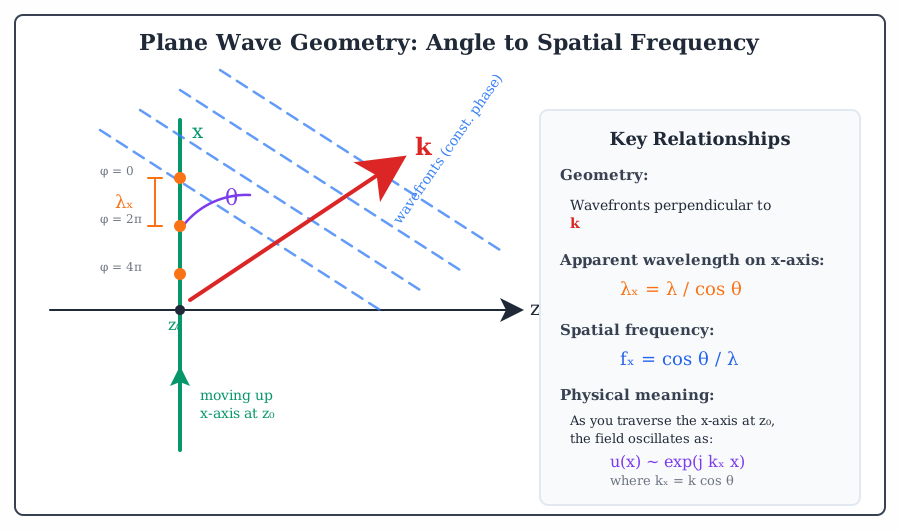
The diagram shows a plane wave with wavevector $\mathbf{k}$ tilted at angle $\theta$ from the x-axis. The dashed blue lines are wavefronts (surfaces of constant phase), perpendicular to $\mathbf{k}$.
As you move along the x-axis at observation plane $z_0$, you cross successive wavefronts. The spacing between crossings is the apparent wavelength $\lambda_x = \lambda / \cos\theta$, which is always larger than $\lambda$ (wavefronts appear “stretched” when viewed obliquely).
The spatial frequency $f_x = \cos\theta / \lambda$ is just the reciprocal — how many cycles per unit length you see along x. A steeper tilt (larger $\theta$) means fewer crossings per unit length, hence lower spatial frequency.
Verify that $f_x = \frac{\cos\theta}{\lambda}$ behaves correctly at extreme angles:
Case 1: $\theta = \pi/2$ (90°)
- Wave propagates purely along $z$
- Wavefronts are vertical — no variation in $x$
- $f_x = \frac{\cos(\pi/2)}{\lambda} = 0$ ✓
Case 2: $\theta = 0$
- Wave propagates along $x$
- Phase changes rapidly in $x$ — maximum $x$-variation
- $f_x = \frac{\cos(0)}{\lambda} = \frac{1}{\lambda}$ (maximum spatial frequency) ✓
Takeaway: The spatial frequency along $x$ is the projection of the wavevector onto the $x$-axis.
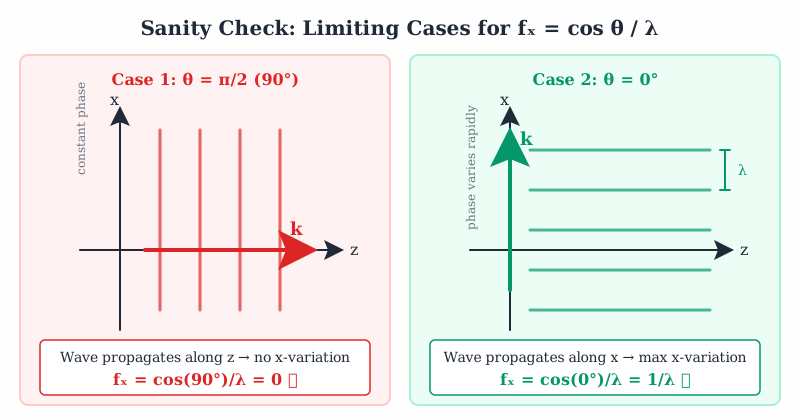
Left (θ = 90°): The wavevector $\mathbf{k}$ points along $z$, so wavefronts are vertical lines. Moving along the x-axis, you stay on the same wavefront — no phase variation, hence $f_x = 0$.
Right (θ = 0°): The wavevector $\mathbf{k}$ points along $x$, so wavefronts are horizontal. Moving along x, you cross every wavefront at maximum rate — one cycle per wavelength, hence $f_x = 1/\lambda$.
For LSI systems, convolution in space becomes multiplication in frequency:
$$ \tilde{G}_2(\bar{f}) = \tilde{G}_1(\bar{f}) \cdot \tilde{H}(\bar{f}) $$where $\tilde{H}(\bar{f}) = \mathcal{F}\{h(\bar{x})\}$ is the transfer function.
Causality (Spatial vs Temporal)
In time series analysis, causality states that the value of the output at time $t_0$ does not depend on future values of the input $t > t_0$. This relationship requires all impulse responses to be nonsymmetric, and thus the transfer function must be complex.
When time is the independent variable, causality is required since “future” cannot affect “present”, but “past” can.
For real transfer function, impulse response must be Hermitian.
| $g(x)$ | $\tilde{G}(f_x)$ |
|---|---|
| Real | Hermitian |
| Hermitian | Real |
| Real/Even | Real/Even |
| Complex/Even | Complex/Even |
| Complex/Odd | Complex/Odd |
When a linear system is analyzed as a function of spatial variables, causality no longer is required. Values to the “right” of a point can effect the value of the point just as easily as values to the “left”. The point spread function can then be symmetric, and real transfer functions are possible.
Two-Dimensionality and Separability
The most obvious difference between a temporal and spatial Fourier transform is the two-dimensional aspect of the latter. If we write the forward Fourier transform as:
$$ \tilde{U}(f_x, f_y) = \iint_{-\infty}^{\infty} u(x,y)\exp(-j2\pi(f_x \cdot x + f_y \cdot y))dxdy $$and if $u(x,y) = u_1(x) \cdot u_2(y)$, then we can express the transform as the product of two one-dimensional transforms:
$$ \tilde{U}(f_x, f_y) = \iint u_1(x) \cdot u_2(y)\exp(-j2\pi(f_x \cdot x + f_y \cdot y))dxdy $$$$ = \int u_1(x)\exp(-j2\pi(f_x \cdot x))dx \cdot \int u_2(y)\exp(-j2\pi(f_y \cdot y))dy $$$$ = \tilde{U}(f_x) \cdot \tilde{U}(f_y) $$Circular Symmetry and Polar Coordinates
Many problems in optics involve fields with circular symmetry. For these problems, it is useful to express the two-dimensional Fourier transform in polar coordinates. Consider a function with circular symmetry $u(\sqrt{x^2 + y^2})$.
The two-dimensional Fourier transform of u is given by:
$$ \tilde{V}(f_x, f_y) = \iint_{-\infty}^{\infty} u(\sqrt{x^2 + y^2})\exp(-j2\pi(f_x \cdot x + f_y \cdot y))dxdy $$Let $r, \theta$ be radial and angular variables in real space such that:
$$ x = r\cos\theta, \quad y = r\sin\theta $$Let $\rho, \phi$ be radial and angular variables in Fourier space such that:
$$ f_x = \rho\cos\phi, \quad f_y = \rho\sin\phi $$The Fourier transform then becomes:
$$ \tilde{V}(\rho\cos\phi, \rho\sin\phi) = \int_0^{\infty} \int_0^{2\pi} u(r')\exp(-j2\pi(r'\cos\theta' \cdot \rho\cos\phi + r'\sin\theta' \cdot \rho\sin\phi))r'dr'd\theta' $$Derivation of Hankel Transform
Since:
$$ \cos\theta'\cos\phi + \sin\theta'\sin\phi = \cos(\theta' - \phi) $$$$ \tilde{V}(\rho\cos\phi, \rho\sin\phi) = \int_0^{\infty} \int_0^{2\pi} u(r')\exp(-j2\pi\rho r'\cos(\theta' - \phi))r'dr'd\theta' $$Using the Bessel function identity:
$$ \int_0^{2\pi} \exp(-ja\cos(\theta' - \phi))d\theta' = 2\pi J_0(a) $$we have:
$$ \tilde{V}(\rho\cos\phi, \rho\sin\phi) = 2\pi \int_0^{\infty} u(r')J_0(2\pi\rho r')r'dr' $$where $J_0()$ is the zero-order Bessel function. Notice that the right-hand side of the equation is only a function of $\rho$. Hence we can define a new one-dimensional function:
$$ \tilde{U}(\rho) = \tilde{V}(\rho\cos\phi, \rho\sin\phi) $$such that:
$$ \tilde{U}(\rho) = 2\pi \int_0^{\infty} u(r')J_0(2\pi\rho r')r'dr' $$This is called the zero order Hankel transform, or sometimes the Fourier-Bessel transform.
V. Sampling Theorem
It is often useful to represent a light field by an array of samples taken on a discrete set of points. The sampling theorem can be used to specify the sampling rate, as well as prescribe a recipe for recovering the original continuous function.
If a signal is band-limited, and it is sampled at a rate greater than or equal to twice the bandlimit, then the original continuous signal can be obtained from the sampled signal exactly.
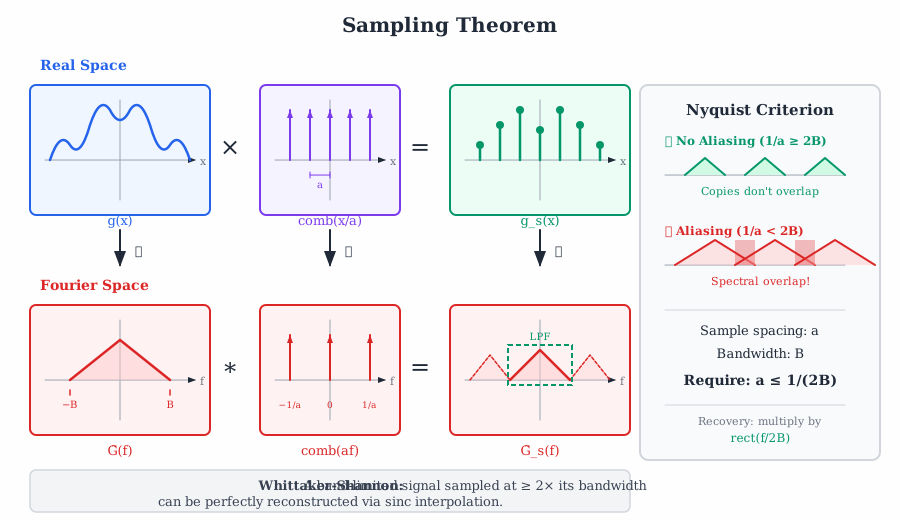
Top row (Real Space): Sampling is multiplication of the continuous signal $g(x)$ by a comb function (a train of delta functions spaced by $a$). The result $g_s(x)$ is a series of impulses whose heights equal the signal values at sample points.
Bottom row (Fourier Space): Multiplication in real space becomes convolution in Fourier space. Convolving the band-limited spectrum $\tilde{G}(f)$ with a comb creates spectral replicas centered at multiples of $1/a$.
Right panel (Nyquist Criterion): If replicas are spaced far enough apart ($1/a \geq 2B$), they don’t overlap and the original spectrum can be recovered with a low-pass filter. If they overlap (aliasing), high frequencies masquerade as low frequencies and perfect recovery is impossible.
Sampling Theorem Proof
A function $g(x,y)$ is band-limited if its Fourier transform $\tilde{G}(f_x, f_y)$ has compact support, i.e.:
$$ \tilde{G}(f_x, f_y) = 0 \text{ for } |f_x| > B_x \text{ and } |f_y| > B_y $$where $B_x$ and $B_y$ are the bandlimits.
Proof of Sampling Theorem
Define a sampling function (the Dirac comb):
$$ \text{comb}(x) = \sum_{n=-\infty}^{\infty} \delta(x - n) $$Assume a function $g(x,y)$ is bandlimited so that:
$$ \tilde{G}(f_x, f_y) = 0 \text{ for } |f_x| > B_x, |f_y| > B_y $$Form a sampled version of $f(x,y)$ by multiplying with a sampling function:
$$ g_s(x,y) = g(x,y) \cdot \frac{\text{comb}(x/a)}{a} \cdot \frac{\text{comb}(y/b)}{b} $$We can show that:
$$ \mathcal{F}\{\text{comb}(x)\} = \text{comb}(f_x) $$where $\mathcal{F}$ is the Forward Fourier Transform.
The key insight: Sampling is multiplication by a comb. By the convolution theorem:
$$ \mathcal{F}\{g(x) \cdot \text{comb}(x)\} = \mathcal{F}\{g(x)\} * \mathcal{F}\{\text{comb}(x)\} = G(f) * \text{comb}(f) $$Convolving any function with a comb produces periodic copies of that function centered at each delta spike. This is why the spectrum of a sampled signal consists of the original spectrum repeated at intervals of $1/a$ (the sampling frequency).
Grating analogy: A diffraction grating is a periodic structure (like a comb in transmission). It produces discrete diffraction orders — the same mathematics explains both phenomena.
Hence:
$$ \mathcal{F}\{g_s(x,y)\} = \tilde{G}_s(f_x, f_y) = \tilde{G}(f_x, f_y) ** \left(\frac{a \cdot \text{comb}(af_x)}{a} \cdot \frac{b \cdot \text{comb}(bf_y)}{b}\right) $$where $**$ is a two-dimensional convolution.
The result shows:
- Continuous spectrum $\tilde{G}(f_x)$ gets replicated at intervals of $\frac{1}{a}$
- Sampled spectrum shows folding at the folding frequency $B_x$
- The Nyquist frequency is $\frac{1}{a}$ (the sampling rate)
Nyquist Criterion
It is clear from the figure that the aliases will not overlap if:
$$ \frac{1}{a} \geq 2B_x, \text{ or } a \leq \frac{1}{2B_x} $$and
$$ \frac{1}{b} \geq 2B_y, \text{ or } b \leq \frac{1}{2B_y} $$This is the Nyquist Criterion.
In real space, the Nyquist criterion says that the highest frequency component in the x direction (frequency $B_x$), must be sampled at least twice.
Recovery via Low-Pass Filtering
If we satisfy the Nyquist criterion, it is a simple matter to recover the original function $g(x,y)$ by low pass filtering the sampled result $g_s(x,y)$.
$$ \tilde{G}_s(f_x, f_y) \cdot \text{rect}\left(\frac{f_x}{2B_x}\right)\text{rect}\left(\frac{f_y}{2B_y}\right) = \tilde{G}(f_x, f_y) $$In real space, this equation becomes:
$$ g(x,y) = g_s(x,y) ** [4B_x B_y \, \text{sinc}(2B_x x) \, \text{sinc}(2B_y y)] $$where $\text{sinc}(x) = \frac{\sin(\pi x)}{\pi x}$ and $\text{rect}(x) = \begin{cases} 1, & |x| \leq \frac{1}{2} \\ 0, & \text{otherwise} \end{cases}$
Note: $\text{rect}(x/a)$ is a rectangle of width $a$ centered at the origin.
This is a statement of the Whittaker-Shannon Sampling Theorem.
The sinc function has a special property: $\text{sinc}(n) = 0$ for all nonzero integers $n$, but $\text{sinc}(0) = 1$.
When samples are spaced at the Nyquist interval $\Delta x = \frac{1}{2B_x}$, each sinc kernel centered on a sample point:
- Equals 1 at that sample location
- Equals 0 at all other sample locations
This means each sample contributes its value only at its own position, with no interference from neighboring samples. Between samples, the sincs overlap and sum to produce the smooth interpolated curve. This is the unique interpolation that perfectly reconstructs a bandlimited signal.
Aliasing
What happens when the Nyquist criterion is violated? Aliasing results, where high frequencies fold over and look like lower ones.
When a signal contains frequencies above the Nyquist limit ($f > f_s/2$), those frequencies don’t simply disappear — they fold back into the sampled spectrum, masquerading as lower frequencies. This is aliasing.
Common examples:
- Pinstripe suits on TV: The fine stripes have spatial frequencies exceeding the camera sensor’s sampling rate. The result is moiré patterns — false low-frequency waves that shimmer and shift as the person moves.
- Wagon wheel effect: In film (24 fps), a wheel spinning faster than 12 rotations/second appears to rotate backwards — high temporal frequency aliased to a negative low frequency.
- Digital images of fine textures: Brick walls, fabric weaves, or screen doors photographed with insufficient resolution show false patterns not present in the original scene.
Aliasing is irreversible — once frequencies are folded together, they cannot be separated. The only prevention is to bandlimit the signal before sampling (anti-aliasing filter).
Notice the important additional results which can be seen from the above proof of the sampling theorem:
- Sampling in real space produces a repeated continuous function in Fourier space
- Sampling in Fourier space produces a repeated continuous function in real space
VI. Common Transform Pairs
| Function | Transform |
|---|---|
| $\text{rect}(x)\text{rect}(y)$ | $\text{sinc}(x)\text{sinc}(y)$ |
| $\delta(x,y)$ | $1$ |
| $\delta(x \pm x_0, y \pm y_0)$ | $\exp[\pm j2\pi(x_0 f_x + y_0 f_y)]$ |
| $\text{comb}(x)\text{comb}(y)$ | $\text{comb}(f_x)\text{comb}(f_y)$ |
| $\text{circ}(r) = \begin{cases} 1, & r < 1 \\ 0, & \text{else} \end{cases}$ | $\frac{J_1(2\pi\rho)}{\rho}$ |
Linear Systems, Fourier Transforms, and Optics by Jack D. Gaskill contains comprehensive tables of:
- Fourier transform pairs (1D and 2D)
- Transform theorems and properties
- Special functions used in optics (rect, sinc, circ, comb, etc.)
These tables are invaluable for quickly looking up transforms without rederiving them.
If a signal is not bandlimited (low-pass filtered) before sampling, aliased frequencies cannot be separated from the original spectrum afterward.
Why: Aliasing folds high frequencies on top of low frequencies. Once mixed, they occupy the same frequency bins. Without prior knowledge of the original spectrum, there is no way to determine which components are “real” and which are aliases.
Prevention: Always apply an anti-aliasing (low-pass) filter before sampling to remove frequencies above $f_s/2$.
Anti-Aliasing Filter Chain
The standard signal processing chain to avoid aliasing:
Continuous   →   Low-Pass    →   Sampler   →   Digital
  Image          Filter           (CCD)        Signal
              (anti-alias)
The low-pass filter must come before sampling. Once high frequencies alias into the baseband, they’re indistinguishable from the original signal — no amount of post-processing can undo aliasing.
The filter must restrict bandwidth to less than $\frac{1}{2}$ the sampling frequency (Nyquist limit). If the sampling rate is $f_s$, frequencies above $f_s/2$ will fold back.
In optical systems, several mechanisms naturally provide anti-aliasing:
| Mechanism | How it works |
|---|---|
| Optical blur (PSF) | Finite aperture limits resolution, attenuating high frequencies |
| Detector integration | Each pixel averages over its area, acting as a spatial low-pass filter |
| Intentional defocus | Spreading the PSF further reduces bandwidth |
The imaging optics themselves act as a low-pass filter — the optical transfer function cuts off at $1/\lambda F$ for a diffraction-limited system. This is why well-designed cameras often don’t need separate anti-aliasing filters: the optics already band-limit the image.
Aliasing of Noise
Even if the signal satisfies Nyquist, broadband noise may not:
| Component | Spectrum | After Sampling |
|---|---|---|
| Signal | Band-limited (within Nyquist) | Clean replicated copies |
| Noise | Broadband (extends beyond Nyquist) | Aliases fold into signal band |
High-frequency noise that would normally be outside the signal band folds back and adds to the in-band noise. This degrades the signal-to-noise ratio.
Solution: Low-pass filter the signal+noise together before sampling. This eliminates out-of-band noise before it can alias, improving SNR even though it slightly blurs the signal.
VII. Fourier Transform Reference
The following sections contain key theorems, special functions, and properties used throughout physical optics.
Fourier Theorems
1. Linearity
$$ \mathcal{F}\{a \cdot g(x,y) + b \cdot h(x,y)\} = a \cdot \mathcal{F}\{g(x,y)\} + b \cdot \mathcal{F}\{h(x,y)\} $$2. Similarity Theorem (Scaling Theorem)
If $\mathcal{F}\{g(x,y)\} = G(f_x, f_y)$
then $\mathcal{F}\{g(ax, by)\} = \frac{1}{|ab|} G\left(\frac{f_x}{a}, \frac{f_y}{b}\right)$
The focal spot of a lens is the Fourier transform of its aperture (in the Fraunhofer limit). The similarity theorem directly predicts:
- Larger aperture (scale up by $a > 1$) → spectrum scales down by $1/a$ → smaller, tighter focus
- Smaller aperture → larger, more spread-out focus
This is why telescope mirrors and camera lenses are made as large as practical — a bigger aperture means sharper resolution. The diffraction limit $\theta \approx \lambda/D$ is just this scaling relationship.
3. Shift Theorem
If $\mathcal{F}\{g(x,y)\} = G(f_x, f_y)$
then $\mathcal{F}\{g(x-a, y-b)\} = G(f_x, f_y) \exp[-j2\pi(f_x a + f_y b)]$
Shifting a function in space doesn’t change the magnitude of its spectrum — only the phase. The shift $(a, b)$ adds a linear phase ramp $\exp[-j2\pi(f_x a + f_y b)]$ across the frequency domain.
A uniform field $E(x) = 1$ has a spectrum that’s a delta at the origin (zero frequency — no spatial variation).
A prism tilts the wavefront, multiplying by $\exp\left[-j\frac{2\pi}{\lambda}x\sin\theta\right]$. By the dual of the shift theorem (multiplication by exponential ↔ shift in frequency), this moves the delta to a new location in frequency space.
The prism doesn’t change the amplitude distribution — it shifts the angular spectrum, steering the beam.
4. Parseval’s Theorem
If $\mathcal{F}\{g(x,y)\} = G(f_x, f_y)$
Then:
$$ \iint_{-\infty}^{\infty} |g(x,y)|^2 \, dxdy = \iint_{-\infty}^{\infty} |G(f_x, f_y)|^2 \, df_x df_y $$The total energy (integrated intensity) is the same whether computed in the spatial domain or the frequency domain. This has practical consequences:
- Power conservation: Light passing through a lossless optical system conserves total power. Parseval’s theorem ensures our Fourier-based models respect this.
- Spectral analysis: To find how much power is in a given spatial frequency band, integrate $|G(f_x, f_y)|^2$ over that band — no need to transform back to real space.
- Unitarity: The Fourier transform (with proper normalization) is a unitary operator, meaning it preserves inner products and norms. This is why frequency-domain and spatial-domain descriptions are equally valid.
5. Convolution Theorem
If $\mathcal{F}\{g(x,y)\} = G(f_x, f_y)$ and $\mathcal{F}\{h(x,y)\} = H(f_x, f_y)$
then:
$$ \mathcal{F}\{g * h\} = G \cdot H $$or equivalently:
$$ \mathcal{F}\left\{\iint_{-\infty}^{\infty} g(\xi,\eta)h(x-\xi, y-\eta) \, d\xi d\eta\right\} = G(f_x, f_y) H(f_x, f_y) $$Convolution in real space becomes multiplication in frequency space (and vice versa). This is arguably the most important theorem in Fourier optics:
- Imaging: The output image is the input convolved with the PSF. In frequency space, this is just multiplication by the transfer function.
- Diffraction: The far-field pattern is the Fourier transform of the aperture. Multiplying apertures (masking) becomes convolution in the far field.
- Computation: Convolution is $O(N^2)$ directly, but FFT → multiply → IFFT is $O(N \log N)$.
6. Autocorrelation Theorem
If $\mathcal{F}\{g(x,y)\} = G(f_x, f_y)$, then:
$$ \mathcal{F}\{g \star g^*\} = |G(f_x, f_y)|^2 $$where $\star$ denotes correlation (convolution with the conjugate-reversed function):
$$ \mathcal{F}\left\{\iint_{-\infty}^{\infty} g(\xi,\eta) g^*(\xi-x, \eta-y) \, d\xi d\eta\right\} = |G(f_x, f_y)|^2 $$The dual relation (Wiener-Khinchin):
$$ \mathcal{F}\{|g(x,y)|^2\} = G \star G^* = \iint G(\xi,\eta) G^*(\xi-f_x, \eta-f_y) \, d\xi d\eta $$The autocorrelation measures how similar a function is to a shifted version of itself. It peaks at zero shift (perfect overlap) and decays as the shift increases.
- First equation: The Fourier transform of the autocorrelation is the power spectrum $|G|^2$. This is the Wiener-Khinchin theorem — fundamental to spectral analysis and coherence theory.
- Second equation: The Fourier transform of the intensity $|g|^2$ is the autocorrelation of the spectrum.
In optics, autocorrelation appears in:
- Coherence measurements (temporal and spatial)
- Speckle statistics
- Optical transfer function (OTF) as autocorrelation of the pupil function
7. Fourier Integral Theorem
$$ \mathcal{F}\mathcal{F}^{-1}\{g(x,y)\} = \mathcal{F}^{-1}\mathcal{F}\{g(x,y)\} = g(x,y) $$for all points of $g(x,y)$ that are continuous.
Special Functions
Rectangle Function (rect)
$$ \text{rect}(x) = \begin{cases} 1, & |x| \leq \frac{1}{2} \\ 0, & \text{else} \end{cases} $$Shape: A flat-topped pulse of width 1 centered at the origin.
Fourier transform: $\mathcal{F}\{\text{rect}(x)\} = \text{sinc}(f_x)$
In optics: Models slit apertures, uniform illumination, and ideal bandpass filters.
Sinc Function
$$ \text{sinc}(x) = \frac{\sin(\pi x)}{\pi x} $$Shape: An oscillating function that decays as $1/x$, with zeros at all nonzero integers. The central lobe has width 2; sidelobes alternate in sign.
Fourier transform: $\mathcal{F}\{\text{sinc}(x)\} = \text{rect}(f_x)$
In optics: The diffraction pattern of a slit; the ideal interpolation kernel for bandlimited signals (Shannon reconstruction).
Triangle Function (Λ)
$$ \Lambda(x) = \begin{cases} 1 - |x|, & |x| \leq 1 \\ 0, & \text{else} \end{cases} $$Shape: A symmetric triangle (tent) of width 2 and height 1.
Fourier transform: $\mathcal{F}\{\Lambda(x)\} = \text{sinc}^2(f_x)$
In optics: The autocorrelation of a rect (two rects convolved); appears in coherence theory and the MTF of defocused systems.
Comb Function (Shah)
$$ \text{comb}(x) = \sum_{n=-\infty}^{\infty} \delta(x - n) $$Shape: An infinite train of equally-spaced delta functions at integer positions.
Fourier transform: $\mathcal{F}\{\text{comb}(x)\} = \text{comb}(f_x)$ — the comb is its own Fourier transform.
In optics: Represents sampling (multiplying by comb samples a function); diffraction gratings; the reason sampled spectra are periodic.
Circle Function (circ)
$$ \text{circ}(r) = \text{circ}\left(\sqrt{x^2 + y^2}\right) = \begin{cases} 1, & r \leq 1 \\ 0, & \text{else} \end{cases} $$Shape: A uniform disk of radius 1 in 2D.
Fourier transform: $\mathcal{F}\{\text{circ}(r)\} = \dfrac{J_1(2\pi\rho)}{\rho}$ (the Airy pattern / jinc function)
In optics: Models circular apertures and lenses. Its transform is the Airy disk — the fundamental diffraction limit for circular pupils.
Goal: Get the argument of $J_0$ to just be the variable we’re integrating over.
Change of variables (u-substitution):
- Pick substitution: Let $u = 2\pi\rho r$ (the thing inside $J_0$)
- Solve for the old variable: $r = \dfrac{u}{2\pi\rho}$
- Find $dr$: Differentiate both sides: $dr = \dfrac{du}{2\pi\rho}$
- Convert limits:
- When $r = 0$: $u = 2\pi\rho(0) = 0$
- When $r = 1$: $u = 2\pi\rho(1) = 2\pi\rho$
- Substitute everything:
- Simplify:
Summary:
$$ \mathcal{B}\{\text{circ}(r)\} = \frac{1}{2\pi\rho^2} \int_0^{2\pi\rho} r' \, J_0(r') \, dr' $$Bessel identity: $\int_0^x z \, J_0(z) \, dz = x \, J_1(x)$
Therefore:
$$ \mathcal{B}\{\text{circ}(r)\} = \frac{1}{2\pi\rho^2} \int_0^{2\pi\rho} r' \, J_0(r') \, dr' = \frac{J_1(2\pi\rho)}{\rho} $$This result is known as the Airy pattern, jinc function, or sombrero function. It describes the diffraction pattern of a circular aperture.
When $a = 0$:
$$ 2\pi = 2\pi J_0(0) $$so $J_0(0) = 1$.
The Bessel function $J_1(x)$ has the series expansion:
$$ J_1(x) = \frac{x}{2} - \frac{x^3}{16} + \cdots $$Therefore:
$$ \frac{J_1(2\pi\rho)}{\rho} = \frac{2\pi\rho}{2\rho} + \cdots = \pi $$Hence:
$$ \lim_{\rho \to 0} \frac{J_1(2\pi\rho)}{\rho} = \pi $$This gives the central maximum of the Airy pattern.
Let $\mathcal{F}\{g(x)\} = G(f_x)$. Then:
$$ G(f_x) = \int g(x) \exp(-i2\pi f_x x) \, dx $$At zero frequency:
$$ G(0) = \int g(x) \, dx $$The Fourier transform at $f_x = 0$ equals the total area under $g(x)$.
Physical Significance
In Fourier optics, this result describes:
- The Fraunhofer diffraction pattern of a circular aperture
- The point spread function of a circular lens
- The fundamental limit of optical resolution (Airy disk)
Related Topics
Useful Fourier Pairs for Apertures
When apertures are scaled, the similarity theorem applies. These are the most common Fourier pairs in diffraction calculations:
| Aperture | Function | Fourier Transform |
|---|---|---|
| Rectangular (width $a$, height $b$) | $\text{rect}\left(\dfrac{x}{a}, \dfrac{y}{b}\right)$ | $ab \cdot \text{sinc}(a\xi) \cdot \text{sinc}(b\eta)$ |
| Square (side $a$) | $\text{rect}\left(\dfrac{x}{a}, \dfrac{y}{a}\right)$ | $a^2 \cdot \text{sinc}(a\xi, a\eta)$ |
| Circular (radius $r_0$) | $\text{circ}\left(\dfrac{r}{r_0}\right)$ | $\pi r_0^2 \cdot \dfrac{2J_1(2\pi r_0 \rho)}{2\pi r_0 \rho}$ |
Larger apertures produce narrower diffraction patterns (and vice versa). The product of aperture size and diffraction spread is constant — this is the Fourier uncertainty principle in action.
Properties of Delta Functions
1. Defining Properties
$$ \delta(x - x_0) = 0, \quad x \neq x_0 $$$$ \int_{x_1}^{x_2} f(\alpha) \, \delta(\alpha - x_0) \, d\alpha = f(x_0), \quad x_1 < x_0 < x_2 $$The second equation is the sifting property: the delta function “sifts out” the value of $f$ at the spike location $x_0$. This is the defining property that makes delta functions useful — they sample a function at a single point.
2. Scaling Properties
$$ \delta\left(\frac{x - x_0}{b}\right) = |b| \, \delta(x - x_0) $$$$ \delta(ax - x_0) = \frac{1}{|a|} \delta\left(x - \frac{x_0}{a}\right) $$$$ \delta(-x + x_0) = \delta(x - x_0) $$$$ \delta(-x) = \delta(x) \quad \text{(even function)} $$The delta function must always integrate to 1. If you compress it horizontally by factor $a$, it becomes narrower — but the area must stay the same, so the height must increase by $|a|$. Conversely, $\delta(ax)$ is $a$ times narrower, so it must be divided by $|a|$ to preserve unit area.
3. Properties in Products
$$ f(x) \, \delta(x - x_0) = f(x_0) \, \delta(x - x_0) $$$$ x \, \delta(x - x_0) = x_0 \, \delta(x - x_0) $$$$ \delta(x) \, \delta(x - x_0) = 0, \quad x_0 \neq 0 $$$$ \delta(x - x_0) \, \delta(x - y_0) $$is not defined
The first equation is the freezing property: when you multiply $f(x)$ by $\delta(x - x_0)$, the delta “freezes” the value of $f$ at $x_0$. Since the delta is zero everywhere except at $x_0$, only the value $f(x_0)$ matters. The result is a delta spike of strength $f(x_0)$.
4. Integral Properties
$$ \int_{-\infty}^{\infty} A \, \delta(\alpha - x_0) \, d\alpha = A $$$$ \int_{-\infty}^{\infty} \delta(\alpha - x_0) \, \delta(x - \alpha) \, d\alpha = \delta(x - x_0) $$The second integral is a convolution: $\delta(x) * \delta(x - x_0) = \delta(x - x_0)$. Convolving with a shifted delta just shifts the function — the delta acts as a “copy and shift” operator.
Proof via Fourier transform:
- $\mathcal{F}\{\delta(x)\} = 1$ (delta transforms to a constant)
- $\mathcal{F}\{\delta * \delta\} = \mathcal{F}\{\delta\} \cdot \mathcal{F}\{\delta\} = 1 \cdot 1 = 1$ (convolution theorem)
- $\mathcal{F}^{-1}\{1\} = \delta(x)$
Interpretation: The delta function is the identity element for convolution — convolving any function with $\delta$ returns that function unchanged. Convolving $\delta$ with itself just returns $\delta$.
Properties of Convolution
Commutative
$$ f(x) * h(x) = h(x) * f(x) $$Distributive
$$ [a \, v(x) + b \, w(x)] * h(x) = a[v(x) * h(x)] + b[w(x) * h(x)] $$Shift Invariance
If $f(x) * h(x) = g(x)$
then $f(x - x_0) * h(x) = g(x - x_0)$
Shifting the input shifts the output by the same amount. This is the defining property of LSI systems — the system behaves the same regardless of where the input is located.
Associative
$$ [v(x) * w(x)] * h(x) = v(x) * [w(x) * h(x)] $$$[v(x) \cdot w(x)] * h(x) \neq v(x) \cdot [w(x) * h(x)]$
Counter example: Let $w(x) = \delta(x)$
- $[v(x) \cdot \delta(x)] * h(x) = v(0) h(x)$
- But $v(x) \cdot [\delta(x) * h(x)] = v(x) h(0)$
Identity Operator
$$ f(x) * \delta(x) = f(x) $$The delta function is the identity element for convolution — convolving with $\delta$ leaves the function unchanged. This is analogous to multiplying by 1 or adding 0.
Derivatives
$$ f(x) * \delta^{(k)}(x) = f^{(k)}(x) $$where $\delta^{(k)} = \frac{d^k \delta(x)}{dx^k}$ ($k$ = derivative)
and $f^{(k)} = \frac{d^k f(x)}{dx^k}$
Convolving with the derivative of a delta differentiates the function. This works because convolution commutes with differentiation:
$$ \frac{d}{dx}[f * g] = f * \frac{dg}{dx} = \frac{df}{dx} * g $$Setting $g = \delta$ and using $f * \delta = f$ gives the result. In practice, this means you can compute derivatives by convolving with an approximation to $\delta'$ (a difference kernel like $[1, -1]$).
Repeated Convolution
Convolving multiple functions together produces a result that tends toward a Gaussian, regardless of the original shapes (provided they have finite variance):
$$ f_1(x) * f_2(x) * f_3(x) * \cdots * f_n(x) \xrightarrow{n \to \infty} \text{Gaussian} $$Each convolution “smooths” the result further. Sharp features get rounded, asymmetries cancel out, and the characteristic bell curve emerges. After just a few convolutions, even rectangular or triangular functions look nearly Gaussian.
This is the convolution form of the Central Limit Theorem. In probability, convolution corresponds to summing independent random variables — the PDF of a sum is the convolution of the individual PDFs.
No matter what shape the original distributions have (as long as they have finite variance), their repeated convolution approaches a Gaussian. This is why:
- The Gaussian appears so often in nature (many small independent effects add up)
- Diffraction patterns from complex apertures often have Gaussian-like envelopes
- Repeated imaging through imperfect systems tends toward Gaussian blur
Scaling
If $f(x) * h(x) = g(x)$
then $f\left(\frac{x}{b}\right) * h\left(\frac{x}{b}\right) = |b| \, g\left(\frac{x}{b}\right)$
Example of Scaling Theorem
Let $f(x) = h(x) = \text{rect}(x)$
$$ g(x) = f(x) * h(x) = \text{tri}(x) $$where $\text{tri} = \begin{cases} 1 - |x|, & |x| \leq 1 \\ 0, & \text{else} \end{cases}$
Let $b = 2$
$$ f\left(\frac{x}{b}\right) = \text{rect}\left(\frac{x}{2}\right) $$$$ g(x) = \text{rect}\left(\frac{x}{2}\right) * \text{rect}\left(\frac{x}{2}\right) = 2 \, \text{tri}\left(\frac{x}{2}\right) $$Area with no shift $= 1 \times 2 = 2$
The triangle function now extends from $-2$ to $2$ with peak value of $2$ at $x = 0$.
Examples of Convolutions in Two Dimensions
i) $f(x,y) * \delta(x,y)$ - Perfect Sampling
Laser beam scanning negligible width
$$ g(x,y) = f(x,y) * \delta(x,y) = f(x,y) $$Detector receives exact photograph $f(x,y)$.
ii) $f(x,y) * b(x,y)$ - Total Light Through Spot
$$ g(x',y') = \iint f(x,y) \, b(x-x', y-y') \, dx \, dy $$Detector receives: $g(x,y) = f(x,y) * b(x,y) = f(x,y) \otimes b(x,y)$
If $b(x,y)$ is symmetric (i.e., $b(-x,-y) = b(x,y)$), then convolution and correlation are identical:
$$ f * b = f \star b $$Why: Correlation is defined as convolution with the flipped function: $f \star b = f * b(-x,-y)$. If $b$ is already symmetric, flipping does nothing, so the two operations coincide.
In optics: Many PSFs are symmetric (e.g., Airy disk, Gaussian blur), so imaging can be described equivalently as convolution or correlation with the PSF.
iii) $f(x,y) * \delta(x)$ - Line Response
$$ g(x,y) = f(x,y) * \delta(x) \cdot 1 $$$$ = \int_{-\infty}^{\infty} f(x,\beta) \, d\beta = \ell_x(x) $$Detector receives line response: y-dependence is averaged out, result is only a function of x.
Line Response and Transfer Function
This means that if we are interested in the frequency response along the x-axis only, we can apply a line function $\delta(x)$ to the system (to form $\ell_x(x)$), and take its Fourier transform (one-dim) to yield $H(f_x,0)$.
To find other profiles of the general transfer function, we can rotate the line response to any angle (not necessary) just along x or y axis.
$$ H(f_x,0) = \iint f(x,y) e^{-j2\pi f_x x} \, dx \, dy $$$$ = \int \left[\int f(x,\beta) \, d\beta\right] e^{-j2\pi f_x x} \, dx $$where $\ell_x(x)$ = line response
Edge Response (Step Response)
Consider applying a step to the input:
$$ f(x,y) = \text{step}(x) \cdot 1 $$$$ e_x(x) = \mathcal{L}\{\text{step}(x) \cdot 1\} = h(x,y) * * \text{step}(x) \cdot 1 $$$$ = \iint h(\alpha,\beta) \, \text{step}(x-\alpha) \, d\alpha \, d\beta $$$$ = \int \left[\int h(\alpha,\beta) \, d\beta\right] \text{step}(x-\alpha) \, d\alpha $$$$ = \int_{-\infty}^{\infty} \ell_x(\alpha) \, \text{step}(x-\alpha) \, d\alpha = \int_{-\infty}^{x} \ell_x(\alpha) \, d\alpha $$$$ \implies \quad \ell_x(x) = \frac{d}{dx} e_x(x) $$The line spread function $\ell_x(x)$ equals the derivative of the edge response $e_x(x)$:
$$ \ell_x(x) = \frac{d}{dx} e_x(x) $$Why this matters practically: Edges are easier to create than thin lines. To measure an optical system’s LSF:
- Image a sharp edge (knife-edge test)
- Measure the blurred edge response $e_x(x)$
- Differentiate numerically to get the LSF
This avoids the difficulty of creating a perfectly thin, uniform line source.
Finally:
$$ H(f_x,0) = \mathcal{F}\{\ell_x(x)\} = \mathcal{F}\left\{\frac{d}{dx} e_x(x)\right\} $$$$ = j2\pi f_x \, \mathcal{F}\{e_x(x)\} $$This means we can apply a step function to the system, Fourier transform the result in one-dimension, and multiply by $j2\pi f_x$ to obtain $H(f_x,0)$.
Physical Interpretation
Impulse Response
$$ \delta(x) \rightarrow \boxed{\frac{h(\alpha)}{H(f_x)}} \rightarrow h(x) $$- Spectrum of input: $1$
- Spectrum of output: $H(f_x) = \mathcal{F}\{h(x)\}$
Step Response
$$ \text{step}(x) \rightarrow \boxed{\frac{h(x)}{H(f_x)}} \rightarrow \int h(\alpha) \, d\alpha = e_x(x) $$- Spectrum of input: $\frac{1}{j2\pi f_x}$ (plus DC)
- Transfer function: $H(f_x) = j2\pi f_x \, \mathcal{F}\{e_x(x)\}$
We use that the delta function can be thought of as generating all frequencies simultaneously in a LSI system. Unlike the delta function input (which excites all frequencies with equal amplitude), the step function excites frequencies with amplitude $\frac{1}{f_x}$. We must therefore multiply the result by $f_x$ to compensate and obtain $H(f_x)$.
Lecture start: 2025-02-05
- Sound waves in gas require scalar values (scalar diff. theory)
- EM waves are vectors (vector theory)
Maxwell’s Equations (Current & Source-free)
Faraday’s Law (changing $\vec{H}$ induces $\vec{E}$):
$$ \nabla \times \vec{E} = -\mu \frac{\partial \vec{H}}{\partial t} $$Ampère’s Law (changing $\vec{E}$ induces $\vec{H}$):
$$ \nabla \times \vec{H} = \epsilon(r) \frac{\partial \vec{E}}{\partial t} $$Gauss’s Law for Electricity (no free charges):
$$ \nabla \cdot \vec{D} = 0 $$Gauss’s Law for Magnetism (no magnetic monopoles):
$$ \nabla \cdot \mu_0 \vec{H} = 0 $$where $H$ is the magnetic field intensity.
Derivation of Wave Equation
We have:
$$ \nabla \times (\nabla \times \vec{E}) = -\mu \cdot \nabla \times \left(\frac{\partial \vec{H}}{\partial t}\right) = -\mu_0 \epsilon(r) \frac{\partial^2 \vec{E}}{\partial t^2} $$Therefore:
$$ \nabla^2 \vec{E} - \nabla\left(\nabla \cdot \frac{\vec{D}}{\epsilon(r)}\right) - \mu_0 \epsilon(r) \frac{\partial^2 \vec{E}}{\partial t^2} = 0 $$If medium is homogeneous, $\epsilon(r) = \text{constant}$, then:
$$ \nabla \cdot \frac{\vec{D}}{\epsilon(r)} = \frac{1}{\epsilon}[\nabla \cdot \vec{D}] = 0 $$Also: $c = \frac{1}{\sqrt{\mu_0 \epsilon_0}}$ (speed of light), so $\mu_0 \epsilon = \mu_0 n^2 \epsilon_0 = \frac{n^2}{c^2}$
Then, for each component of the vector $E_x, E_y, E_z$, we have:
$$ \nabla^2 E_i - \frac{n^2}{c^2} \frac{\partial^2 E_i}{\partial t^2} = 0, \quad i = x, y, \text{ or } z $$where the wave propagation speed is $c/n$.
- $n(r)$ must not change significantly over a distance $\lambda$
- All apertures must be $\geq \lambda$
- Observations not too close to the aperture
- Polarization state is linear and unaffected by diffraction
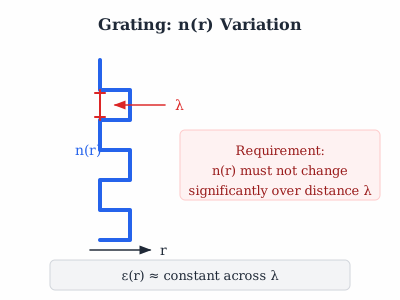
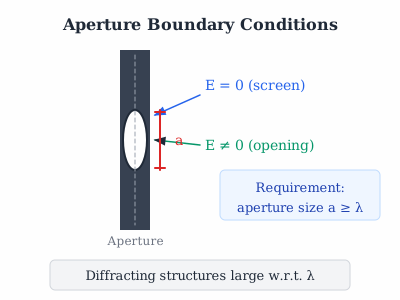
If $\epsilon(r)$ varies (e.g., phase grating), the medium is not homogeneous and an extra term $\nabla\left(\nabla \cdot \frac{\vec{D}}{\epsilon(r)}\right)$ couples vector components, making the problem more difficult.
When these assumptions hold, the cross term can be neglected and we can use a scalar wave equation:
$$ \nabla^2 E - \frac{n^2}{c^2} \frac{\partial^2 E}{\partial t^2} = 0 $$where $E$ is a scalar representing the amplitude of a single field component.
Helmholtz Equation (Frequency-Domain Form)
Starting from the wave equation:
$$ \nabla^2 E - \frac{n^2}{c_0^2} \frac{\partial^2 E}{\partial t^2} = 0 $$Take the time Fourier transform of the equation.
Thus:
$$ \nabla^2 \hat{u}(\bar{r},\omega) + \frac{n^2 \omega^2}{c_0^2} \hat{u}(\bar{r},\omega) = 0 $$Define the wavenumber:
$$ k = \frac{n\omega}{c_0} = \frac{2\pi n}{\lambda} $$Therefore, the Helmholtz equation is:
Monochromatic Wave
$$ u(\bar{r},t) = a(x,y,z) \cos[2\pi\nu_0 t - \phi(x,y,z)] $$$$ = a(x,y,z) \cos\left[2\pi\nu_0 \left(t - \frac{\phi(x,y,z)}{2\pi\nu_0}\right)\right] $$$$ \Rightarrow \hat{u}(\bar{r},\omega_0) = a(x,y,z) \, \mathcal{F}\left\{\cos\left[2\pi\nu_0 \left(t - \frac{\phi(x,y,z)}{2\pi\nu_0}\right)\right]\right\} $$$$ = a(x,y,z) \, e^{-j2\pi\nu \frac{\phi(x,y,z)}{2\pi\nu_0}} \left[\frac{\delta(\nu-\nu_0)}{2} + \frac{\delta(\nu+\nu_0)}{2}\right] $$$$ = a(x,y,z) \, e^{-j\phi(x,y,z)} \frac{\delta(\nu-\nu_0)}{2} + a(x,y,z) \, e^{+j\phi(x,y,z)} \frac{\delta(\nu+\nu_0)}{2} $$where $a(x,y,z)$ is real.
Complex Amplitude
We denote the complex amplitude as the amplitude of one of these delta functions (use $\delta(\nu - \nu_0)$):
$$ \boxed{\hat{u}(x,y,z) = \frac{a(x,y,z)}{2} \exp[-j\phi(x,y,z)]} $$Complex Amplitude
It is not surprising that the result of a Fourier transformation is a complex function. Only if the original is even (i.e., $\phi = 0$) would the F.T. be real.
Returning to Original Time Signal
To return to original time signal, we perform the inverse F.T. in time:
$$ u(x,y,z,t) = \mathcal{F}_t^{-1}\left\{\hat{u}(x,y,z)\delta(\nu+\nu_0) + \hat{u}^*(x,y,z)\delta(\nu-\nu_0)\right\} $$$$ = \int \frac{a(x,y,z)}{2} e^{+j\phi(x,y,z)} \delta(\nu+\nu_0) e^{+j2\pi\nu t} \, d\nu $$$$
- \int \frac{a(x,y,z)}{2} e^{-j\phi(x,y,z)} \delta(\nu-\nu_0) e^{+j2\pi\nu t} , d\nu $$
Returning to Time Signal (Alternative Method)
We can also return to the original time signal by using the expression:
But this is simply:
$$ u(x,y,z,t) = \frac{\hat{u}^*(x,y,z) e^{j2\pi\nu_0 t}}{2} + \frac{\hat{u}(x,y,z) e^{-j2\pi\nu_0 t}}{2} $$But note this is just a Fourier synthesis where we have added both positive & negative frequency components at frequency $\nu_0$ with weights given by the Fourier coefficients $\hat{u}(x,y,z)$.
We can perform an inverse Fourier transform without knowing it, and are also restoring the $\delta(\nu - \nu_0)$ delta function.
But this is simply the real part of $\hat{u}^*(x,y,z)$.
Therefore, we care about amplitude and phase separately, as the real part is a linear combination of both.
Plane-Wave Solutions of the Helmholtz Equation
The Helmholtz equation is:
$$ \nabla^2 \hat{u}(\bar{r}) + k^2 \hat{u}(\bar{r}) = 0 $$A plane-wave solution is:
$$ \hat{u}(\bar{r}) = \hat{C} e^{j\vec{k} \cdot \bar{r}} $$where the wavevector is $\vec{k} = (k_x, k_y, k_z)$.
This is a plane wave solution to our E-M wave (or sound wave) in free space (3-dim).
- $\vec{k}$ is the direction of propagation
- $\hat{C}$ is a complex constant
Alternative Expression
Let the complex amplitude be written as:
$$ \hat{C} = |A| e^{j\phi} $$Write the wavevector as:
$$ \vec{k} = (k_x, k_y, k_z) = k(\gamma_x, \gamma_y, \gamma_z) $$where $\theta_x$, $\theta_y$, $\theta_z$ are angles from the respective axes.
Plane Wave in Cartesian Coordinates
Thus:
$$ \hat{u}(x,y,z) = A e^{j\phi} e^{jk(\gamma_x x + \gamma_y y + \gamma_z z)} $$- $A$ is the amplitude of the wave field
- $\phi$ is the phase at the origin
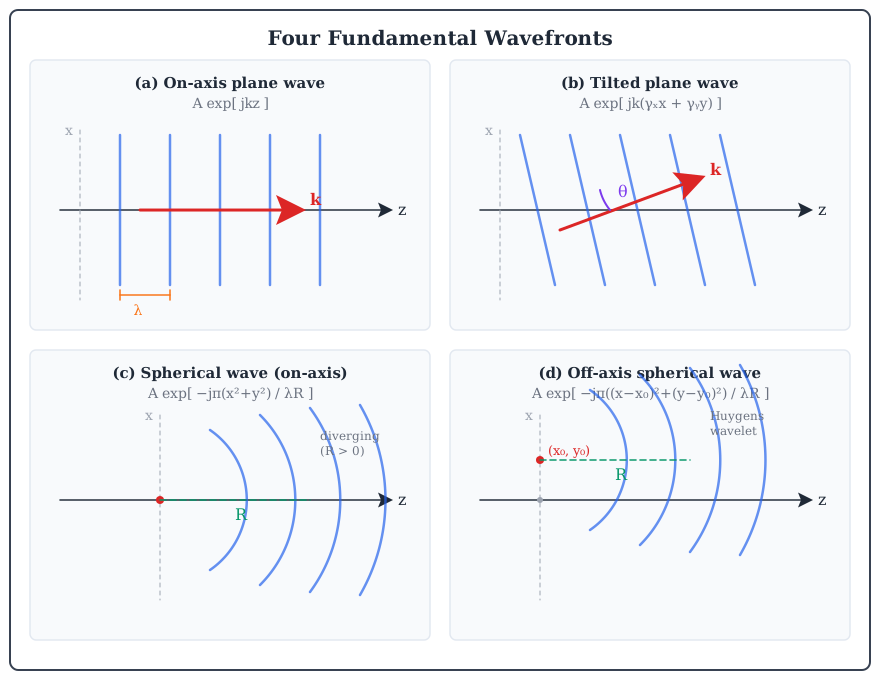
On-axis plane wave — constant phase, no transverse variation:
$$ A \exp[jkz] $$Propagates straight down the optical axis. Appears as the carrier phase prefactor $e^{jkz}$ in every diffraction formula.
Tilted plane wave — linear phase, flat wavefront:
$$ A \exp\!\left[jk(\gamma_x x + \gamma_y y)\right] $$Propagates at a fixed angle determined by direction cosines $(\gamma_x, \gamma_y)$; each point on the wavefront has the same phase at any given $z$-plane.
Spherical wave (paraxial) — quadratic phase, curved wavefront:
$$ A \exp\!\left[-j\frac{\pi(x^2 + y^2)}{\lambda R}\right] $$Diverging ($R > 0$) or converging ($R < 0$) wavefront with radius of curvature $R$. Equivalently written as $\exp[jk(x^2+y^2)/2R]$.
Off-axis spherical wave (Huygens wavelet) — shifted center of curvature:
$$ A \exp\!\left[-j\frac{\pi\left((x - x_0)^2 + (y - y_0)^2\right)}{\lambda R}\right] $$Spherical wave centered at $(x_0, y_0)$ rather than the origin. This is the impulse response of free-space propagation — each point in the input plane emits one of these, and the output field is their coherent superposition (Huygens’ principle).
A lens converts between them: it adds or subtracts quadratic phase to collimate (spherical → plane) or focus (plane → spherical).
Plane Wave Time Domain and Direction Cosines
The real field distribution is obtained by inverse Fourier transforming (in temporal frequency), this spatial distribution multiplied by $\frac{\delta(\nu+\nu_0) + \delta(\nu-\nu_0)}{2}$.
This gives:
$$ u(x,y,z,t) = \frac{A e^{+j(k(\gamma_x x + \gamma_y y + \gamma_z z) + \phi)}}{2} e^{-j2\pi\nu_0 t} + \frac{A e^{-j(k(\gamma_x x + \gamma_y y + \gamma_z z) + \phi)}}{2} e^{+j2\pi\nu_0 t} $$$$ = A \cos(2\pi\nu_0 t - k(\gamma_x x + \gamma_y y + \gamma_z z) - \phi) $$Direction Cosines Normalization
Recall: $\vec{k} = |\vec{k}|(\gamma_x, \gamma_y, \gamma_z)$
Then:
$$ \vec{k} \cdot \vec{k} = |\vec{k}|^2 (\gamma_x, \gamma_y, \gamma_z) \cdot (\gamma_x, \gamma_y, \gamma_z) = |\vec{k}|^2 (\gamma_x^2 + \gamma_y^2 + \gamma_z^2) $$But also $\vec{k} \cdot \vec{k} = |\vec{k}|^2$. Therefore:
Propagating vs. Evanescent Components
Case 1: Propagating wave
If $\gamma_x^2 + \gamma_y^2 < 1$, then $\gamma_z$ is real and $e^{jk\gamma_z z}$ represents a propagating wave in the $+z$ direction.
Case 2: Evanescent wave
If $\gamma_x^2 + \gamma_y^2 > 1$, then $\gamma_z$ is imaginary. Write $\gamma_z = j\alpha$ where $\alpha > 0$. Then:
$$ e^{jk\gamma_z z} = e^{jk(j\alpha)z} = e^{-k\alpha z} $$The field amplitude decays exponentially with $z$:
$$ e^{-k\alpha z} $$This is an evanescent (exponentially decaying) field that does not propagate.
Plane Wave Propagation
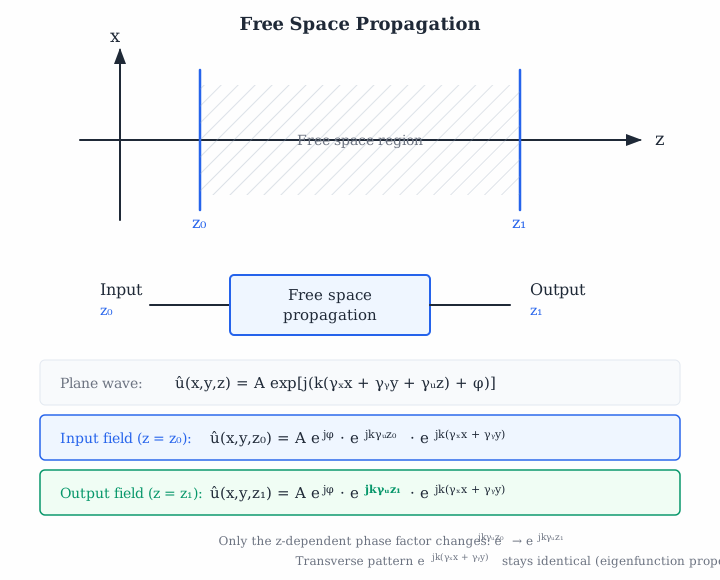
The diagram shows two transverse planes (z₀ and z₁) perpendicular to the optical axis, with free space between them. A field at the input plane z₀ propagates to produce a field at z₁.
This can be abstracted as a linear system — the same framework used for electronic filters. Because free space propagation is linear and shift-invariant, it has a transfer function:
$$ H(\gamma_x, \gamma_y) = e^{jk\gamma_z(z_1 - z_0)} $$The input field is the optical field distribution at the starting plane $z_0$ — what you feed into the “system.” The output field is what you get at $z_1$ after propagation. Comparing input to output, the only change is the phase factor $e^{jk\gamma_z z_0} \to e^{jk\gamma_z z_1}$ — the transverse pattern $e^{jk(\gamma_x x + \gamma_y y)}$ stays identical.
This is the eigenfunction property: plane waves pass through free space unchanged in shape, just phase-shifted by the eigenvalue. This framing connects wave optics to Fourier optics: decompose any input field into plane waves (angular spectrum), propagate each by multiplying by $H$, then recombine — exactly like filtering in signal processing.
Eigenfunctions of Free-Space Propagation
The transverse plane wave factor $e^{jk(\gamma_x x + \gamma_y y)}$ is an eigenfunction of the free-space propagation operator.
Why This Works
Write the field at the input plane as:
$$ \hat{u}(x,y,z_0) = A e^{j\phi} e^{jk\gamma_z z_0} e^{jk(\gamma_x x + \gamma_y y)} $$Propagating from $z_0$ to $z_1$ multiplies the field by the transfer function:
$$ H = e^{jk\gamma_z(z_1 - z_0)} $$Thus the output is:
$$ \hat{u}(x,y,z_1) = e^{jk\gamma_z(z_1 - z_0)} \cdot \hat{u}(x,y,z_0) $$Substituting the input field:
$$ \hat{u}(x,y,z_1) = A e^{j\phi} e^{jk\gamma_z z_1} e^{jk(\gamma_x x + \gamma_y y)} $$Eigenvalue Interpretation
Since propagation acts as:
$$ e^{jk(\gamma_x x + \gamma_y y)} \to e^{jk\gamma_z(z_1 - z_0)} \cdot e^{jk(\gamma_x x + \gamma_y y)} $$Eigenfunction: $e^{jk(\gamma_x x + \gamma_y y)}$
Eigenvalue: $e^{jk\gamma_z(z_1 - z_0)}$
Recall from linear algebra: if $\mathbf{v}$ is an eigenvector of matrix $A$, then:
$$ A\mathbf{v} = \lambda \mathbf{v} $$The matrix doesn’t rotate or distort $\mathbf{v}$ — it just scales it by $\lambda$.
Same thing here. The propagation operator $\mathcal{P}$ acts on the transverse pattern:
$$ \mathcal{P}\{e^{jk(\gamma_x x + \gamma_y y)}\} = \underbrace{e^{jk\gamma_z(z_1-z_0)}}_{\text{eigenvalue}} \cdot e^{jk(\gamma_x x + \gamma_y y)} $$The shape in $(x,y)$ is unchanged. Only a phase factor multiplies it.
Why this matters:
- Plane waves don’t diffract or spread — they just accumulate phase
- Free space doesn’t mix spatial frequencies — each propagates independently
- Any field can be decomposed into plane waves, each propagated separately, then recombined
This is why Fourier optics works: propagation is “diagonal” in the plane-wave basis, just like LSI systems are diagonal in the complex exponential (frequency) basis for time signals.
Unlike typical eigenvalue problems where eigenvalues are fixed constants, here we have a parameterized family of propagation operators — one for each distance $(z_1 - z_0)$.
- The eigenfunction (transverse spatial pattern) stays the same
- The eigenvalue (phase shift) accumulates with distance
This is why plane waves are useful: they maintain their shape while propagating, just picking up phase.
- Each transverse plane wave propagates independently
- Free space does not mix spatial frequencies
- Propagation only adds a phase (or decay) along $z$
This is the foundation of:
- Angular spectrum theory
- Fresnel / Fraunhofer diffraction
- Fourier-optics propagation models
Transfer Function of Propagation
Since the eigenvalue describes the transfer function:
$$ H(\gamma_x, \gamma_y) = \exp\left[jk\gamma_z(z_1 - z_0)\right] = \exp\left[jk\sqrt{1-(\gamma_x^2 + \gamma_y^2)}(z_1-z_0)\right] $$where $\gamma_x^2 + \gamma_y^2 \leq 1$ (non-evanescent)
This transfer function is the bridge connecting eigenfunction theory to computational propagation:
The conceptual chain:
$$ \text{Plane waves as eigenfunctions} \to \text{Eigenvalues as phase factors} $$$$ \to \text{Transfer function} \to \text{FFT-based propagation} $$Frequency-domain propagation: Since each plane-wave component propagates independently, propagation becomes multiplication in spatial-frequency space:
$$ \tilde{U}(f_x, f_y; z_1) = H(f_x, f_y) \cdot \tilde{U}(f_x, f_y; z_0) $$This is the angular spectrum method: take the 2D Fourier transform of the input field, multiply by $H$, then inverse transform to get the output field.
Why the square root matters: The factor $\sqrt{1 - \gamma_x^2 - \gamma_y^2}$ comes from the dispersion relation (Helmholtz equation), ensuring the wavevector magnitude equals $k = 2\pi/\lambda$. When $\gamma_x^2 + \gamma_y^2 > 1$, the square root becomes imaginary, giving exponential decay — this is how the formulation naturally handles:
- Near-field (evanescent) components
- Spatial-frequency cutoffs at $1/\lambda$
- The transition from propagating to decaying waves
Complex Amplitude and Amplitude Transmittance
Consider complex amplitude (monochromatic, with time dependence removed) at a plane $z = z_i$:
$$ u(x,y,z_i) = u_i(x,y) $$We define the complex amplitude transmittance as:
$$ t_i(x,y) = \frac{u_i^+(x,y)}{u_i^-(x,y)} $$where:
- $u_i^-(x,y)$ = field just before the aperture (incident)
- $u_i^+(x,y)$ = field just after the aperture (transmitted)
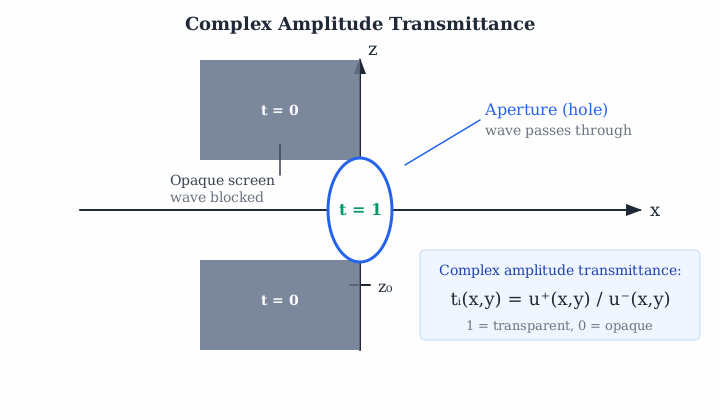
The diagram shows a cross-section of an opaque screen with an aperture (hole) at plane $z_0$. The gray regions block light ($t = 0$), while the opening transmits it unchanged ($t = 1$). The complex amplitude transmittance $t_i(x,y) = u^+/u^-$ is the ratio of transmitted to incident field at each point.
Why t = 1 Inside, t = 0 Outside
Inside the aperture (the hole): The wave passes through unchanged
$$ u^+(x,y) = u^-(x,y) \Rightarrow t_i(x,y) = 1 $$Outside the aperture (opaque screen): The wave is blocked
$$ u^+(x,y) = 0 \Rightarrow t_i(x,y) = 0 $$Therefore, for an ideal aperture:
$$ t_i(x,y) = \begin{cases} 1, & (x,y) \text{ inside aperture} \\ 0, & (x,y) \text{ outside aperture} \end{cases} $$This is often called the aperture function or pupil function.
Because the transmitted field is $u^+(x,y) = t_i(x,y) \cdot u^-(x,y)$, the aperture literally multiplies the field.
This is why apertures turn into convolutions in Fourier space — the gateway to diffraction theory.
Other Types of Transmittance
Film (amplitude mask): $t_i(x,y)$ describes the dark/light pattern; $0 \leq |t_i| \leq 1$
Phase object (clear but not flat): $|t_i(x,y)| = 1$ but $t_i$ is complex, representing different phase delays from varying thickness
Angular Plane Wave Spectrum
The angular plane wave spectrum is the fundamental concept connecting spatial patterns to propagating waves. Any complex field distribution $u_i(x,y)$ at a plane $z = z_i$ can be decomposed into a superposition of plane waves traveling in different directions.
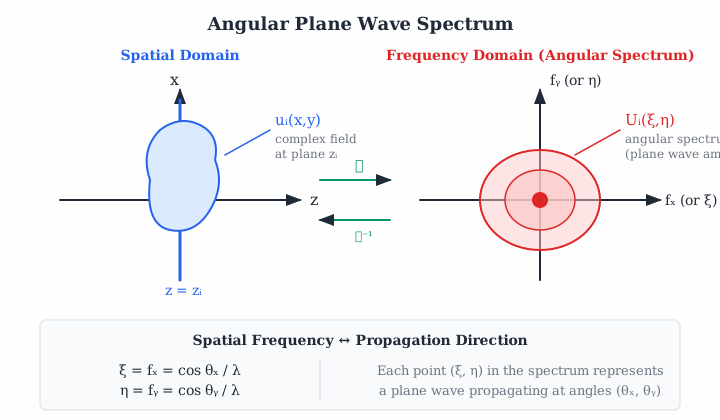
This figure illustrates the duality between spatial domain and frequency domain representations of an optical field:
Left (Spatial Domain): The complex field $u_i(x,y)$ at a plane $z = z_i$, shown as an arbitrary wavefront. This is the physical field distribution—what a detector would measure in amplitude and phase at that plane.
Right (Frequency Domain): The angular spectrum $U_i(\xi, \eta)$, shown as a peaked distribution in frequency space. The center (origin) represents low spatial frequencies (slowly varying features, nearly on-axis propagation), while points farther from the origin represent higher spatial frequencies (fine detail, steep propagation angles).
Center Arrows: The Fourier transform $\mathcal{F}$ converts from spatial to frequency domain; the inverse $\mathcal{F}^{-1}$ converts back. These are exact, lossless transformations—no information is lost.
Bottom Box: The crucial physical interpretation: spatial frequency $\xi = \cos\theta_x / \lambda$ directly encodes propagation direction. A point $(\xi, \eta)$ in the spectrum represents a plane wave component traveling at angles $(\theta_x, \theta_y)$ from the coordinate axes. Higher frequencies correspond to steeper angles.
Fourier Transform Relationship
The angular spectrum $U_i(\xi, \eta)$ and the spatial field $u_i(x,y)$ form a Fourier transform pair:
$$ U_i(\xi, \eta) = \mathcal{F}\{u_i(x,y)\} = \iint u_i(x,y) \, e^{-j2\pi(\xi x + \eta y)} \, dx \, dy $$$$ u_i(x,y) = \mathcal{F}^{-1}\{U_i(\xi, \eta)\} = \iint U_i(\xi, \eta) \, e^{j2\pi(\xi x + \eta y)} \, d\xi \, d\eta $$The inverse transform shows that $u_i(x,y)$ is a weighted sum of complex exponentials $e^{j2\pi(\xi x + \eta y)}$. Each exponential is the transverse part of a plane wave. The spectrum $U_i(\xi, \eta)$ gives the complex amplitude (magnitude and phase) of each plane wave component.
Connecting Spatial Frequency to Propagation Angle
A plane wave propagating in direction $(\gamma_x, \gamma_y, \gamma_z)$ has the form:
$$ C \exp\left[jk(\gamma_x x + \gamma_y y + \gamma_z z)\right] $$At a fixed plane $z = z_i$, the transverse part is:
$$ C \exp\left[jk(\gamma_x x + \gamma_y y)\right] = C \exp\left[j2\pi\left(\frac{\gamma_x}{\lambda} x + \frac{\gamma_y}{\lambda} y\right)\right] $$Comparing with the Fourier basis $e^{j2\pi(\xi x + \eta y)}$, the spatial frequencies are:
$$ \boxed{\xi = \frac{\gamma_x}{\lambda} = \frac{\cos\theta_x}{\lambda} = f_x} $$$$ \boxed{\eta = \frac{\gamma_y}{\lambda} = \frac{\cos\theta_y}{\lambda} = f_y} $$where $\gamma_x = \cos\theta_x$ and $\gamma_y = \cos\theta_y$ are the direction cosines (angles measured from the $x$ and $y$ axes).
Each point $(\xi, \eta)$ in the angular spectrum corresponds to a plane wave propagating at a specific angle. Low spatial frequencies (near the origin) represent waves traveling nearly parallel to the $z$-axis. High spatial frequencies represent steeply tilted waves.
The constraint $\gamma_x^2 + \gamma_y^2 + \gamma_z^2 = 1$ means:
- If $\xi^2 + \eta^2 < 1/\lambda^2$: propagating wave (real $\gamma_z$)
- If $\xi^2 + \eta^2 > 1/\lambda^2$: evanescent wave (imaginary $\gamma_z$, exponential decay)
Consider a 1D cosine grating as the input field:
$$ u_i(x,y) = \cos(2\pi f_0 x) $$The angular plane-wave spectrum is:
$$ U_i(\xi,\eta) = \iint u_i(x,y) \, e^{-j2\pi(\xi x + \eta y)} \, dx \, dy $$Using the Fourier transform of a cosine:
$$ \cos(2\pi f_0 x) = \frac{1}{2}\left(e^{j2\pi f_0 x} + e^{-j2\pi f_0 x}\right) $$we obtain:
$$ U_i(\xi,\eta) = \frac{1}{2}\Big[\delta(\xi - f_0) + \delta(\xi + f_0)\Big] \, \delta(\eta) $$Using the angular-frequency relations $\xi = \cos\theta_x / \lambda$ and $\eta = \cos\theta_y / \lambda$:
$$ U_i(\xi,\eta) = \frac{1}{2}\left[\delta\!\left(\frac{\cos\theta_x}{\lambda} - f_0\right) + \delta\!\left(\frac{\cos\theta_x}{\lambda} + f_0\right)\right] \delta\!\left(\frac{\cos\theta_y}{\lambda}\right) $$Physical interpretation: The cosine grating consists of exactly two plane waves propagating symmetrically at angles $\pm\theta_x$ where $\cos\theta_x = \lambda f_0$. The delta functions at $\pm f_0$ in frequency space correspond to these two discrete propagation directions. Higher grating frequencies $f_0$ mean steeper propagation angles.
Why This Matters
The angular spectrum representation is powerful because:
Propagation becomes multiplication: Each plane wave component propagates independently, just multiplied by the transfer function $H(\xi, \eta) = e^{jk\gamma_z \Delta z}$
Diffraction is natural: The finite extent of an aperture spreads the angular spectrum, causing the beam to diverge
Computation is efficient: Propagation via FFT → multiply by $H$ → IFFT is $O(N \log N)$
Angular Spectrum Diffraction Formulation
The complete recipe for propagating a field from plane $z = z_i$ to plane $z = z_o$ using the angular spectrum method:
Step 1: Input field and its angular spectrum
The input field $u_i(x,y)$ at plane $z = z_i$ has angular spectrum:
$$ U_i(\xi, \eta) = \iint u_i(x,y) \, e^{-j2\pi(\xi x + \eta y)} \, dx \, dy $$Step 2: Diffraction transfer function
The transfer function for propagation through distance $\Delta z = z_o - z_i$ is:
$$ H(\xi, \eta) = \exp\left[jk(z_o - z_i)\sqrt{1 - \lambda^2(\xi^2 + \eta^2)}\right] $$- When $\xi^2 + \eta^2 < 1/\lambda^2$: the square root is real → propagating wave (phase accumulation)
- When $\xi^2 + \eta^2 > 1/\lambda^2$: the square root is imaginary → evanescent wave (exponential decay)
Step 3: Propagation in frequency domain
Multiply the angular spectrum by the transfer function:
$$ U_o(\xi, \eta) = U_i(\xi, \eta) \cdot H(\xi, \eta) $$Step 4: Output field via inverse transform
The output field at plane $z = z_o$ is:
$$ u_o(x,y) = \mathcal{F}^{-1}\{U_i(\xi, \eta) \cdot H(\xi, \eta)\} $$Explicitly:
$$ u_o(x,y) = \iint U_i(\xi, \eta) \exp\left[jk(z_o - z_i)\sqrt{1 - \lambda^2(\xi^2 + \eta^2)}\right] e^{j2\pi(\xi x + \eta y)} \, d\xi \, d\eta $$This is exact (within the scalar wave approximation) and handles both near-field and far-field diffraction. The Fresnel and Fraunhofer approximations are limiting cases of this general formulation.
Convolution Form
By the convolution theorem, multiplication in the frequency domain corresponds to convolution in the spatial domain:
$$ u_o(x,y) = u_i(x,y) * \mathcal{F}^{-1}\{H(\xi,\eta)\} $$The inverse Fourier transform of the transfer function $\mathcal{F}^{-1}\{H\}$ is the impulse response (point spread function) of free-space propagation.
Paraxial Approximation
When the angular spectrum is concentrated near the optical axis (low spatial frequencies dominate), the paraxial approximation simplifies the transfer function.
Condition: $\lambda^2(\xi^2 + \eta^2) \ll 1$ (spatial frequencies much smaller than $1/\lambda$)
Binomial expansion: For small $a$:
$$ (1 - a)^{1/2} \approx 1 - \frac{a}{2} $$Applying this to the transfer function:
$$ \sqrt{1 - \lambda^2(\xi^2 + \eta^2)} \approx 1 - \frac{\lambda^2}{2}(\xi^2 + \eta^2) $$The paraxial transfer function becomes:
$$ H_{\text{paraxial}}(\xi,\eta) = \exp\left[jk\Delta z\right] \cdot \exp\left[-j\pi\lambda\Delta z(\xi^2 + \eta^2)\right] $$- First factor $\exp[jk\Delta z]$: A global phase that depends only on propagation distance. This is the on-axis phase accumulation and is often dropped since it doesn’t affect intensity.
- Second factor $\exp[-j\pi\lambda\Delta z(\xi^2 + \eta^2)]$: Produces diffraction spreading. Higher spatial frequencies (larger $\xi, \eta$) accumulate more phase, causing fine details to spread faster than coarse features.
The paraxial transfer function leads directly to the Fresnel diffraction integral. The quadratic phase factor $\exp[-j\pi\lambda\Delta z(\xi^2 + \eta^2)]$ is the signature of Fresnel diffraction.
Transmitted Field and Angular Plane Wave Spectrum
If we know the amplitude transmittance $t_i(x,y)$ and the incident wave field $u_i(x,y)$, we obviously can calculate the transmitted complex field:
$$ \boxed{u_i^+(x,y) = u_i^-(x,y) \cdot t_i(x,y)} $$Complete Example: Tilted Plane Wave Through Circular Aperture
This section provides a complete angular-spectrum analysis of an oblique plane wave passing through a circular aperture.
Setup and Notation
- Transverse coordinate: $\mathbf{r} = (x, y)$
- Spatial frequency: $\mathbf{f} = (f_x, f_y)$
- Wavenumber: $k = n\omega/c_0 = 2\pi/\lambda$
- Direction cosines: $\boldsymbol{\gamma} = (\gamma_x, \gamma_y, \gamma_z)$ with $\gamma_x^2 + \gamma_y^2 + \gamma_z^2 = 1$
- Transverse spatial frequency of tilted plane wave: $\mathbf{f}_0 = \frac{k}{2\pi}(\gamma_x, \gamma_y)$
Step 1: Incident Plane Wave at Object Plane $z = z_0$
A plane wave incident obliquely arrives at the object plane with the transverse factor:
$$ u^-(x,y) = A e^{j\phi} e^{jk(\gamma_x x + \gamma_y y)} = A_0 e^{j2\pi \mathbf{f}_0 \cdot \mathbf{r}} $$where $A_0 = A e^{j\phi}$ and $\mathbf{r} = (x, y)$.
Step 2: Aperture Transmittance
Take a circular aperture of radius $a = d/2$. The transmittance is:
$$ t(\mathbf{r}) = \text{circ}\left(\frac{\|\mathbf{r}\|}{a}\right) = \begin{cases} 1, & \|\mathbf{r}\| \leq a \\ 0, & \|\mathbf{r}\| > a \end{cases} $$The transmitted field immediately after the aperture is:
$$ u^+(\mathbf{r}) = u^-(\mathbf{r}) \cdot t(\mathbf{r}) = A_0 e^{j2\pi \mathbf{f}_0 \cdot \mathbf{r}} \cdot t(\mathbf{r}) $$Step 3: Angular Spectrum Representation
Using the modulation/shift property:
$$ \mathcal{F}\{e^{j2\pi \mathbf{f}_0 \cdot \mathbf{r}} \cdot t(\mathbf{r})\}(\mathbf{f}) = T(\mathbf{f} - \mathbf{f}_0) $$where $T(\mathbf{f}) = \mathcal{F}\{t\}(\mathbf{f})$ is the aperture’s Fourier transform.
Therefore the angular spectrum of the transmitted field is:
$$ U^+(\mathbf{f}) = A_0 \, T(\mathbf{f} - \mathbf{f}_0) $$The plane-wave factor shifts the aperture spectrum: the aperture’s FT is centered at $\mathbf{f}_0$ (not at the origin).
Step 4: Fourier Transform of Circular Aperture
The 2D FT of a circular aperture of radius $a$ is radially symmetric:
$$ T(\mathbf{f}) = \mathcal{F}\{t\}(\mathbf{f}) = a^2 \frac{J_1(2\pi a \rho)}{\rho}, \quad \rho = \|\mathbf{f}\| $$Thus:
$$ U^+(\mathbf{f}) = A_0 \, a^2 \frac{J_1(2\pi a \|\mathbf{f} - \mathbf{f}_0\|)}{\|\mathbf{f} - \mathbf{f}_0\|} $$The angular spectrum is the Airy-like radial profile centered at $\mathbf{f}_0$.
Step 5: Free-Space Propagation from $z_0$ to $z_1$
Propagation multiplies each spectral component by the transfer factor:
$$ H(\mathbf{f}; \Delta z) = \exp(jk_z(\mathbf{f}) \Delta z), \quad \Delta z = z_1 - z_0 $$with:
$$ k_z(\mathbf{f}) = \sqrt{k^2 - (2\pi f_x)^2 - (2\pi f_y)^2} $$If $|2\pi \mathbf{f}| > k$ then $k_z$ is imaginary → evanescent decay.
The propagated angular spectrum is:
$$ U(\mathbf{f}; z_1) = U^+(\mathbf{f}) \cdot H(\mathbf{f}; \Delta z) = A_0 \, T(\mathbf{f} - \mathbf{f}_0) \, e^{jk_z(\mathbf{f}) \Delta z} $$Step 6: Field at Output Plane $z = z_1$
The field is the inverse 2D FT:
$$ u(\mathbf{r}, z_1) = \iint_{\mathbb{R}^2} U(\mathbf{f}; z_1) e^{j2\pi \mathbf{f} \cdot \mathbf{r}} \, d^2\mathbf{f} $$Change variable $\mathbf{s} = \mathbf{f} - \mathbf{f}_0$:
$$ u(\mathbf{r}, z_1) = A_0 e^{j2\pi \mathbf{f}_0 \cdot \mathbf{r}} \iint_{\mathbb{R}^2} T(\mathbf{s}) e^{jk_z(\mathbf{s} + \mathbf{f}_0) \Delta z} e^{j2\pi \mathbf{s} \cdot \mathbf{r}} \, d^2\mathbf{s} $$- The prefactor $e^{j2\pi \mathbf{f}_0 \cdot \mathbf{r}} = e^{jk(\gamma_x x + \gamma_y y)}$ is the plane-wave tilt preserved across propagation
- The integral contains the aperture FT multiplied by propagation phase — different spatial frequencies accumulate different phase, reshaping the transverse profile
Step 7: Special/Limiting Cases
Case (a): Small aperture — If $T(\mathbf{s})$ is sharply peaked around $\mathbf{s} = 0$, approximate $k_z(\mathbf{s} + \mathbf{f}_0) \approx k_z(\mathbf{f}_0)$. The plane-wave factor acts almost like a true eigenfunction.
Case (b): Fraunhofer (far-field) — For large $\Delta z$, the field reduces to the FT of the exit pupil at scaled coordinates. The far-field intensity is $|T(\mathbf{f} - \mathbf{f}_0)|^2$ — the Airy disk pattern shifted by incidence angle.
Case (c): Evanescent components — If $\|\mathbf{f} - \mathbf{f}_0\| > k/(2\pi)$, then $k_z$ is imaginary and that component decays as $\exp(-|\text{Im}\, k_z| \Delta z)$. High spatial frequencies (fine details) are attenuated.
Step 8: Final Expression
where $\mathbf{s} = \mathbf{f} - \mathbf{f}_0$.
Physics Summary
- A transverse plane-wave factor $e^{jk(\gamma_x x + \gamma_y y)}$ shifts the aperture FT: the pattern is centered at $\mathbf{f}_0$
- Propagation multiplies each spectral component by $e^{jk_z \Delta z}$: this produces phase changes (and evanescent decay) that reshape the field
- In the far field, the pattern is the shifted FT of the aperture — for a circle, that’s the Airy pattern displaced by incidence angle
- The plane-wave transverse factor is a carrier: it survives as $e^{j2\pi \mathbf{f}_0 \cdot \mathbf{r}}$ in the output, but the aperture imprint and propagation phase determine the transverse envelope
Propagation Transfer Function
We know that plane waves are eigenfunctions of the free space propagation operator. Thus, each plane wave will propagate from $z_i$ to $z_e$ and still be a plane wave, multiplied by an amount $\lambda = H(\gamma_x, \gamma_y)$
Thus, the resultant magnitude and phase of the plane waves at $z_e$ are given by:
Propagation Condition
$$ \gamma_x^2 + \gamma_y^2 < 1 $$True only when:
$$ \tilde{U}_i(\xi,\eta) \cdot H(\xi,\eta) = \tilde{U}_e(\xi,\eta) \cdot \exp\left\{jk(z_e - z_i)\left[1 - \lambda^2(\xi^2 + \eta^2)\right]^{1/2}\right\} $$$$ \Rightarrow (\lambda\xi)^2 + (\lambda\eta)^2 < 1 $$$$ \xi^2 + \eta^2 < \frac{1}{\lambda^2} $$Note: This means that amplitudes of all plane waves is preserved. Only the phase is changed due to path length differences.
Finally, the amplitude distribution at $z_e$ can be calculated by an inverse Fourier transform:
$$ u_e(x,y) = \mathcal{F}^{-1}\left\{\tilde{U}_i(\xi,\eta) \cdot H(\xi,\eta)\right\} $$$$ = \iint_{-\infty}^{\infty} \tilde{U}_i(\xi,\eta) \exp\left\{jk(z_e - z_i)\left[1 - \lambda^2(\xi^2 + \eta^2)\right]^{1/2}\right\} e^{+j2\pi(\xi x + \eta y)} d\xi d\eta $$This angular spectrum formulation has exactly the same structure as a 1D linear filter:
| Domain | 1D Signal Processing | 2D Optical Propagation |
|---|---|---|
| Spatial | $f(x) \to h(x) \to g(x) = f * h$ | $u_i(x,y) \to h(x,y) \to u_o(x,y) = u_i * h$ |
| Frequency | $G(\xi) = F(\xi) \cdot H(\xi)$ | $U_o(\xi,\eta) = U_i(\xi,\eta) \cdot H(\xi,\eta)$ |
Free-space propagation is a linear shift-invariant system with transfer function $H(\xi,\eta) = \exp\{jk\Delta z[1 - \lambda^2(\xi^2+\eta^2)]^{1/2}\}$. The same convolution/multiplication duality applies.
Diffraction from plane $z_i$ to plane $z_e$
Similarity Between 1-dim and 2-dim Fourier Synthesis
One dim:
$$ f(t) \rightarrow \boxed{\quad} \rightarrow \text{sinusoid} $$Two dim:
- No $y$ dependence: $e^{j\pi\gamma_x x}$ gives different phases of the plane wave
- $\gamma_x$ = effective phase change in x direction (equivalent to frequency of complex sinusoid)
Note: A single plane wave, measured in the $z_i$ plane looks like a single complex sinusoid in x and y. This is a little different than 1-dim. Time, a single complex exponential corresponds to propagation, but here it corresponds to angle of travel.
Square Wave Aperture (One-dim case)
Now, synthesis of a square aperture is identical to one-dim case:
$$ f(x,y) \xrightarrow{H(x,y)} g(x,y) $$A single plane wave is of infinite spatial extent — its Fourier transform is a delta function. In practice, any physical aperture (e.g., a rectangular opening or lens) truncates the wave to a finite region, multiplying the infinite plane wave by a rect function. In the frequency domain, this replaces the delta with a sinc — the finite aperture smears each angular component into a lobe of finite width. This is exactly what a lens or aperture does: it selects a finite “rectangle” of the plane wave, converting perfect angular precision (delta) into a diffraction-limited spot (sinc).
Sine Wave Grating
$$ u_i(x,y) = \cos(2\pi f_0 x) $$Angular plane wave spectrum:
$$ \tilde{U}_i(\xi,\eta) = \iint u_i(x,y) e^{-j2\pi(\xi x + \eta y)} \, dx \, dy $$$$ = \frac{1}{2}\left[\delta(\xi - f_0) + \delta(\xi + f_0)\right] \delta(\eta) $$where $\gamma_x = \lambda\xi$, $\gamma_y = \lambda\eta$
Physically, this corresponds to 2 plane waves at angles $\cos^{-1}(f_0\lambda)$ and $\cos^{-1}(-f_0\lambda)$ in x direction, and angles $\cos^{-1}(0\lambda)$ in y direction (i.e., perpendicular to y).
$$ \alpha = \cos^{-1}(f_0\lambda) \quad \text{or} \quad \gamma_x = f_0\lambda $$$$ \beta = \cos^{-1}(-f_0\lambda) \quad \text{or} \quad \gamma_x = -f_0\lambda $$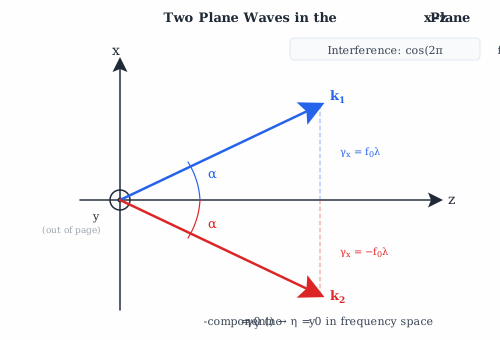
In this 2D cross-section, the $y$-axis points out of the page (perpendicular to the diagram). The two plane waves propagate in the $x$–$z$ plane, symmetric about the $z$-axis at angles $\pm\alpha = \pm\cos^{-1}(f_0\lambda)$. Their $k$-vectors have no $y$-component ($\gamma_y = 0$), so $\eta = 0$ in frequency space. The $x$-components of the two $k$-vectors are equal and opposite ($\gamma_x = \pm f_0\lambda$), producing the interference pattern $\cos(2\pi f_0 x)$ along the $x$-axis.
Interference Pattern
But we know from physics I that the interference of two plane waves creates a sinusoidal interference pattern!
$$ \frac{1}{2}e^{jk_x x} + \frac{1}{2}e^{-jk_x x} = \cos(k_x x) = \cos(|k|\gamma_x x) $$$$ = \cos\left(\frac{2\pi}{\lambda}(f_0\lambda)x\right) = \cos(2\pi f_0 x) $$Returning to Diffraction Formula
We have:
$$ \tilde{U}_e(\xi,\eta) = \tilde{U}_i(\xi,\eta) \cdot H(\xi,\eta) $$where:
$$ \tilde{U}_e(\xi,\eta) = \iint u_e(x,y) e^{-j2\pi(\xi x + \eta y)} \, dx \, dy $$$$ \tilde{U}_i(\xi,\eta) = \iint u_i(x,y) e^{-j2\pi(\xi x + \eta y)} \, dx \, dy $$$$ H(\xi,\eta) = \exp\left\{jk(z_e - z_i)\left[1 - \lambda^2(\xi^2 + \eta^2)\right]^{1/2}\right\} $$where $\gamma_x = \lambda\xi$, $\gamma_y = \lambda\eta$
We can write this in convolution form using the convolution theorem:
$$ \Rightarrow u_e(x,y) = u_i(x,y) ** \mathcal{F}^{-1}\{H(\xi,\eta)\} $$Fresnel Approximation
This is the Fresnel Approach. However, to simplify things, we first restrict the angular plane waves to small angles ($\gamma_x \ll 1$, $\gamma_y \ll 1$):
$$ \Rightarrow \lambda^2\xi^2 \ll 1 \quad \text{and} \quad \lambda^2\eta^2 \ll 1 $$Using the binomial expansion $(1-a)^{1/2} \approx 1 - \frac{a}{2}$, we have:
$$ H(\xi,\eta) \approx \exp\left\{jk(z_e - z_i)\left[1 - \frac{\lambda^2}{2}(\xi^2 + \eta^2)\right]\right\} $$$$ = \exp\{jk(z_e - z_i)\} \exp\{-j\pi\lambda(z_e - z_i)(\xi^2 + \eta^2)\} $$We now need to calculate $h(x,y)$ by inverse Fourier transform:
$$ \mathcal{F}_\xi^{-1}\mathcal{F}_\eta^{-1}\left\{\exp\left[-j\pi\lambda(z_e - z_i)(\xi^2 + \eta^2)\right]\right\} $$$$ = \mathcal{F}_\xi^{-1}\left\{\exp\left[-j\pi\lambda(z_e - z_i)\xi^2\right]\right\} \cdot \mathcal{F}_\eta^{-1}\left\{\exp\left[-j\pi\lambda(z_e - z_i)\eta^2\right]\right\} $$But $\exp\left[-j\pi\lambda(z_e - z_i)\xi^2\right] = \text{Gaus}(a\xi)$
where $a = \sqrt{j\lambda(z_e - z_i)}$
and $\text{Gaus}(\xi) = \exp(-\pi\xi^2)$
Fresnel Diffraction Formula
And $\mathcal{F}^{-1}\{\text{Gaus}(a\xi)\} = \frac{1}{|a|} \text{Gaus}\left(\frac{x}{a}\right)$
Recall Gaussian problem 2.4d: $\mathcal{B}\{e^{-\pi\xi^2}\} = e^{-\pi\xi^2}$
$$ \implies \mathcal{F}^{-1}\left\{\exp\left[-j\pi\lambda(z_e - z_i)\xi^2\right]\right\} $$$$ = \frac{1}{\sqrt{j\lambda(z_e - z_i)}} \exp\left[-\frac{\pi x^2}{j\lambda(z_e - z_i)}\right] $$and $\mathcal{F}^{-1}\mathcal{F}^{-1}\left\{\exp\left[-j\pi\lambda(z_e - z_i)(\xi^2 + \eta^2)\right]\right\}$
$$ = \frac{1}{j\lambda(z_e - z_i)} \exp\left[\frac{j\pi(x^2 + y^2)}{\lambda(z_e - z_i)}\right] $$Finally, $\mathcal{F}^{-1}\mathcal{F}^{-1}\{H(\xi,\eta)\} = \frac{\exp\{jk(z_e - z_i)\}}{j\lambda(z_e - z_i)} \exp\left[\frac{j\pi(x^2 + y^2)}{\lambda(z_e - z_i)}\right]$
We thus have the convolution form (with $\frac{\pi}{\lambda} = \frac{k}{2}$):
$$ \boxed{u_e(x,y) = u_i(x,y) ** \frac{\exp\{jk(z_e - z_i)\}}{j\lambda(z_e - z_i)} \exp\left[\frac{jk(x^2 + y^2)}{2(z_e - z_i)}\right]} $$$$ = \frac{\exp\{jk(z_e - z_i)\}}{j\lambda(z_e - z_i)} \iint u_i(\alpha,\beta) \exp\left\{\frac{jk[(x-\alpha)^2 + (y-\beta)^2]}{2(z_e - z_i)}\right\} d\alpha d\beta $$Fresnel Formula (Angular Approximation / Fresnel Formula)
Huygens’ Principle
(Tie long awaited)
Recall from first quarter that Huygens’ principle stated that any field distribution could be thought of as a superposition of spherical waves:
$$ = \sum \text{superposition} $$Mathematical Statement of Huygens’ Principle
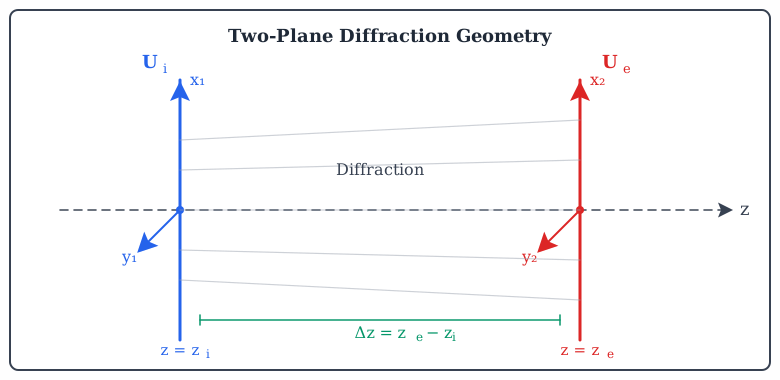
where $\exp\left(\frac{jkr}{j\lambda r}\right)$ is a spherical wave (multiplied by $\frac{1}{j\lambda}$)
Source of spherical waves in $x_1, y_1$
$$ r = \sqrt{(z_e - z_i)^2 + (x_1 - x_2)^2 + (y_1 - y_2)^2} $$$$ r = (z_e - z_i)\sqrt{1 + \frac{(x_1 - x_2)^2 + (y_1 - y_2)^2}{(z_e - z_i)^2}} $$Approximations
(1) Fresnel Approximation
As before, we limit the observations to regions where:
$$ (z_e - z_i) >> |x_1 - x_2| \quad \text{and} \quad (z_e - z_i) >> |y_1 - y_2| $$(2) $\frac{1}{r}$ Approximation
Then the binomial expansion for $r$ gives:
$$ r = (z_e - z_i) + \frac{1}{2(z_e - z_i)}\left[(x_1 - x_2)^2 + (y_1 - y_2)^2\right] $$Use this approximation for exponential
(3) We also approximate $r \approx (z_e - z_i)$ in denominator of spherical wave. Reason: $\frac{1}{r} \approx \frac{1}{z_e - z_i}$, but we cannot use $\exp(jkr) \approx \exp(jkz)$ because $k$ may be large and this may cause the exponential to change from +1 to -1.
Proper Approximation for Huygens’ Principle
The proper approximation becomes:
$$ u_e(x_2, y_2) = \iint u_i(x_1, y_1) \frac{\exp\left\{jk\left[(z_e - z_i) + \frac{1}{2(z_e - z_i)}(x_1 - x_2)^2 + (y_1 - y_2)^2\right]\right\}}{j\lambda(z_e - z_i)} \, dx_1 dy_1 $$$$ \boxed{= \frac{\exp\{jk(z_e - z_i)\}}{j\lambda(z_e - z_i)} \iint u_i(x_1, y_1) \exp\left[\frac{jk}{2(z_e - z_i)}\left((x_1 - x_2)^2 + (y_1 - y_2)^2\right)\right] dx_1 dy_1} $$$u_e(x_2, y_2)$ — Output field. The complex optical field at the observation plane. Contains both amplitude and phase; intensity is $|u_e|^2$.
$u_i(x_1, y_1)$ — Input field. The field in the source/aperture plane. Encodes aperture shape, object transmission, phase masks, etc. Every point $(x_1, y_1)$ acts as a secondary radiator (Huygens).
$\iint dx_1\, dy_1$ — Superposition. Every point in the input plane contributes to every point in the output plane. Diffraction is nonlocal — no ray tracing here. The output is the coherent sum of all secondary waves. This is where interference comes from.
$\exp\{jk(z_e - z_i)\}$ — Carrier phase. A global phase advance corresponding to plane-wave propagation over distance $z_e - z_i$. Same for all $(x_2, y_2)$. Does not affect intensity, but matters if this field interferes with another.
$\dfrac{1}{j\lambda(z_e - z_i)}$ — Amplitude scaling. $1/(z_e - z_i)$: spherical wave spreading (inverse square law for intensity). $1/\lambda$: normalization of the Huygens-Fresnel kernel (arises from $k = 2\pi/\lambda$). $j$: enforces the correct phase convention. Together these ensure energy conservation.
$\exp\!\left[\dfrac{jk}{2(z_e - z_i)}\left((x_1 - x_2)^2 + (y_1 - y_2)^2\right)\right]$ — Quadratic phase kernel (the heart of Fresnel diffraction).
- Represents the extra path length from $(x_1, y_1)$ to $(x_2, y_2)$, retained to second order (paraxial approximation)
- Introduces position-dependent phase delays → constructive/destructive interference → diffraction fringes and Fresnel zones
- Quadratic because off-axis rays travel slightly farther: $R \approx (z_e - z_i) + \frac{(x_2 - x_1)^2 + (y_2 - y_1)^2}{2(z_e - z_i)}$
- This is where wave optics departs from ray optics
Structural meaning: Propagation = convolution with a quadratic-phase kernel. Free-space propagation is a linear shift-invariant system whose impulse response is a chirped spherical wave. This is why lenses cancel quadratic phase, and why Fresnel diffraction becomes Fourier optics in the far field.
One-line intuition: Every point in the input plane emits a spherical wave; the output field is the coherent sum of those waves, with phase delays determined by geometry and wavelength.
Note: This is exactly the results obtained from our previous analysis using angular (plane wave decomposition). Thus, the diffraction effect can apparently be described by considering the effect at $z_e$ to be the superposition of spherical waves $\frac{\exp(jkr)}{j\lambda r}$ at $z_i$, weighted by the field distribution at $z_i$. This is Huygens’ Principle.
Homework: Goodman: 4-5, 4-7; Cathey: 1-3
(or quadratic form of Huygens’ Principle)
Recall that the Fresnel approximation was valid for “small” angular plane waves: $\gamma_x \ll 1$, $\gamma_y \ll 1$.
Specifically, the approximations were (for Huygens’ development):
i) $\frac{1}{r} \approx \frac{1}{(z_e - z_i)}$
ii) $\exp[jkr] \approx \exp\left\{jk\left[(z_e - z_i) + \frac{(x_1 - x_2)^2 + (y_1 - y_2)^2}{2(z_e - z_i)}\right]\right\}$
For i) to be true, we require:
$$ (z_e - z_i) >> |x_1 - x_2| $$and
$$ (z_e - z_i) >> |y_1 - y_2| $$The angle between a ray and the optical axis is $\theta \approx \frac{|x_1 - x_2|}{z_e - z_i}$, so requiring $(z_e - z_i) \gg |x_1 - x_2|$ is equivalent to $\theta \ll 1$ — the paraxial condition. Under this condition, $\sin\theta \approx \theta$ and $\cos\theta \approx 1$, which justifies the $1/r \approx 1/z$ amplitude approximation. The more demanding Fresnel condition (below) controls the phase approximation, which is sensitive to much smaller errors because $k$ is large.
For ii) to be true, we require the next term in the binomial expansion to be insignificant:
$$ r = \left[(z_e - z_i)^2 + (x_1 - x_2)^2 + (y_1 - y_2)^2\right]^{1/2} = (z_e - z_i)\left\{1 + \frac{(x_1 - x_2)^2 + (y_1 - y_2)^2}{(z_e - z_i)^2}\right\}^{1/2} $$$$ \exp(jkr) = \exp\left\{jk(z_e - z_i)\left[1 + \frac{(x_1 - x_2)^2 + (y_1 - y_2)^2}{2(z_e - z_i)^2} - \frac{[(x_1-x_2)^2 + (y_1-y_2)^2]^2}{8(z_e - z_i)^4} + \cdots\right]\right\} $$The Fresnel approximation keeps only the first two terms (constant + quadratic). For this to be valid, the next term — the fourth-order correction $\frac{[(x_1-x_2)^2 + (y_1-y_2)^2]^2}{8(z_e-z_i)^4}$ — must contribute negligible phase, i.e., its contribution $k(z_e - z_i) \times (\text{fourth-order term})$ must be $\ll 1$ radian. This is quantified by the Fresnel condition below.
In order to neglect third term in expansion, we must have:
$$ \frac{k(z_e - z_i)\left[(x_1 - x_2)^2 + (y_1 - y_2)^2\right]^2}{8(z_e - z_i)^4} \ll 1 $$$$ \boxed{(z_e - z_i)^3 >> \frac{\pi}{4\lambda}\left[(x_1 - x_2)^2 + (y_1 - y_2)^2\right]^2_{\text{max}}} $$This is a sufficient Fresnel Condition
(It may not actually be necessary)
What this section proved: It is okay to replace a spherical wave with a quadratic phase — because the error is small.
The exact distance $R$ between input and output points involves a square root. Factoring out the propagation distance gives $R = (z_e - z_i)\sqrt{1 + \varepsilon}$, where:
$$ \varepsilon = \frac{(x_1 - x_2)^2 + (y_1 - y_2)^2}{(z_e - z_i)^2} $$The binomial expansion $(1+\varepsilon)^{1/2} = 1 + \frac{1}{2}\varepsilon - \frac{1}{8}\varepsilon^2 + \cdots$ then gives:
$$ R \approx (z_e - z_i) + \frac{(x_1 - x_2)^2 + (y_1 - y_2)^2}{2(z_e - z_i)} - \frac{\left[(x_1 - x_2)^2 + (y_1 - y_2)^2\right]^2}{8(z_e - z_i)^3} + \cdots $$Inside $\exp(jkR)$, each term plays a distinct role:
| Term | Role |
|---|---|
| Constant $(z_e - z_i)$ | Carrier phase |
| Quadratic | Fresnel diffraction kernel |
| Fourth-order and above | Small corrections (dropped) |
Why “small” means small: The neglected fourth-order term contributes phase $k(z_e - z_i) \times \varepsilon^2/8$. The Fresnel condition above guarantees this is $\ll 1$ radian — too small to shift interference fringes.
Physical conditions for $\varepsilon \ll 1$: Narrow apertures, long propagation distances, small diffraction angles — the paraxial regime.
Hierarchy of approximations:
| Approximation | Terms kept | Result |
|---|---|---|
| Exact | All terms | Rayleigh–Sommerfeld |
| Fresnel | Up to quadratic | Near-field diffraction |
| Fraunhofer | Linearized phase | Far-field / Fourier transform |
One-sentence intuition: You’re approximating a sphere by a paraboloid — and the Fresnel condition proves the error is small.
Two Forms for the Fresnel Diffraction Formula
From here on, let $z$ simply be the distance between observation plane and aperture, i.e., $z = (z_e - z_i)$
Convolution Form
$$ U_2(x,y) = \frac{e^{jkz}}{j\lambda z} \iint U_1(\alpha,\beta)\, \exp\!\left[jk\frac{(x-\alpha)^2 + (y-\beta)^2}{2z}\right] d\alpha\, d\beta $$$$ U_2(x,y) = \frac{e^{jkz}}{j\lambda z} \bigl[U_1 * h\bigr](x,y), \quad h(x,y) = \exp\!\left[jk\frac{x^2+y^2}{2z}\right] $$$$ H(\xi,\eta) = \exp[jkz] \exp[-j\pi\lambda z(\xi^2 + \eta^2)] $$By expanding out the quadratic phase in the integral and factoring, we arrive at a second form:
Fourier Transform Form (Quadratic-Phase / Fourier Form)
$$ U_2(x,y) = \frac{e^{jkz}}{j\lambda z} \exp\!\left[jk\frac{x^2+y^2}{2z}\right] \iint U_1(\alpha,\beta)\, \exp\!\left[jk\frac{\alpha^2+\beta^2}{2z}\right] \exp\!\left[-j\frac{2\pi}{\lambda z}(x\alpha+y\beta)\right] d\alpha\, d\beta $$Recognizing the remaining exponential as the Fourier transform kernel, this can be written compactly as:
$$ U_2(x,y) = \frac{e^{jkz}}{j\lambda z} \exp\!\left[jk\frac{x^2+y^2}{2z}\right] \mathcal{F}\!\left\{U_1(\alpha,\beta)\, \exp\!\left[jk\frac{\alpha^2+\beta^2}{2z}\right]\right\}\Bigg|_{f_x = \frac{x}{\lambda z},\; f_y = \frac{y}{\lambda z}} $$where the 2D Fourier transform is:
$$ \mathcal{F}\{g(\alpha,\beta)\}(f_x,f_y) = \iint g(\alpha,\beta)\, e^{-j2\pi(f_x\alpha + f_y\beta)}\, d\alpha\, d\beta $$The first form writes Fresnel diffraction as a convolution with a quadratic-phase impulse response $h(x,y)$, showing free-space propagation is a linear shift-invariant system. The second form factors the quadratic phase to reveal a scaled Fourier transform of a chirp-modulated input field. The spatial frequencies $f_x, f_y$ correspond to observation-plane coordinates via $f_x = x/(\lambda z)$, revealing the direct connection between free-space propagation and Fourier optics — and leading directly to the Fraunhofer (far-field) limit.
Note that this equation can be thought of as some phase factors multiplying the Fourier transform of the aperture transmittance and a quadratic phase factor $\exp\left\{\frac{jk[\alpha^2+\beta^2]}{2z}\right\}$
Fraunhofer Diffraction Formula (Far Field)
In the Fourier transform form of the Fresnel diffraction formula, the input field $U_1(\alpha,\beta)$ is multiplied by a quadratic-phase chirp factor $\exp\{jk(\alpha^2+\beta^2)/2z\}$ before being Fourier transformed. This chirp encodes the curvature of the Fresnel kernel — it’s what makes near-field diffraction different from a pure Fourier transform.
If the propagation distance $z$ is large enough, the phase variation of this chirp across the entire aperture becomes negligible, and the exponential can be replaced by unity:
$$ \exp\left\{\frac{jk[\alpha^2+\beta^2]}{2z}\right\} \approx 1 $$This requires:
$$ \frac{k(\alpha^2+\beta^2)}{2z} \ll 1 \quad \text{for all } \alpha, \beta \text{ in the diffracting aperture} $$$$ \Rightarrow \boxed{z >> \frac{k(\alpha^2+\beta^2)_{\text{max}}}{2}} $$Fraunhofer Condition
For an input aperture of radius $a$, the maximum phase variation of the chirp factor is:
$$ \Delta\phi = k\frac{a^2}{2z} = \pi\frac{a^2}{\lambda z} $$Requiring $\Delta\phi \ll 1$ gives the equivalent condition:
$$ \boxed{\frac{a^2}{\lambda z} \ll 1} $$The quantity $a^2/\lambda z$ is the Fresnel number. In the small Fresnel number limit, the chirp factor drops out and Fresnel diffraction reduces to Fraunhofer diffraction — the field becomes proportional to the Fourier transform of the input.
Under this condition, the quadratic phase term in the input plane is negligible, so the Fresnel diffraction equation reduces to:
$$ \boxed{U_2(x,y) = \frac{e^{jkz}}{j\lambda z} \exp\!\left[jk\frac{x^2+y^2}{2z}\right] \iint U_1(\alpha,\beta)\, \exp\!\left[-j\frac{2\pi}{\lambda z}(x\alpha + y\beta)\right] d\alpha\, d\beta} $$Recognizing the Fourier kernel, this may be written as:
$$ U_2(x,y) = \frac{e^{jkz}}{j\lambda z} \exp\!\left[jk\frac{x^2+y^2}{2z}\right] \mathcal{F}\{U_1(\alpha,\beta)\}\bigg|_{f_x = \frac{x}{\lambda z},\; f_y = \frac{y}{\lambda z}} $$Fraunhofer Diffraction Formula
This is the Fraunhofer approximation (far-field diffraction). The observation-plane coordinates map directly to spatial frequencies via $f_x = x/(\lambda z)$ and $f_y = y/(\lambda z)$, so a position $x$ on the screen corresponds to a unique spatial frequency in the aperture. The far-field pattern is therefore the Fourier transform of the aperture transmittance, evaluated at these scaled coordinates — up to a prefactor (plane wave propagation, quadratic phase). This is the foundation for all diffraction-based spectral analysis: rectangular apertures produce sinc patterns, circular apertures produce Airy disks, and gratings produce arrays of delta-like orders.
Each factor corresponds to one of the fundamental wavefronts:
| Factor | Wavefront | Role |
|---|---|---|
| $\dfrac{e^{jkz}}{j\lambda z}$ | On-axis plane wave | Carrier phase + amplitude scaling (inverse-square law) |
| $\exp\!\left[jk\dfrac{x^2+y^2}{2z}\right]$ | Spherical wave ($R = z$) | Quadratic phase curvature of the observation-plane field |
| $\displaystyle\iint U_1 \, e^{-j\frac{2\pi}{\lambda z}(x\alpha+y\beta)} d\alpha\, d\beta$ | Tilted plane wave basis | Fourier transform — decomposes the aperture into plane waves |
The Fraunhofer formula is a product of all three fundamental wavefront types.
Here $u_e(x,y)$ is the complex electric field at plane $z_e$. Most detectors of light (film, eye, photodiode) are only capable of measuring power.
We define the intensity (power/unit area) as:
$$ I_e(x,y) = u_e(x,y) \cdot u_e^*(x,y) $$This gives an extremely simple diffraction formula in the Fraunhofer region:
$$ I_e(x,y) = \left| \frac{\exp(jkz)}{j\lambda z} \exp\left\{\frac{jk(x^2+y^2)}{2z}\right\} \mathcal{F}\{u_i(\alpha,\beta)\}\right|^2 $$$$ = \frac{1}{(\lambda z)^2} \left| \mathcal{F}\{u_i(\alpha,\beta)\}\bigg|_{\xi=\frac{x}{\lambda z}, \eta=\frac{y}{\lambda z}} \right|^2 $$Or simply, the intensity pattern (as seen by eye, etc.) is the squared magnitude of the two-dim Fourier Transform (scaled by $\frac{1}{\lambda z}$).
$$ \text{Inverse Square Law} $$Why intensity, not field? Detectors (film, eye, photodiode) measure power, not phase. Phase information disappears unless you interfere fields. So the measurable quantity is $I = |U|^2$.
Why the phase terms cancel: Substituting the Fraunhofer field into $I = U_2 \cdot U_2^*$, the exponential phase factors $e^{jkz}$ and $e^{jk(x^2+y^2)/2z}$ have unit magnitude and cancel in the product, leaving only the magnitude of the Fourier transform.
The prefactor $1/\lambda^2 z^2$: This comes from $|1/(j\lambda z)|^2$. The $1/z^2$ is geometric spreading (inverse square law); the $1/\lambda^2$ is the Huygens-Fresnel normalization. It affects brightness, not pattern shape.
The punchline: Fraunhofer diffraction intensity is the squared magnitude of the Fourier transform of the aperture field. This is the central result of Fourier optics — aperture shape determines the diffraction pattern:
- Slits → $\mathrm{sinc}^2$
- Gratings → comb spectra
- Circular apertures → Airy disk
This is the equation that turns optics into Fourier analysis.
The Fraunhofer condition is fairly severe:
$$ z >> \frac{k(\alpha^2 + \beta^2)_{\text{max}}}{2} = \frac{\pi(\alpha^2 + \beta^2)_{\text{max}}}{\lambda} $$He-Ne laser (red): $\lambda \approx 6 \times 10^{-7}$ m, $k = \frac{2\pi}{\lambda} \approx 1.05 \times 10^7$ m$^{-1}$
Square aperture: $2.5 \times 2.5$ cm, so $\alpha_\text{max} = \beta_\text{max} = 1.25 \times 10^{-2}$ m
$$ z \gg \frac{\pi(\alpha^2 + \beta^2)_\text{max}}{\lambda} = \frac{\pi\left[(1.25 \times 10^{-2})^2 + (1.25 \times 10^{-2})^2\right]}{6 \times 10^{-7}} = \frac{\pi \cdot 3.125 \times 10^{-4}}{6 \times 10^{-7}} \approx 1{,}636 \text{ m} $$So the Fraunhofer (far-field) approximation requires $z \gg 1{,}600$ m — over a mile away for a modest 2.5 cm aperture at visible wavelengths. This illustrates why the Fraunhofer condition is “fairly severe” and why lenses are used in practice to bring the Fourier plane to a manageable distance.
Nevertheless, it is often a useful approximation.
Transfer Functions Associated with Approximations
$$ H(\xi,\eta) = \exp\left\{jkz\left[1 - \lambda^2(\xi^2+\eta^2)\right]^{1/2}\right\} $$— No approximation
$$ H_F(\xi,\eta) \cong \exp\left\{jkz\left[1 - \frac{\lambda^2}{2}(\xi^2+\eta^2)\right]\right\} $$— Fresnel Approximation
$H_F(\xi,\eta) \rightarrow$ does not exist, because the Fourier transform operator is not shift invariant and thus has no transfer function associated with it.
However, the Fraunhofer region can be thought of as a limit of the Fresnel region, which does have a transfer function associated with Fresnel diffraction (i.e., the Fresnel equations are obviously good in the Fraunhofer region, and the transfer function associated with Fresnel diffraction can be used).
Microwave Antenna (Transmitter)
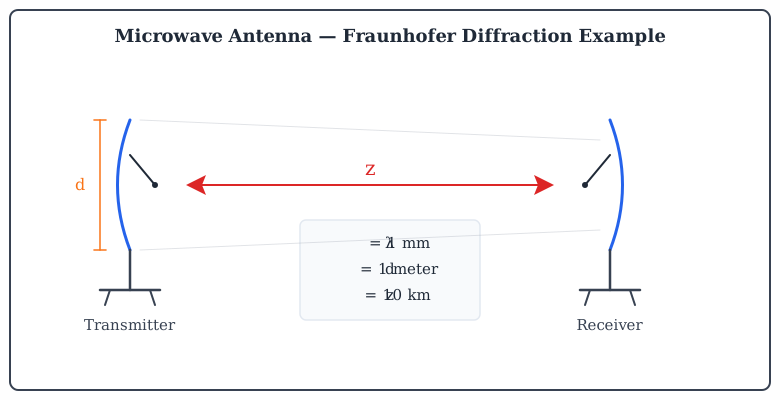
Setup:
- $\lambda = 1$ mm
- $d = 1$ meter
- $z = 10$ km
Question: How much power will be received by the receiving antenna?
Equivalent Set-up
$$ u^i(x,y) = A \cdot \text{circ}\left(\frac{r}{d/2}\right) $$where $r$ = radius
Fraunhofer Condition
$$ z >> \frac{k(\alpha^2 + \beta^2)_{\text{max}}}{2} = \frac{\pi r^2}{\lambda} $$$$ z >> \frac{\pi(0.5)^2}{10^{-3}} = 750 \text{ m} $$$\implies z = 10$ km is in the Fraunhofer region
Intensity Pattern
$$ I_e(x,y) = \frac{1}{(\lambda z)^2} \left| \mathcal{F}\mathcal{F}\left\{A \cdot \text{circ}\left(\frac{r}{d/2}\right)\right\}\right|^2_{\xi=\frac{x}{\lambda z}, \eta=\frac{y}{\lambda z}} $$$$ = \frac{1}{(\lambda z)^2} \left| \frac{A\pi d^2}{4} \text{somb}\left(\frac{d\rho}{\lambda z}\right) \right|^2 $$or:
$$ = \frac{1}{(\lambda z)^2} \left| \frac{Ad}{2} \frac{J_1(\pi d\rho/\lambda z)}{\rho/\lambda z} \right|^2 $$where $\rho = \sqrt{x^2 + y^2}$
Fraunhofer Diffraction - Airy Pattern
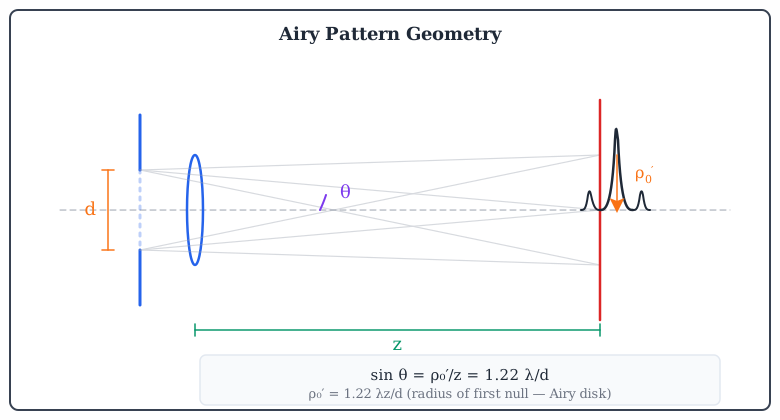
The intensity pattern follows a sombrero function:
$$ \text{somb}\left(\frac{d\rho}{\lambda z}\right) = \frac{2J_1\left(\frac{\pi d\rho}{\lambda z}\right)}{\frac{\pi d\rho}{\lambda z}} $$and $J_1(\pi)(1.22) = 0$
The first zero of the Bessel function occurs at:
$$ \frac{d\rho_1}{\lambda z} = 1.22 $$$$ \rho_1 = \frac{(1.22)\lambda z}{d} $$$$ = \frac{(1.22)(10^{-3})(10^4)}{1} = 12.2 \text{ m} $$Form of Result
From $\rho = 1.22 \frac{\lambda z}{d}$
and $\frac{\rho}{z} \approx \sin\theta$
we have:
$$ \boxed{\sin\theta = 1.22 \frac{\lambda}{d}} $$Very Important Equation
$\rho_1$ = radius of main lobe
For a square aperture, the result is almost the same:
$$ \text{rect}\left(\frac{x'}{d}, \frac{y'}{d}\right) \xrightarrow{z} I \propto \left| d^2 \text{sinc}\left(\frac{dx'}{\lambda z}, \frac{dy'}{\lambda z}\right) \right|^2 $$$$ \text{sinc}(1) = 0 $$$$ \Rightarrow \frac{da}{\lambda z} = 1, \text{ or } a = \frac{\lambda z}{d} $$But $\frac{a}{z} = \sin\theta$
$$ \implies \boxed{\sin\theta = \frac{\lambda}{d}} $$Thus we see a general result:
$$ \boxed{\sin\theta = K\frac{\lambda}{d}} $$Far Field Diffraction from an Aperture
where $K$ is a value close to 1, and is dependent on the shape of the aperture.
| Aperture | K |
|---|---|
| Square | $K = 1$ |
| Circle | $K = 1.22$ |
| Square ($d \times d$) | Circular (diameter $d$) | |
|---|---|---|
| Aperture | $\text{rect}(x/d)\cdot\text{rect}(y/d)$ | $\text{circ}(2r/d)$ |
| Transform | $d^2\,\text{sinc}(d\xi)\,\text{sinc}(d\eta)$ | $\frac{\pi d^2}{4}\,\text{somb}(d\rho)$ |
| Intensity | $\propto \text{sinc}^2$ (separable) | $\propto \text{somb}^2$ (circularly symmetric) |
| First null | $\sin\theta = \lambda/d$ | $\sin\theta = 1.22\,\lambda/d$ |
| $K$ factor | $1$ | $1.22$ |
The 22% larger first null for the circular aperture reflects the Bessel function zero ($J_1(1.22\pi) = 0$) vs the sinc zero ($\text{sinc}(1) = 0$). Both follow $\sin\theta = K\lambda/d$ — aperture shape only changes the constant.
Notice Effect of Rectangular Antennas
Rectangular Antenna Pattern
An antenna with a rectangular shape such as shown has less broadening of the beam in the horizontal direction ($\theta$) than the vertical direction ($\phi$).
A ship radar uses a wide, short rectangular aperture with horizontal dimension $d_1$ and vertical dimension $d_2$ (where $d_1 > d_2$).
The far-field intensity pattern for a rectangular aperture is:
$$ I(x',y') = \frac{1}{\lambda^2 z^2} \left| d_1 d_2 \, \text{sinc}\!\left(\frac{d_1 x'}{\lambda z}, \frac{d_2 y'}{\lambda z}\right) \right|^2 $$The first null occurs when the sinc argument equals 1. In the horizontal direction:
$$ \frac{d_1 x'}{\lambda z} = 1 \implies x' = \frac{\lambda z}{d_1} $$$$ \boxed{\sin\theta = \frac{x'}{z} = \frac{\lambda}{d_1}}, \quad \sin\phi = \frac{\lambda}{d_2} $$Thus, a rectangular antenna has less beam broadening in the horizontal direction ($\theta$) than in the vertical direction ($\phi$).
Resolution Considerations
Consider a radar antenna that tries to locate an object by rotating with beam “illuminates” object.
Two objects can be distinguished separately only if beam is narrow. A broad antenna has better resolution in horizontal direction than vertical direction.
Diffraction Grating (Sinusoidal, Absorption)
!sinusoidal_absorption_grating.svg Frequency of grating in $x$ is $\frac{1}{T} = f_0$. The depth of modulation is represented by $m$ where $0 < m \leq 1$.
$$ u_i^-(x,y) = A $$$$ t(x,y) = \left[\frac{1}{2} + \frac{m}{2}\cos(2\pi f_0 x)\right] \text{rect}\left(\frac{x}{\ell}\right) \text{rect}\left(\frac{y}{\ell}\right) $$$$ \implies u_i^+(x,y) = A\left[\frac{1}{2} + \frac{m}{2}\cos(2\pi f_0 x)\right] \text{rect}\left(\frac{x}{\ell}\right) \text{rect}\left(\frac{y}{\ell}\right) $$Far Field Calculation
The transmitted field contains discrete plane wave components (constant term plus two diffracted orders at $\pm f_0$). In frequency space, discrete components appear as delta functions — each delta represents a plane wave at that spatial frequency.
The convolution with $\text{sinc}(\ell\xi)\text{sinc}(\ell\eta)$ spreads each delta into a sinc pattern, reflecting the finite aperture size $\ell$. Without the finite aperture, the far-field would consist of three infinitely sharp spots.
By the sifting property, convolution with a shifted delta simply shifts the function:
$$ \delta(\xi - f_0) * g(\xi) = g(\xi - f_0) $$With $g(\xi) = \text{sinc}(\ell\xi)$, the entire argument is evaluated at $\xi - f_0$:
$$ \delta(\xi - f_0) * \text{sinc}(\ell\xi) = \text{sinc}(\ell(\xi - f_0)) $$A common mistake is writing $\text{sinc}(\ell\xi - f_0)$, but this equals $\text{sinc}(\ell(\xi - f_0/\ell))$ — a shift by $f_0/\ell$ instead of $f_0$. The delta replaces $\xi$ with $\xi - f_0$ everywhere it appears, including inside the factor of $\ell$.
Output Field
$$ u_e(x',y') = \frac{A\ell^2}{j\lambda z}\exp(jkz)\exp\left(j\frac{k(x'^2+y'^2)}{2z}\right)\text{sinc}\left(\frac{\ell y'}{\lambda z}\right) $$$$ \times \left\{\text{sinc}\left(\frac{\ell x'}{\lambda z}\right) + \frac{m}{2}\text{sinc}\left[\frac{\ell}{\lambda z}(x'+\lambda z f_0)\right] + \frac{m}{2}\text{sinc}\left[\frac{\ell}{\lambda z}(x'-\lambda z f_0)\right]\right\} $$The intensity pattern shows peaks at $x' = 0$, $x' = \pm f_0\lambda z$, with width $\frac{\ell x'}{\lambda z} = 1 \Rightarrow x' = \frac{\lambda z}{\ell}$.
!grating_output_pattern.svg
Diffraction Grating - Resolution Analysis
Key Observations
Note:
- Distance from origin to first zero of sinc function $= \frac{\lambda z}{\ell}$
- Distance to next sinc function $= f_0\lambda z = \frac{\lambda z}{T}$
Since $f_0 = \frac{1}{T}$:
$$ \implies \text{If } T << \ell, $$$$ \frac{\lambda z}{\ell} << \frac{\lambda z}{T} \text{ and the overlap of sinc functions is small.} $$When $T \ll \ell$, the number of sinusoidal periods across the aperture ($\ell/T$) is large, so the three sinc lobes are well-separated. Since non-overlapping sinc functions have essentially zero product, the cross terms in $|u_e|^2$ vanish:
$$ |u_e|^2 = |A_0 + A_{-1} + A_{+1}|^2 \approx |A_0|^2 + |A_{-1}|^2 + |A_{+1}|^2 $$The total intensity pattern decomposes into a simple sum of three independent sinc² terms — one for each diffraction order.
!sinc_decomposition.svg
Intensity Pattern
$$ I_e(x',y') = \frac{A^2\ell^4}{4\lambda^2 z^2}\text{sinc}^2\left(\frac{\ell y'}{\lambda z}\right)\left\{\text{sinc}^2\left(\frac{\ell x'}{\lambda z}\right) + \frac{m^2}{4}\text{sinc}^2\left[\frac{\ell}{\lambda z}(x'+\lambda z f_0)\right] + \frac{m^2}{4}\text{sinc}^2\left[\frac{\ell}{\lambda z}(x'-\lambda z f_0)\right]\right\} $$Diffraction Orders
The position of the $\pm 1$ order components $= f_0\lambda z = \frac{\lambda z}{T}$
Since $\sin\theta = \frac{x_0}{z}$:
$$ \boxed{\sin\theta = \frac{x_0}{z} = \frac{\lambda}{T}} $$This device can be used to disperse white light into colors.
- The width of each order is $\frac{\lambda z}{\ell}$
- The spatial separation is $f_0\lambda z$
Rayleigh Criterion
Two wavelengths are just resolved when the peak of one sinc² pattern falls on the first null of the other. The minimum resolvable separation is:
$$ x_{\text{Rayleigh}} = \frac{\lambda z}{\ell} $$If two points are coherent, they add in complex field (amplitudes), not in intensity — making the Rayleigh criterion harder to satisfy since the dip between peaks is shallower.
With two sinc peaks separated by 1 (normalized), the midpoint field is:
$$ u\!\left(\tfrac{1}{2}\right) = \text{sinc}\!\left(\tfrac{1}{2}\right) + \text{sinc}\!\left(-\tfrac{1}{2}\right) = 2\,\text{sinc}\!\left(\tfrac{1}{2}\right) = 2\,\frac{\sin(\pi/2)}{\pi/2} = \frac{4}{\pi} $$Since $\frac{4}{\pi} \approx 1.27 > 1$, the midpoint intensity is:
$$ I\!\left(\tfrac{1}{2}\right) = \left(\frac{4}{\pi}\right)^2 = \frac{16}{\pi^2} \approx 1.62 $$This exceeds each peak’s intensity of $1$ — there is no dip at all, and the two points are unresolved.
If the points are incoherent, intensities add directly. Each peak has $I(0) = 1$, and at the midpoint:
$$ I\!\left(\tfrac{1}{2}\right) = \text{sinc}^2\!\left(\tfrac{1}{2}\right) + \text{sinc}^2\!\left(-\tfrac{1}{2}\right) = 2\,\text{sinc}^2\!\left(\tfrac{1}{2}\right) = 2\,\frac{\sin^2(\pi/2)}{(\pi/2)^2} = \frac{8}{\pi^2} \approx 0.81 $$Since $0.81 < 1$, there is a visible dip of $1 - 8/\pi^2 \approx 0.19$ (19%) between the two peaks — the points are resolved by the Rayleigh criterion.
!rayleigh_criterion.svg
Spectral Resolution
The resolving power of a grating $\bar{\lambda}/\Delta\lambda = qN$ depends only on the diffraction order $q$ and the number of lines $N$ — not on the slit width or line spacing individually. This is because narrower spacing increases angular dispersion but proportionally broadens each order’s peak, and vice versa; the two effects cancel, leaving only $N$ (the total number of periods across the aperture) as the determining factor.
This quantity $N$ is the space-bandwidth product of the grating: the number of resolvable spots equals the number of independent spatial samples across the aperture, a fundamental limit that appears throughout optics and signal processing.
!phase_grating.svg
Unlike the absorption grating, a phase grating has no absorption — the transmitted amplitude $|t| = 1$ everywhere. Instead, the grating modulates the phase of the transmitted wave via a sinusoidal variation in refractive index $n(x)$.
$$ u^-(x,y) = 1 $$$$ t(x,y) = \exp\left[j\frac{m}{2}\sin(2\pi f_0 x)\right] \text{rect}\left(\frac{x}{\ell}\right) \text{rect}\left(\frac{y}{\ell}\right) $$$$ u^+(x,y) = t(x,y) $$The phase arises from a varying thickness $h(x)$ in the grating. With $k = 2\pi/\lambda$:
$$ t(x) = \exp[jk\,h(x)] = \exp[j\,\phi(x)], \quad \text{where } \phi(x) = k\,h(x) = \frac{m}{2}\sin(2\pi f_0 x) $$The phase varies sinusoidally between $+m/2$ and $-m/2$, where $m$ is the modulation depth.
Bessel Function Identity
Is $\exp[j\frac{m}{2}\sin(2\pi f_0 x)]$ periodic? Yes — since $\sin(2\pi f_0 x)$ is periodic with period $T = 1/f_0$, any function of it is periodic with the same period.
Since it is periodic, it has a Fourier series in harmonics of $f_0$:
$$ \exp\left[j\frac{m}{2}\sin(2\pi f_0 x)\right] = \sum_{q=-\infty}^{\infty} c_q \, \exp(j2\pi q f_0 x) $$The Fourier coefficients $c_q$ turn out to be exactly the Bessel functions of the first kind: $c_q = J_q(m/2)$.
Fourier Transform
Taking the Fourier transform of both sides of the Bessel identity:
$$ \mathcal{F}\left\{\exp\left[j\frac{m}{2}\sin(2\pi f_0 x)\right]\right\} = \mathcal{F}\left\{\sum_{q=-\infty}^{\infty} J_q\left(\frac{m}{2}\right)\exp(j2\pi q f_0 x)\right\} = \sum_{q=-\infty}^{\infty} J_q\left(\frac{m}{2}\right)\delta(\xi - qf_0) $$Each complex exponential becomes a delta function — the phase grating produces infinitely many diffraction orders at $\xi = qf_0$ (unlike the absorption grating which only has orders $0, \pm 1$).
Including the rect aperture:
$$ \mathcal{FF}\{t(x,y)\} = \ell^2 \text{sinc}(\ell\xi)\text{sinc}(\ell\eta) * \left[\sum_{q=-\infty}^{\infty} J_q\left(\frac{m}{2}\right)\delta(\xi - qf_0, \eta)\right] $$$$ = \sum_{q=-\infty}^{\infty} \ell^2 J_q\left(\frac{m}{2}\right)\text{sinc}[\ell(\xi - qf_0)]\text{sinc}(\ell\eta) $$Output Field
$$ \Rightarrow u(x',y') = \frac{\ell^2}{j\lambda z}\exp(jkz)\exp\left[j\frac{k}{2z}(x'^2+y'^2)\right] $$$$ \times \sum_{q=-\infty}^{\infty} J_q\left(\frac{m}{2}\right)\text{sinc}\left[\frac{\ell}{\lambda z}(x'-qf_0\lambda z)\right]\text{sinc}\left(\frac{\ell y'}{\lambda z}\right) $$!phase_grating_output.svg
Intensity Pattern
When $f_0 \ell \gg 1$ (many grating periods fit inside the aperture), the sinc lobes centered on each diffraction order barely overlap. The cross terms vanish (same argument as the absorption grating), and intensity becomes a simple sum over orders:
$$ I(x',y') \cong \left(\frac{\ell^2}{\lambda z}\right)^2 \sum_{q=-\infty}^{\infty} J_q^2\left(\frac{m}{2}\right)\text{sinc}^2\left[\frac{\ell}{\lambda z}(x'-qf_0\lambda z)\right]\text{sinc}^2\left(\frac{\ell y'}{\lambda z}\right) $$Each factor has a distinct physical role:
| Factor | Role |
|---|---|
| $\left(\dfrac{\ell^2}{\lambda z}\right)^2$ | Overall scaling — larger aperture $\ell$ collects more light; larger $\lambda z$ spreads it over a wider area |
| $J_q^2\!\left(\dfrac{m}{2}\right)$ | Weight of the $q$-th order — set entirely by the modulation depth $m$ |
| $\text{sinc}^2\!\left[\dfrac{\ell}{\lambda z}(x' - qf_0\lambda z)\right]$ | Sinc² peak centered at $x' = qf_0\lambda z$, with first-null width $\dfrac{\lambda z}{\ell}$ |
| $\text{sinc}^2\!\left(\dfrac{\ell y'}{\lambda z}\right)$ | $y'$-envelope from the square aperture (same for every order) |
The absorption grating transmittance is $\frac{1}{2} + \frac{m}{2}\cos(2\pi f_0 x)$, which contains only three Fourier terms — so it produces exactly three diffraction orders ($0, \pm 1$) with weights $1, m/2, m/2$.
The phase grating transmittance $\exp[j\frac{m}{2}\sin(2\pi f_0 x)]$ has a Fourier series with infinitely many harmonics (the Bessel expansion) — so it produces infinitely many diffraction orders at $x' = qf_0\lambda z$ for all integer $q$, each weighted by $J_q^2(m/2)$.
Behavior of $J_q^2\!\left(\frac{m}{2}\right)$
The Bessel weights determine how optical power is distributed among orders as $m$ changes:
- $J_0^2$ starts at 1 (all power in zeroth order) and decreases as $m$ grows
- Higher-order terms $J_1^2, J_2^2, \ldots$ start at 0 and peak at progressively larger values of $m/2$
!bessel_weights_vs_modulation.svg
Because each $J_q$ has distinct zeros, choosing $m/2$ at a zero of a particular $J_q$ suppresses that order entirely.
Example: $J_0(2.405) = 0$, so $m/2 = 2.405$ ($m \approx 4.81$ rad) eliminates the zeroth-order peak — all power goes to higher orders.
Diffraction Pattern Example
With $m = 8$ radians ($m/2 = 4$):
- $J_1(4) \approx 0$, so the first-order peaks vanish
- Power redistributes into the zeroth and higher orders ($q = 0, \pm 2, \pm 3, \ldots$)
The resulting diffraction pattern shows peaks at positions $x' = qf_0\lambda z$ for integer $q$, with relative intensities set by $J_q^2(4)$.
!phase_grating_m8_pattern.svg
Resolving Power of the Phase Grating
The absorption grating (orders $0, \pm 1$ only) has resolving power $\frac{\bar{\lambda}}{\Delta\lambda} = N$, where $N = \ell / T$ is the number of grating lines.
Because the phase grating produces higher orders, observing in the $q$-th order multiplies the resolving power:
$$ \boxed{\frac{\bar{\lambda}}{\Delta\lambda} = qN} $$There is a resolution–intensity trade-off: observing in a higher diffraction order $q$ multiplies the resolving power by $q$ (since the angular dispersion scales with order), but the intensity in order $q$ is weighted by $J_q^2(m/2)$, which falls off rapidly for $q > m/2$. In practice, one chooses the highest order that still carries usable signal — a grating with large modulation depth $m$ pushes energy into higher orders, enabling greater resolution before the Bessel roll-off becomes limiting.
Large-Order Bessel Asymptotic
For large order $n$ (with $x$ fixed), the Bessel function decays super-exponentially:
$$ J_n(x) \sim \frac{1}{\sqrt{2\pi n}}\left(\frac{ex}{2n}\right)^n \quad (n \gg 1) $$Once $n > m/2$, the ratio $\frac{ex}{2n} < 1$ and raising it to the $n$-th power drives $J_n \to 0$ rapidly. In practice, only orders $|q| \lesssim m/2$ carry significant power — the infinite sum in the intensity formula is effectively finite.
Antenna & Hydrophone Arrays
The far-field radiation pattern of an antenna (electromagnetic) and the beam pattern of a hydrophone array (acoustic/sonar) are both governed by the same Fourier transform relationship between aperture field and angular intensity. Everything derived below applies to either domain — only the wavelength $\lambda$ changes.
Far Field Diffraction Pattern for Square Antenna
Recall the far field diffraction pattern for a single square antenna (width = $d$):
$$ t(x,y) = \text{rect}\left(\frac{x}{d}, \frac{y}{d}\right) $$$$ I(\xi_x, \xi_y) = \left(\frac{1}{\lambda z}\right)^2 \left| \iint u_i(x,y) \exp\{-j2\pi(x\xi_x + y\xi_y)\} dx\,dy \right|^2 $$where $\xi_x = \cos\theta/\lambda$, $\xi_y = \cos\phi/\lambda$ are spatial frequencies (direction cosines divided by wavelength).
If we have a square antenna, this becomes:
$$ I(\xi_x, \xi_y) = I\left(\frac{\cos\theta}{\lambda}, \frac{\cos\phi}{\lambda}\right) = \left(\frac{1}{\lambda z}\right)^2 \left| d^2 \text{sinc}\left(\frac{d\cos\theta}{\lambda}\right) \text{sinc}\left(\frac{d\cos\phi}{\lambda}\right) \right|^2 $$The intensity pattern shows angular sensitivity in the $\frac{\cos\theta}{\lambda}$ direction.
Antenna Array
Consider $M$ square antennas (width $d$) spaced $D$ apart along $x$ ($M$ odd, $D \geq d$), illuminated by a unit plane wave $u^- = 1$:
$$ t(x,y) = \text{rect}\left(\frac{x}{d}, \frac{y}{d}\right) * \left[\frac{1}{D}\text{comb}\left(\frac{x}{D}\right) \cdot \text{rect}\left(\frac{x}{MD}\right)\right] \cdot \delta(y) $$$$ \Rightarrow u^+(x,y) = t(x,y) $$The $\delta(y)$ ensures the convolution replicates elements along $x$ only (a linear array, not a 2D grid).
Antenna Array - Intensity Pattern
Far-Field Derivation
The Fourier transform of $u^+$ gives the far-field pattern. The element factor transforms to $d^2\,\text{sinc}$, and the array factor (product in space → convolution in frequency) becomes:
$$ \mathcal{F}\{u^+\} = d^2\,\text{sinc}\left(\frac{d\cos\theta}{\lambda},\,\frac{d\cos\phi}{\lambda}\right) \cdot \left[MD\,\text{comb}\left(D\frac{\cos\theta}{\lambda}\right) * \text{sinc}\left(MD\frac{\cos\theta}{\lambda}\right)\right] $$Expanding the comb into a sum of deltas:
$$ \text{comb}\left(D\frac{\cos\theta}{\lambda}\right) = \frac{1}{D}\sum_{q=-\infty}^{\infty}\delta\left(\frac{\cos\theta}{\lambda} - \frac{q}{D}\right) $$Each delta shifts the sinc, so the convolution evaluates to:
$$ \mathcal{F}\{u^+\} = Md^2\,\text{sinc}\left(\frac{d\cos\theta}{\lambda},\,\frac{d\cos\phi}{\lambda}\right)\cdot\left[\sum_{q=-\infty}^{\infty}\text{sinc}\left(MD\left(\frac{\cos\theta}{\lambda} - \frac{q}{D}\right)\right)\right] $$- The element factor $\text{sinc}(d\cos\theta/\lambda)$ is the broad envelope set by a single antenna of width $d$
- The array factor $\sum_q \text{sinc}(MD(\cos\theta/\lambda - q/D))$ produces narrow peaks (width $\sim 1/(MD)$) at $\cos\theta/\lambda = q/D$, i.e., at angles where all $M$ elements add in phase
Array Intensity Formula
$$ I\left(\frac{\cos\theta}{\lambda}, \frac{\cos\phi}{\lambda}\right) = \left(\frac{1}{\lambda z}\right)^2 \left| Md^2 \text{sinc}\left(\frac{d\cos\theta}{\lambda}, \frac{d\cos\phi}{\lambda}\right) \right|^2 \cdot \left| \sum_{q=-\infty}^{\infty}\text{sinc}\left(MD\left(\frac{\cos\theta}{\lambda} - \frac{q}{D}\right)\right) \right|^2 $$Assuming $M \gg 1$, the sinc peaks in the sum are narrow (width $\sim 1/(MD)$) and non-overlapping, so cross terms vanish (same argument as the diffraction gratings):
$$ I\left(\frac{\cos\theta}{\lambda}, \frac{\cos\phi}{\lambda}\right) = M^2 d^4 \,\text{sinc}^2\left(\frac{d\cos\theta}{\lambda}\right) \cdot \text{sinc}^2\left(\frac{d\cos\phi}{\lambda}\right) \cdot \sum_{q=-\infty}^{\infty}\text{sinc}^2\left(MD\left(\frac{\cos\theta}{\lambda} - \frac{q}{D}\right)\right) $$In polar form (plotting intensity vs angle $\theta$ from the $z$-axis), the pattern shows a narrow main beam along $z$ with angular width set by the total array length $MD$, and smaller side lobes and grating lobes at other angles.
!antenna_polar_pattern.svg
Grating Lobes
The central lobe is very narrow ($\propto 1/MD$) giving high directivity, but the periodic sampling at spacing $D$ also creates grating lobes — full-strength copies of the main beam at angles $\cos\theta/\lambda = q/D$ for each integer $q$. These are the spatial analogue of diffraction orders from an optical grating. In a receiving system, grating lobes cause ambiguity: a signal arriving from a grating lobe direction is indistinguishable from one at the main beam angle, making it impossible to determine the true source direction without additional information.
The array factor produces narrow peaks at $\cos\theta/\lambda = q/D$ for all integer $q$. The element factor $\text{sinc}^2(d\cos\theta/\lambda)$ acts as an envelope with its first zero at $\cos\theta/\lambda = 1/d$.
With $D = 2d$, the envelope zero falls at $1/d = 2/D$, so:
- $q = 0$: main lobe — at the peak of the envelope
- $q = 1$: grating lobe at $1/D$ — sits at the midpoint of the envelope, significant amplitude
- $q = 2$: at $2/D = 1/d$ — falls on the envelope zero, suppressed
- $q = 3$: at $3/D$ — weak, beyond the envelope main lobe
Between the narrow array peaks are side lobes of the array factor sinc² functions.
!antenna_array_D2d.svg
Physical Reason for Grating Lobes
Two point sources make two sets of plane waves. The phases received by the antennas from both plane waves are identical — the array cannot distinguish which direction the signal came from.
Antenna Arrays - Main Lobe Condition
Eliminating Grating Lobes
a) Make $D = d$ — the first grating lobe at $1/D$ coincides with the element envelope zero at $1/d$, suppressing it. But higher grating lobes ($q = 2, 3, \ldots$) may still exist.
b) Make $D < \lambda$ ✓ — the first grating lobe requires $\cos\theta = \lambda/D > 1$, which is impossible. No grating lobes exist.
c) Make $D > \lambda$ — this makes grating lobes worse (more lobes within the visible range)
d) Make $D \neq d$ — does not help in general; grating lobes still appear at $q/D$
The condition for no grating lobes:
$$ \frac{\cos\theta}{\lambda} = \frac{1}{D} \text{ does not exist} \implies \cos\theta = \frac{\lambda}{D} > 1 $$$$ \implies \boxed{D < \lambda} $$The element spacing must satisfy $D < \lambda$ to eliminate all grating lobes. This is the spatial analogue of the Nyquist sampling theorem: the array samples the incoming wavefield at intervals $D$, and if $D \geq \lambda$, the spatial spectrum is undersampled — producing aliased copies of the main beam (grating lobes) at angles where $\cos\theta = n\lambda/D$ falls within the visible range $|\cos\theta| \leq 1$.
General Case - Linear Array of Arbitrary Antennas
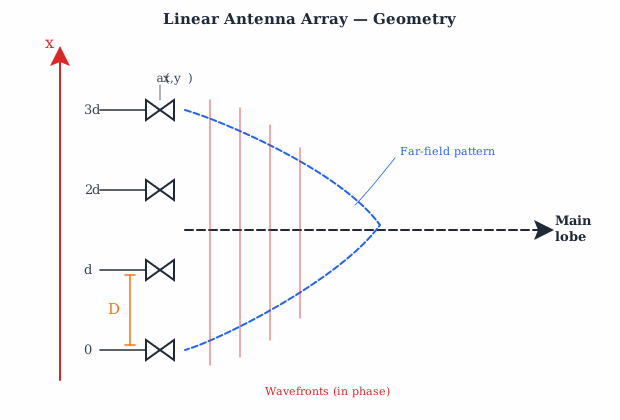
For the general case of a linear array of arbitrary shaped antennas with shape $a(x,y)$ we have:
$$ \Rightarrow t(x,y) = a(x,y) * \left[\text{samp}(x)\right] $$where $\text{samp}(x)$ is some sampling function (not necessarily equally spaced delta functions) of finite length.
From the convolution theorem, we simply have:
$$ I\left(\frac{\cos\theta}{\lambda}, \frac{\cos\phi}{\lambda}\right) = \left| A\left(\frac{\cos\theta}{\lambda}, \frac{\cos\phi}{\lambda}\right) \right|^2 \cdot \left| \mathcal{FF}\{\text{samp}(x)\} \right|^2 $$$$ = \underbrace{\text{Antenna Factor}}_{\text{Antenna Factor}} \times \underbrace{\text{Array Factor}}_{\text{Array Factor}} $$Array Theorem
The array theorem for antennas simply states:
The pattern which results from a linear array of antennas is given by the product of the antenna factor (pattern from a single antenna) and the array factor (pattern resulting from antennas considered as point sources).
Intensity with Direction Cosines
Since we have:
$$ I\left(\frac{\cos\theta'}{\lambda}, \frac{\cos\phi}{\lambda}\right) = \left(\frac{1}{\lambda z}\right)^2 \left| T\mathcal{FF}\{t(x,y)\}\bigg|_{\xi=\frac{\cos\theta}{\lambda}, \eta=\frac{\cos\phi}{\lambda}} \right|^2 $$And the Fourier shift theorem states:
$$ \mathcal{FF}\{t(x,y)e^{j2\pi\alpha x}\} = T\left(\frac{\cos\theta}{\lambda} - \alpha, \frac{\cos\phi}{\lambda}\right) $$$$ = T\left(\frac{\cos\theta - \cos\theta'}{\lambda}, \frac{\cos\phi}{\lambda}\right) $$where $\alpha = \frac{\cos\theta'}{\lambda}$
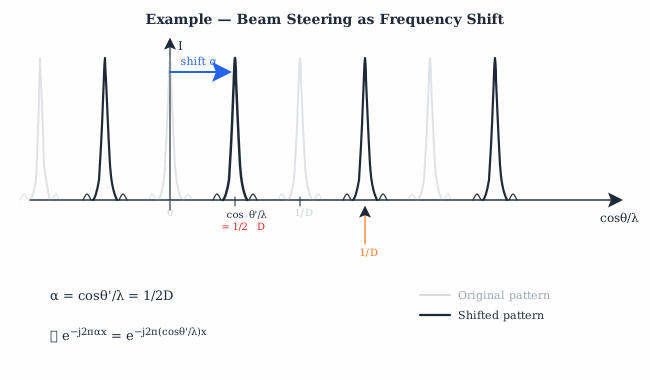
Setting $\alpha = \frac{\cos\theta'}{\lambda} = \frac{1}{2D}$ shifts the entire array factor pattern by half the grating lobe spacing. The linear phase applied across the array elements produces this shift in the far-field:
$$ e^{-j2\pi\alpha x} = e^{-j2\pi\frac{\cos\theta'}{\lambda}x} = e^{-j\pi\frac{x}{D}} $$At element positions $x = MD$ (where $M$ is the integer array number):
$$ e^{-jM\pi} = [+1,\; -1,\; +1,\; -1,\; \ldots] $$So for this steering angle, each element simply alternates sign — a 180° phase flip on every other antenna.
Phase Delay Beam Steering
Then by simply providing a phase delay from one receiver (or transmitter) to the other, we can steer the beam.
The scan range and beam resolution are independent quantities determined by:
| Quantity | Expression | Meaning |
|---|---|---|
| Largest scan angle | $\frac{1}{D}$ | Grating lobe spacing — set by element spacing $D$ |
| Size of single lobe | $\frac{1}{MD}$ | Beam width — set by total aperture $MD$ |
| Number of unique scan directions | $M = \frac{1/D}{1/MD}$ | Equals the number of elements |
The width of a beam (given by diffraction) is reduced by the overall array size, and the angular range (given by maximum angle in which aliasing has not occurred) are independent quantities.
Phased Array Implementation
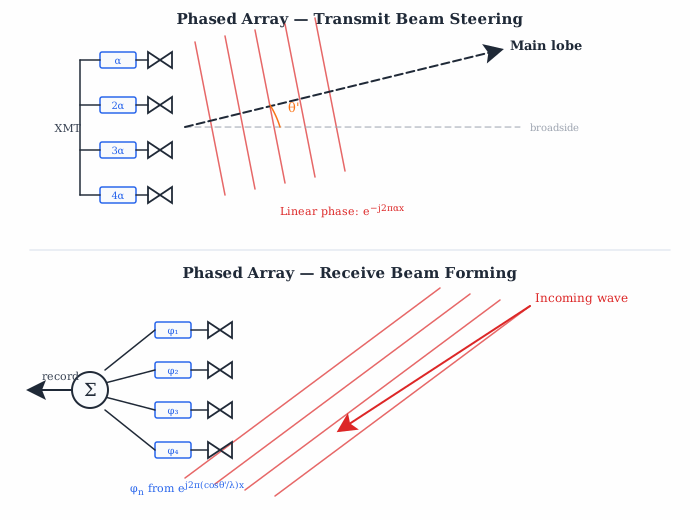
In transmit, each element is fed through a progressive phase shift ($\alpha, 2\alpha, 3\alpha, 4\alpha$), tilting the combined wavefront and steering the main lobe to angle $\theta'$.
Fixed phase delays can be introduced by varying lengths of coax or transmission line to each element, but this only steers to one fixed direction. If the phase is varied electronically (e.g., with voltage-controlled phase shifters), the beam can be steered without moving the antennas — enabling rapid, agile beam scanning.
Phased Array Receiving
Equivalent Large Antenna
In receiving, if we record a sum of all antennas with a given linear phase shift, we have the equivalent of a large antenna pointed at a specific direction.
A plane wave arriving from angle $\theta'$ reaches each array element at a different time. For element $k$ at position $x_k$, the path-length difference relative to the reference element is $x_k \cos\theta'$, giving a time delay $\tau_k = \frac{x_k \cos\theta'}{c}$. The relative time delay is thus proportional to the relative displacement of the receiving antenna — which is exactly the phase $\phi_k = \omega\tau_k = 2\pi\frac{\cos\theta'}{\lambda}x_k$ that the beam former must compensate to coherently sum the signals.
Digital Beam Forming
The received signals pass through phase shifters $\phi_1$ to $\phi_4$ (from $e^{j2\pi\frac{\cos\theta'}{\lambda}x}$) and are summed at $\Sigma$ to coherently combine the signal arriving from direction $\theta'$.
If each antenna is recorded independently, the phase shifts $\phi_1$–$\phi_N$ can be applied after the fact by a digital computer. By changing the phases and replaying the recordings, the beam can be steered to any direction in post-processing — no hardware reconfiguration needed. This also means a single recording can be re-processed for every angle, producing a complete angular image (as shown in the DFT example below).
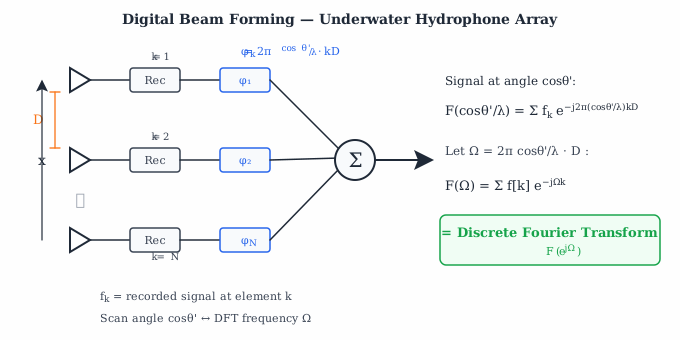
Each of $N$ hydrophone elements (spaced by $D$) independently records its signal $f_k$. To steer to angle $\theta'$, apply phase shift $\phi_k = 2\pi\frac{\cos\theta'}{\lambda}kD$ and sum:
$$ F\left(\frac{\cos\theta'}{\lambda}\right) = \sum_{k=1}^{N} f_k \exp\left[-j2\pi \frac{\cos\theta'}{\lambda} kD\right] $$Letting $\Omega = 2\pi\frac{\cos\theta'}{\lambda}D$:
$$ F(\Omega) = \sum_{k=1}^{N} f[k]\, e^{-j\Omega k} = F(e^{j\Omega}) $$This is exactly the Discrete Fourier Transform. Steering the array to different angles is equivalent to evaluating the DFT at different frequency bins — each scan direction $\cos\theta'$ maps to a DFT frequency $\Omega$.
Adaptive Beam Forming and Nulling
Angular Image of Energy
In this way, an angular image of the energy can be produced:
$$ \text{Signal at angle } \cos\theta_1: \sum_{k=1}^{N} f_k(t) e^{j2\pi \frac{\cos\theta_1}{\lambda} k\Delta} $$where:
- $D$ = spacing between antennas
- $N$ = number of antennas
Adaptive Beam Forming and Nulling
Goal: Choose phases that place null on top of noise source
$$ \text{Signal at any angle } \cos\theta_p: \sum_{k=1}^{N} f_k(t) e^{j\pi \frac{\cos\theta_p}{\lambda} k\Delta} $$The summation $\sum_{k=1}^{N} f_k(t)\, e^{j2\pi \frac{\cos\theta_p}{\lambda} k\Delta}$ is a discrete Fourier transform: the spatial samples $f_k$ at positions $k\Delta$ are the input, and the angular variable $\cos\theta_p / \lambda$ plays the role of frequency. Each output bin corresponds to a different look direction. This is why an FFT can replace the entire phase-shift-and-sum operation — the spatial→angular transform is identical in structure to the time→frequency DFT.
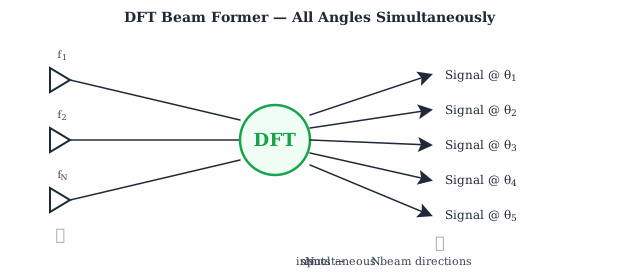
Since beam forming is a DFT, all $N$ scan directions can be computed at once. The $N$ recorded element signals go in; $N$ simultaneous beam outputs — one per angular bin — come out. An FFT computes the full angular image in a single pass, with no need to sweep angles sequentially.
System for “Imaging” Sources
Thus, we have a system for “imaging” sources:
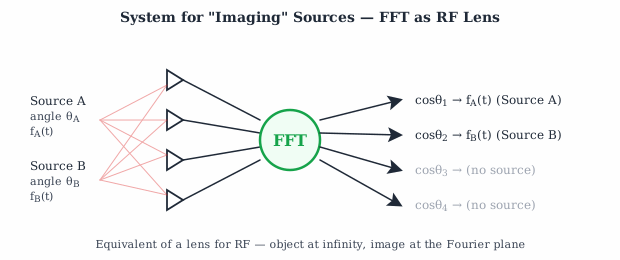
The phased array + DFT beam former is the RF equivalent of an optical lens. In optics, a lens takes a plane wave from a distant source and focuses it to a point in the focal (Fourier) plane — performing a continuous Fourier transform of the aperture field. The phased array does exactly the same thing digitally: sources at infinity produce plane waves across the array, and the FFT maps each arrival angle to a distinct output bin. The array is the aperture, the FFT is the lens, and the output bins are the focal plane.
Array Configurations
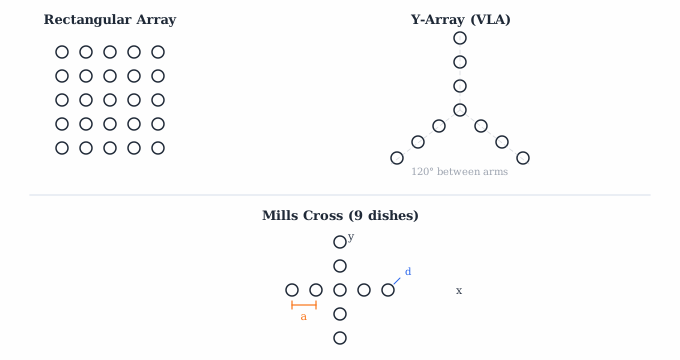
Rectangular Array: Full 2D grid — best spatial frequency coverage but requires the most elements ($N^2$ for an $N \times N$ grid).
Y-Array (e.g., the Very Large Array, New Mexico): The VLA uses 27 dishes in a Y-shaped configuration, with elements movable along railroad tracks to adjust spacing. A Y-array provides better 2D spatial frequency ($(u,v)$) coverage than a simple cross, since three arms at 120° fill more of the Fourier plane. Each dish records independently; a correlator computes the spatial Fourier transform across all baselines, producing a radio image of the sky — exactly the “FFT as RF lens” described above.
Mills Cross (9 antenna dishes): Two perpendicular linear arrays sharing a central element. Only $2N - 1$ elements needed for $N \times N$ equivalent coverage, at the cost of higher side lobes. Element spacing $a$, dish diameter $d$.
Calculation for Mills Cross
$$ \rho(x,y) = \left[\delta(x) \cdot \text{comb}\left(\frac{y}{a}\right) \cdot \text{rect}\left(\frac{y}{5a}\right)\right] ** \text{cyl}\left(\frac{\sqrt{x^2+y^2}}{d}\right) \quad \leftarrow I $$$$
- \left[\text{comb}\left(\frac{x}{a}\right)\delta(y) \cdot \text{rect}\left(\frac{x}{5a}\right)\right] ** \text{cyl}\left(\frac{\sqrt{x^2+y^2}}{d}\right) \quad \leftarrow II $$
Fourier Transforming
$$ I \Rightarrow \left[5a \cdot \text{comb}\left(\frac{a\cos\phi}{\lambda}\right) * \text{sinc}\left(\frac{5a\cos\phi}{\lambda}\right)\right] \cdot \frac{\pi d^2}{4}\text{somb}\left(d\sqrt{\left(\frac{\cos\theta}{\lambda}\right)^2 + \left(\frac{\cos\phi}{\lambda}\right)^2}\right) $$$$ II \Rightarrow \left[5a^2\text{comb}\left(\frac{a\cos\theta}{\lambda}\right) * \text{sinc}\left(\frac{5a\cos\theta}{\lambda}\right)\right] \cdot \frac{\pi d^2}{4}\text{somb}\left(d\sqrt{\left(\frac{\cos\theta}{\lambda}\right)^2 + \left(\frac{\cos\phi}{\lambda}\right)^2}\right) $$$$ III \Rightarrow \left[\frac{\pi d^2}{4}\text{somb}\left(d\sqrt{\left(\frac{\cos\theta}{\lambda}\right)^2 + \left(\frac{\cos\phi}{\lambda}\right)^2}\right)\right] $$Mills Cross - Complete Solution
Combined Result
$$ \implies I + II - III \Rightarrow \left[5a^2 \text{comb}\left(\frac{a\cos\phi}{\lambda}\right) * \text{sinc}\left(\frac{5a\cos\phi}{\lambda}\right) + 5a^2 \text{comb}\left(\frac{a\cos\theta}{\lambda}\right) * \text{sinc}\left(\frac{5a\cos\theta}{\lambda}\right) - 1\right] $$$$ = \left\{5a\sum_{n=-\infty}^{\infty} \text{sinc}\left[5a\left(\frac{\cos\phi}{\lambda} - \frac{n}{a}\right)\right] + 5a\sum_{n=-\infty}^{\infty} \text{sinc}\left[5a\left(\frac{\cos\theta}{\lambda} - \frac{n}{a}\right)\right] - 1\right\} $$$$ \cdot \frac{\pi d^2}{4}\text{somb}\left(d\sqrt{\left(\frac{\cos\theta}{\lambda}\right)^2 + \left(\frac{\cos\phi}{\lambda}\right)^2}\right) $$Pattern Analysis
The pattern shows:
- Antenna factor: Overall envelope from somb function
- Array Factor: Grid of peaks from the cross pattern
- Width of line = $\frac{1}{5a}$
The diagram shows the pattern in $\frac{\cos\theta}{\lambda}$ vs $\frac{\cos\phi}{\lambda}$ space, with the antenna factor providing the overall envelope.
VLBI — Very Long Baseline Interferometry
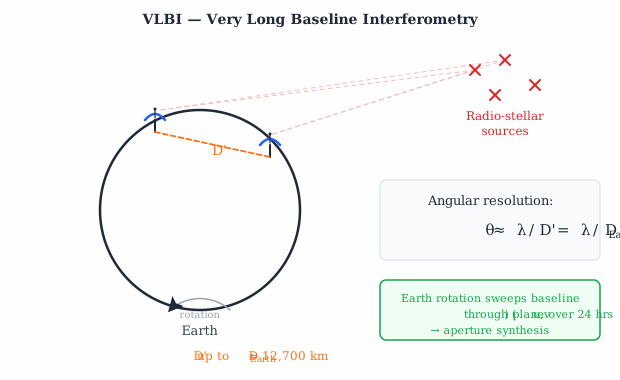
VLBI extends the phased array concept to radio telescopes separated by continental or intercontinental distances. Each telescope independently records the incoming signal along with a precise time reference (atomic clock). The recordings are later correlated to synthesize an array with baseline $D'$ up to the diameter of the Earth.
Angular Resolution
$$ \theta \approx \frac{\lambda}{D'} = \frac{\lambda}{D_\text{Earth}} $$Since $D_\text{Earth} \approx 1.3 \times 10^9$ cm, VLBI achieves extraordinary angular resolution at radio wavelengths — far exceeding any single dish or compact array like the VLA.
A sub-milliarcsecond beam from an Earth-sized aperture — sufficient to resolve structure in distant radio-stellar sources.
Earth-Rotation Aperture Synthesis
As the Earth rotates, the baseline vector between two telescopes traces out an ellipse in the $(u,v)$ plane over 24 hours. This fills in spatial frequency coverage that a static array of just two elements could never provide. The key insight: Earth’s rotation turns a sparse array into a well-sampled 2D aperture — the same Fourier relationship between aperture and far-field pattern applies, just sampled over time rather than space.
VLBI is the radio astronomy equivalent of the “FFT as RF lens” system described earlier: radio-stellar sources at infinity are imaged by computing the spatial Fourier transform across all baselines.
Synthetic Aperture Radar (SAR)
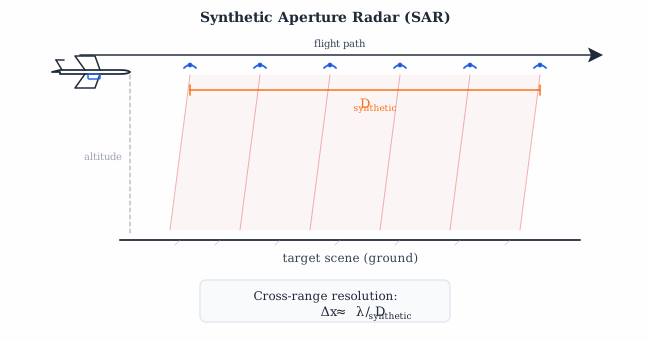
SAR applies the same aperture synthesis principle to radar on a moving platform (ship, aircraft, or satellite). A single antenna transmits and receives pulses at successive positions along its track. By coherently combining the returns — applying the appropriate phase shifts for each position — the system synthesizes an aperture equal to the length of the track traversed.
Resolution
$$ \Delta x \approx \frac{\lambda}{D_\text{synthetic}} $$where $D_\text{synthetic}$ is the length of the synthetic aperture (total distance traveled during data collection). A small physical antenna on a moving platform can achieve the same cross-range resolution as a stationary array spanning the entire track length.
SAR is the radar analogue of VLBI earth-rotation synthesis: platform motion replaces Earth rotation, but the underlying Fourier relationship between aperture and resolution is identical.
Non-Uniform Arrays
Arrays chosen with random position to reduce sidelobes:
Regular array of $N$ radiators:
- Sharp peaks with regular sidelobe pattern
- Predictable grating lobes
Randomly spaced array of $N$ radiators:
- Main beam preserved
- Sidelobes reduced and spread out
- No distinct grating lobes
Mills Cross (Goodman’s Notation)
Configuration
        o
        o ↑a
    d ↗ o  o  o  o  o
        o
        o
Calculation
$$ \rho(x,y) = \left[\delta(x) \cdot \text{comb}\left(\frac{y}{a}\right) \cdot \text{rect}\left(\frac{y}{5a}\right)\right] * \text{circ}\left(\frac{\sqrt{x^2+y^2}}{d/2}\right) \quad \leftarrow I $$$$
- \left[\text{comb}\left(\frac{x}{a}\right)\delta(y) \cdot \text{rect}\left(\frac{x}{5a}\right)\right] * \text{circ}\left(\frac{\sqrt{x^2+y^2}}{d/2}\right) \quad \leftarrow II $$
Fourier Transforming
$$ I: \left\{5a^2 \text{comb}\left(\frac{a\cos\phi}{\lambda}\right) * \text{sinc}\left[\frac{5a\cos\phi}{\lambda}\right]\right\} \cdot \frac{dJ_1(\pi d\rho')}{2\rho'} $$where $\rho' = \sqrt{\left(\frac{\cos\theta}{\lambda}\right)^2 + \left(\frac{\cos\phi}{\lambda}\right)^2}$
$$ II: \left\{5a^2 \text{comb}\left[\frac{a\cos\theta}{\lambda}\right] * \text{sinc}\left[\frac{5a\cos\theta}{\lambda}\right]\right\} \cdot \frac{dJ_1(\pi d\rho')}{2\rho'} $$$$ III: \left\{\frac{dJ_1(\pi d\rho')}{2\rho'}\right\} $$$$ I + II - III \Rightarrow \left\{5a\sum_{n=-\infty}^{\infty}\text{sinc}\left[5a\left(\frac{\cos\phi}{\lambda} - \frac{n}{a}\right)\right] + 5a\sum_{n=-\infty}^{\infty}\text{sinc}\left[5a\left(\frac{\cos\theta}{\lambda} - \frac{n}{a}\right)\right] - 1\right\} \cdot \frac{dJ_1(\pi d\rho')}{2\rho'} $$Mills Cross - Pattern Diagram
Two-Dimensional Pattern
The Mills Cross produces a characteristic pattern in $\left(\frac{\cos\theta}{\lambda}, \frac{\cos\phi}{\lambda}\right)$ space:
!mills_cross_pattern.svg
Key Features
- Array Factor: Grid pattern from the cross arrangement of antennas
- Antenna Factor: Circular envelope from individual dish antennas
- Line width: $\frac{1}{5a}$ (determined by the total extent of the array)
- Line spacing: $\frac{1}{a}$ (determined by the spacing between antennas)
The resulting beam pattern is the product of the array factor (grid) and antenna factor (circular envelope).
Fourier Transform Property of a Lens
Setup
Consider a thickness spherical lens:
| Parameter | Value |
|---|---|
| Gaskill | 10-3 |
| Goodman | 5-9 |
| Cathey | 5-9 |
- Maximum thickness = $\Delta_0$
- Index of refraction = $n$
- Thickness at $(x,y)$ = $\Delta(x,y)$
Phase Delay Through a Lens
Phase delay of wave through a region of refractive index $n$:
$$ \text{Recall } e^{jk'r} \Rightarrow k'r \text{ gives the phase of propagation} $$$$ \text{But } k' = \frac{\omega}{c'} = \frac{\omega n}{c_0} \quad \text{since } n = \frac{c_0}{c'} = \frac{\text{free space velocity}}{\text{velocity}} $$$$ \implies \underbrace{\phi}_{\text{phase}} = k'r = \frac{\omega n}{c_0} \cdot r = kn \cdot r, \quad \text{where } k = \frac{\omega}{c_0} $$(Free space wavenumber)
The phase delay suffered by a wave traveling from $U_e$ to $U_i$ is:
where $\Delta(x,y)$ is thickness function of lens
Lens Thickness Function
Phase-Only Transmittance Function
$$ \Rightarrow t_\ell(x,y) \triangleq e^{j\phi(x,y)} = \exp[jk\Delta_0]\exp[jk(n-1)\Delta(x,y)] $$This is a phase-only function.
We assume a “thin lens”, so that we have the field behind the lens given by:
$$ u^+(x,y) = u^-(x,y)t(x,y) = u^-(x,y)\exp[jk\Delta_0]\exp[jk(n-1)\Delta(x,y)] $$Calculating the Thickness Function $\Delta(x,y)$
Split lens into two parts:
Convention: Convex surfaces have positive radii of curvature; concave surfaces have negative radii - for light traveling from left to right.
Left Half of Lens
- Radius $R_1$
- Center at $R_1 - x_1 - y_1$
Right Half of Lens
- Radius $-R_2$
- Center at $\sqrt{R_2^2 - x^2 - y^2}$
(Recall $R_2$ is a negative number by convention)
$$ \Rightarrow \Delta(x,y) = \Delta_1(x,y) + \Delta_2(x,y) $$and:
$$ \Delta_1(x,y) = \Delta_{01} - \left(R_1 - \sqrt{R_1^2 - x^2 - y^2}\right) $$$$ = \Delta_{01} - R_1\left(1 - \sqrt{1 - \frac{x^2+y^2}{R_1^2}}\right) $$$$ \Delta_2(x,y) = \Delta_{02} - \left(-R_2 - \sqrt{R_2^2 - x^2 - y^2}\right) $$$$ = \Delta_{02} - \left(-R_2 + R_2\sqrt{\frac{R_2^2 - x^2 - y^2}{(-R_2)^2}}\right) \leftarrow \text{factor out } -R_2 \text{ and this is a positive number} $$$$ = \Delta_{02} + R_2\left(1 - \sqrt{1 - \frac{x^2+y^2}{R_2^2}}\right) $$Lens Thickness Function - Complete Derivation
Total Thickness Function
$$ \boxed{\Delta(x,y) = \Delta_1(x,y) + \Delta_2(x,y) \approx \Delta_0 - R_1\left(1 - \sqrt{1 - \frac{x^2+y^2}{R_1^2}}\right) + R_2\left(1 - \sqrt{1 - \frac{x^2+y^2}{R_2^2}}\right)} $$where $\Delta_0 = \Delta_{01} + \Delta_{02}$
Paraxial Ray Approximation
Assume deviation from center $(x,y)$ is small, so $x^2 + y^2 << R^2$:
$$ \Rightarrow \sqrt{1 - \frac{x^2+y^2}{R_1^2}} \approx 1 - \frac{x^2+y^2}{2R_1^2} $$and
$$ \sqrt{1 - \frac{x^2+y^2}{R_2^2}} \approx 1 - \frac{x^2+y^2}{2R_2^2} $$(Paraxial rays)
Approximate Thickness Function
Then we have:
$$ \boxed{\Delta(x,y) = \Delta_0 - R_1\left(\frac{x^2+y^2}{2R_1^2}\right) + R_2\left(\frac{x^2+y^2}{2R_2^2}\right) = \Delta_0 - \frac{x^2+y^2}{2}\left(\frac{1}{R_1} - \frac{1}{R_2}\right)} $$Lens Transmittance Function
$$ \implies t_\ell(x,y) = \exp[jk\Delta_0]\exp\left[jk(n-1)\left(\Delta_0 - \frac{x^2+y^2}{2}\left(\frac{1}{R_1} - \frac{1}{R_2}\right)\right)\right] $$$$ = \exp[jk\Delta_0]\exp\left[jk(n-1)\Delta_0\right]\exp\left[-jk(n-1)\frac{(x^2+y^2)}{2}\left(\frac{1}{R_1} - \frac{1}{R_2}\right)\right] $$$$ = \exp[jkn\Delta_0]\exp\left[-jk(n-1)\frac{(x^2+y^2)}{2}\left(\frac{1}{R_1} - \frac{1}{R_2}\right)\right] $$Lens Focal Length and Transmittance Function
Lens Maker’s Formula
Define the focal length of a lens as:
$$ \boxed{\frac{1}{f} \triangleq (n-1)\left(\frac{1}{R_1} - \frac{1}{R_2}\right)} $$Lens Maker’s Formula
Transmittance Function for a Thin Lens
Then we have:
$$ \boxed{t_\ell(x,y) = \exp[jkn\Delta_0]\exp\left[-j\frac{k}{2f}(x^2+y^2)\right]} $$Transmittance Function For a Thin Lens Using The Paraxial Ray Approximation
Meaning of Transmittance Function $t_\ell(x,y)$
$\exp[jkn\Delta_0]$ is a constant phase delay of little interest
$\exp\left[-j\frac{k}{2f}(x^2+y^2)\right]$ is a quadratic approximation to a converging spherical wave, converging at the point $z = f$.
         ← z₂ parabolic
           surface
    ↗  (    )
   (  ( z=f )  → z
    ↘  (    )
   z₁
The quadratic phase factor represents a parabolic approximation to a spherical wavefront converging to the focal point.
Setup
Normal       ↗            u_f(x',y')
Incidence  [lens]           ↗
Plane    → t_e+t_ℓ(x,y)     z = f
wave A   →
         ↗ p(x,y)
      t_0(x,y)
where we have dropped the constant phase term $t_\ell(x,y)$.
Field at the Focal Plane
To calculate the field at $z = f$ we use the Fresnel diffraction formula:
$$ u_f(x',y')\bigg|_{z_e=f} = \underbrace{\frac{\exp\{jkf\}}{j\lambda f}}_{z_e=f} \exp\left\{j\frac{k(x'^2+y'^2)}{2f}\right\} \iint u^+(x,y)\exp\left\{j\frac{k(x^2+y^2)}{2f}\right\} \exp\left\{-j\frac{2\pi}{\lambda f}(xx'+yy')\right\} dx\,dy $$(Fourier Transform Form)
Substituting for $u^+(x,y)$:
$$ u_f(x',y')\bigg|_{z_e=f} = \frac{\exp\left\{j\frac{k(x'^2+y'^2)}{2f}\right\}}{j\lambda f} \iint A\,t_0(x,y)\,p(x,y)\exp\left\{-j\frac{k}{2f}(x^2+y^2)\right\}\exp\left\{j\frac{k(x^2+y^2)}{2f}\right\} \exp\left\{-j\frac{2\pi}{\lambda f}(xx'+yy')\right\} dx\,dy $$$$ = A\frac{\exp\left\{jk\frac{(x'^2+y'^2)}{2f}\right\}}{j\lambda f} \iint_{-\infty}^{\infty} t_0(x,y)\,p(x,y)\exp\left\{-j\frac{2\pi}{\lambda f}(xx'+yy')\right\} dx\,dy $$Lens as Fourier Transform System
Simplified Result
If the object $t_0(x,y)$ is smaller than the lens aperture, we can neglect $p(x,y)$. Then:
$$ u_f(x',y')\bigg|_{z_e=f} = A\frac{\exp\left\{jk\frac{(x'^2+y'^2)}{2f}\right\}}{j\lambda f} \mathcal{FF}\{t_0(x,y)\}\bigg|_{\xi=\frac{x'}{\lambda f}, \eta=\frac{y'}{\lambda f}} $$If we measure the intensity at $z_0 = f$ we have:
$$ I_f(x',y')\bigg|_{z=f} = u_e u_e^* = \frac{A^2}{\lambda^2 f^2}\left|\mathcal{FF}\{t_0(x,y)\}\right|^2_{\xi=\frac{x'}{\lambda f}, \eta=\frac{y'}{\lambda f}} $$This is the Fourier Power Spectrum
The intensity in the back focal plane is directly proportional to the Fourier power spectrum of the transparency $t_0(x,y)$.
Object Placed in Front of the Lens
(at distance $d$)
      d_0
    ↗    ↖← f →↗ y'
  (      )      x'
t_0(x,y)
- Object: $t_0(x,y)$
- Angular plane wave spectrum of object: $\mathcal{FF}\{At_0(x,y)\} = F(\xi,\eta)$
We can calculate the plane wave spectrum at the lens by multiplying by the Fresnel operator to transfer from $\xi = \frac{x}{\lambda}$, $\eta = \frac{y}{\lambda}$:
Object in Front of Lens - Field Calculation
Fresnel Transfer to Lens
$$ \implies F(\xi,\eta) = \left[F_0(\xi,\eta) \cdot \exp\left\{jkd_0\left[1 - \frac{\lambda^2}{2}(\xi^2+\eta^2)\right]\right\}\right] $$$$ = F_0(\xi,\eta) \cdot \exp[-j\pi\lambda d_0(\xi^2+\eta^2)] $$where we leave out $\exp[jkd_0]$ term since it is a constant.
Field at Focal Plane
From the object against the lens calculation, we have:
$$ u_f(x',y')\bigg|_{\substack{\text{Field at focal} \\ \text{pt. at lens}}} = \exp\left[j\frac{k}{2f}(x'^2+y'^2)\right] \cdot \frac{\mathcal{FF}\{At_0(x,y)\}}{j\lambda f}\bigg|_{\xi=\frac{x'}{\lambda f}, \eta=\frac{y'}{\lambda f}} $$$$ = \frac{\exp\left[j\frac{k}{2f}(x'^2+y'^2)\right]}{j\lambda f} F_0\left(\frac{x'}{\lambda f}, \frac{y'}{\lambda f}\right) $$where $F_0$ is the angular plane wave spectrum.
$$ \implies u_f(x',y') = \frac{\exp\left[j\frac{k}{2f}(x'^2+y'^2)\right]}{j\lambda f} \exp\left[-j\pi\lambda d_0\left(\frac{x'^2+y'^2}{\lambda^2 f^2}\right)\right] F_0\left(\frac{x'}{\lambda f}, \frac{y'}{\lambda f}\right) $$$$ = \frac{1}{j\lambda f}\exp\left[j\frac{k}{2f}\left(1 - \frac{d_0}{f}\right)(x'^2+y'^2)\right] F_0\left(\frac{x'}{\lambda f}, \frac{y'}{\lambda f}\right) $$$$ \Rightarrow u_f(x',y') = \frac{A}{j\lambda f}\exp\left[j\frac{k}{2f}\left(1 - \frac{d_0}{f}\right)(x'^2+y'^2)\right] \iint t_0(x,y)\exp\left[j\frac{2\pi}{\lambda f}(xx'+yy')\right] dx\,dy $$Special Case: $f = d_0$
Note: If $f = d_0$ we have:
$$ u_f(x',y') = \frac{A}{j\lambda f}\iint t_0(x,y)\exp\left[-j\frac{2\pi}{\lambda f}(xx'+yy')\right] dx\,dy $$This is exactly the Fourier Transform.
Transform variables: $x \to x$, $y \to z$, $\frac{x'}{\lambda f} \to \xi$, $\frac{y'}{\lambda f} \to \eta$
Fourier Transform Pairs
    1                              δ(x,y)
    ↓     [lens]                    ↓     [lens]
   ←f→    δ(x,y)                   ←f→      1

𝓕{1} = δ(x,y)     Fourier Transform     𝓕{δ(x,y)} = 1
                       Pairs
Shift Theorem
       y
    x ↙  h ↘  f
         δ(x-h)  φ
Note however that this is just a plane wave, since a plane wave can be written as:
$$ \exp\left[-j2\pi\frac{\cos\theta}{\lambda}x'\right] = \exp\left[-j2\pi\frac{\sin\phi}{\lambda}x'\right] $$Connection to Geometrical Optics
From geometrical optics, we note that the ray parallel to the optical axis must be directed through the back focal point.
Hence, we see immediately that $\tan\phi = \frac{h}{f} \approx \phi$.
This result is identical to Fourier optics approach in the paraxial approximation.
Setup
         ↗x
      (  )f(  )     x'
    ←x→     f    →x'←
      d₀
Spherical Wave in Focal Plane
$$ \exp\left[-j\frac{\pi r'^2}{\lambda R}\right] = \exp\left[-j\frac{\pi r'^2}{\lambda x'}\right] $$where $r' = \sqrt{x'^2 + y'^2}$
Imaging Formula
Use imaging formulae to locate focal point:
$$ \frac{1}{d_0} + \frac{1}{d_i} = \frac{1}{f} $$or: $\quad xx' = f^2$ (Newtonian imaging formula)
$$ \implies x' = \frac{f^2}{x} = R \quad (x = d_0 - f, \quad x' = d_i - f) $$Spherical Wave Expression
And spherical wave becomes:
$$ \exp\left[-j\frac{\pi r'^2 x}{\lambda f^2}\right] $$$$ = \exp\left[-j\frac{\pi r'^2(d_0 - f)}{\lambda f \cdot f}\right] $$$$ = \exp\left[+j\frac{\pi r'^2}{\lambda f}\left(1 - \frac{d_0}{f}\right)\right] = \exp\left[j\frac{k}{2f}\left(1 - \frac{d_0}{f}\right)(x'^2+y'^2)\right] $$Note: This is exactly the quadratic phase term predicted for an object “d” in front of a lens, observed in back focal plane:
$$ u(x',y') = \frac{A}{j\lambda f}\exp\left[j\frac{k}{2f}\left(1 - \frac{d_0}{f}\right)(x'^2+y'^2)\right] $$$$ \times \iint t_0(x,y)\exp\left[-j\frac{2\pi}{\lambda f}(xx'+yy')\right] dx\,dy $$↑ focal plane coordinates, ↑ object plane coordinates
Physical Interpretation
The Fourier Transform property can be thought of as simply:
Fraunhofer diffraction at infinity followed by an imaging system to image light from $\infty$ to a finite observation plane.
Limiting Case
Of course,
$$ \frac{1}{d_0} + \frac{1}{d_i} = \frac{1}{f} $$So if $d_0 = \infty$:
- $d_i = f$
- The Fraunhofer pattern at $\infty$ is reimaged at the back focal plane of the lens.
This explains why the Fourier transform appears at the back focal plane: the lens images the far-field (Fraunhofer) diffraction pattern from infinity to the focal plane.
Example: Particle Size Detection
Consider two particles (circles) at points $(a,b)$ and $(c,d)$.
!particle_coordinates.svg
Fourier Power Spectrum
Fourier power spectrum gives by:
$$ \left| \frac{\alpha J_1(2\pi\alpha\sqrt{f_x^2+f_y^2})}{\sqrt{f_x^2+f_y^2}} e^{j\pi(af_x+bf_y)} + \frac{\alpha J_1(2\pi\alpha\sqrt{f_x^2+f_y^2})}{\sqrt{f_x^2+f_y^2}} e^{j\pi(cf_x+df_y)} \right|^2 $$$$ = 2\left(\frac{\alpha J_1(2\pi\alpha\sqrt{f_x^2+f_y^2})}{\sqrt{f_x^2+f_y^2}}\right)^2 + 2\left(\frac{\alpha J_1(2\pi\alpha\sqrt{f_x^2+f_y^2})}{\sqrt{f_x^2+f_y^2}}\right) \cos(2\pi[(a-c)f_x + (b-d)f_y]) $$$$ = \underbrace{\text{independent of particle position}}_{\text{of particle position}} + \underbrace{\text{sum of random cosines}}_{\Rightarrow \text{noise}} $$Distribution Vector
If scene consists of:
- $N_1$ particles of size $d_1$
- $N_2$ of size $d_2$
- …
- $N_L$ of size $d_L$
We can express this answer by a distribution vector:
$$ \underline{N} = (N_1, \cdots, N_L)^T $$Particle Size Distribution - Matrix Formulation
Total Power Spectrum
If $G_i(f_x)$, $i = 1, L$ is the diffraction pattern produced by a single particle of size $d_i$, total power spectrum is:
$$ H(f_x) = \sum_{i=1}^{L} N_i G_i(f_x) + \underbrace{\eta(f_x)}_{\text{noise}} $$Matrix Notation
Sample $f_x$ at discrete frequencies $f_{x_1}, f_{x_2}, \ldots, f_{x_N}$
$$ \Rightarrow \underline{H} = \underline{\underline{G}}\underline{N} + \underline{\eta} \quad \leftarrow \text{(Shaw Stark, 177, 178)} $$Solution Methods
- Filter result to remove $\underline{\eta}$
- Invert by pseudoinverse to solve for $\underline{N}$
$\underline{\underline{G}}$ is not square and has no inverse
$$ \underline{\underline{G}}^+\underline{H} = (\underline{\underline{G}}^+\underline{\underline{G}})\underline{N} $$$$ (\underline{\underline{G}}^+\underline{\underline{G}})^{-1}\underline{\underline{G}}^+\underline{H} = \underline{N}_{LS} $$(Shaw Stark, pg 177-178)
This gives the Least Squares solution for the particle size distribution.
Feature Selection
Goal: We desire to choose a small number of features that are important for pattern recognition.
!feature_selector.svg
Linear Transforms for Feature Extraction
Can we use linear transforms to extract features?
!linear_transform_pipeline.svg
Dimensionality Reduction Example
Example of dimensionality reduction: Choose M data pts. with highest values.
Optimization of Linear Transform
Objective
Choose transform that minimizes the mean-square error when M features are used to regenerate (approx.) original image pts.
!inverse_linear_transform.svg
Mean Square Error (MSE)
$$ \text{MSE} = \left\langle \left| \underbrace{f'(x,y)}_{\substack{\text{Reconstructed} \\ \text{image from} \\ \text{M features}}} - \underbrace{f(x,y)}_{\substack{\text{Original} \\ \text{image}}} \right|^2 \right\rangle $$Karhunen-Loève Transform
Linear Transform that minimizes MSE:
$$ \rightarrow \text{Karhunen-Loève Transform} $$(sometimes called Hotelling Transform or Principal Component Analysis)
Properties
- K-L transform basis functions depend on statistics of image
- Basis functions are given by the eigenvectors of the autocorrelation matrix of the statistical process
If statistics are:
- Large SBP ($N^2 >> 1$)
- Stationary (Independent of position)
Then basis functions become complex exponentials
And linear transform is Fourier Transform
Examples (Shaw Stark, pg. 172)
Applications where Fourier Transform is useful:
- Handwriting
- Printed matter
- Homogeneous aerosols
- Forests, crops (maybe)
- Targets with equal probability of occurring anywhere in the image
Conclusion
Fourier Transform may be useful as a feature extractor when:
- Location is unknown or unimportant
- Important information is delocalized rather than localized (global rather than local) e.g. textures
- SBP is large and statistics are stationary
Examples Where F.T. is Useful
- Handwriting
- Train tracks, orchards
- Aerosol detection
Translational Invariance of Fourier Power Spectrum
!translational_invariance.svg
A shift in position only adds a phase factor to the Fourier transform, which disappears when taking the magnitude squared.
Wedge-Ring Detector
(Shaw Stark, pg 163)
!wedge_ring_detector.svg
The wedge-ring detector samples the Fourier plane in polar coordinates, providing:
- Rings for radial (frequency magnitude) information
- Wedges for angular (orientation) information
Key Properties
- Wedges are scale invariant
- Rings are rotationally invariant
- F.T. of real object is Hermitian so left half is same as right half
Thus, we can sample only half the transform without losing information.
(Shaw Stark, pg. 168)
Variations on Fourier Power Spectrum Sampling (Cont.)
Log-Polar Coordinate Distortion
!log_polar_distortion.svg
Coordinate Transformation
Note: $f(ar, \theta + \theta_0)$ becomes:
$$ f(\underbrace{\log r + \log a}_{x\text{-axis}}, \underbrace{\theta + \theta_0}_{y\text{-axis}}) $$Scale and rotation have been converted into an x-axis & y-axis shift.
Since the Fourier power spectrum is invariant to shifts in $x$ & $y$, the original object can change scale & orientation without affecting the feature.
Mellin Transform
- Transform in $\log(r)$ direction is a Mellin transform
- Features are no longer invariant to translation
(Shaw Stark, pg. 175 & 174)
Complete Invariance: Position, Scale, and Orientation
How to Include All Invariances?
Combining position invariance (as well as scale and orientation):
!complete_invariance_pipeline.svg
Invariance Properties
Translational Invariance: First Fourier transform + magnitude squared removes position dependence
Scale & Rotation Invariance:
- Power spectrum will inversely scale with object
- Power spectrum will rotate directly as object rotates
- Log-polar distortion converts these to shifts
- Second Fourier transform + magnitude squared removes scale and rotation dependence
This cascade of transforms provides features that are invariant to:
- Translation (position)
- Scale (size)
- Rotation (orientation)
Making it ideal for object recognition regardless of where, how big, or how oriented the object appears.
Setup
!telecentric_system.svg
Field at Each Plane
Consider:
- $t(x,y)$ in the object plane $(x_1, y_1)$
- Plane wave illumination of object $A$
From previous development, we know that at focal plane of first lens:
$$ u_2(x_2, y_2) = \frac{A}{j\lambda f_1} \mathcal{FF}\{t(x,y)\}\bigg|_{\xi=\frac{x_2}{\lambda f_1}, \eta=\frac{y_2}{\lambda f_1}} $$$$ = \frac{A}{j\lambda f_1} T\left(\frac{x_2}{\lambda f_1}, \frac{y_2}{\lambda f_1}\right) $$where $T\left(\frac{x_2}{\lambda f_1}, \frac{y_2}{\lambda f_1}\right) = \mathcal{FF}\{t(x,y)\}$
Field at Output Plane
We can equivalently calculate distribution in $(x_3, y_3)$ plane with same formula:
$$ u_3(x_3, y_3) = \left(\frac{A}{j\lambda f_1}\right)\left(\frac{1}{j\lambda f_2}\right) \iint T\left(\frac{x_2}{\lambda f_1}, \frac{y_2}{\lambda f_1}\right) \exp\left[-j\frac{2\pi}{\lambda f_2}(x_2 y_3 + y_2 y_3)\right] dx_2 dy_2 $$- Need inverse transform to return to $u_1$
- $T$ is function of $\frac{x_2}{\lambda f_1}$ and exp is function of $\frac{x_2}{\lambda f_2}$
Variable Substitution
$$ \Rightarrow i) \text{ Let } x_3 = -(-x_3) \text{ and } y_3 = -(-y_3) \text{ in exponential} $$$$ ii) \text{ Let } x_2 = f_1\left(\frac{x_2}{f_1}\right), \quad dx_2 = \lambda f_1 d\left(\frac{x_2}{\lambda f_1}\right), \quad y_2 = f_1\left(\frac{y_2}{f_1}\right) \text{ and } dy_2 = \lambda f_1 d\left(\frac{y_2}{\lambda f_1}\right) $$Then:
$$ u_3(x_3, y_3) = \frac{Af_1}{f_2} \iint T\left(\frac{x_2}{\lambda f_1}, \frac{y_2}{\lambda f_1}\right) \exp\left\{j2\pi f_1\left(\frac{x_2}{\lambda f_1}\right) + (-y_3)\frac{f_1}{f_2}\left(\frac{x_2}{\lambda f_1}\right)\right\} d\left\{\frac{x_2}{\lambda f_1}\right\} d\left\{\frac{y_2}{\lambda f_1}\right\} $$$$ = A\frac{f_1}{f_2} u_1\left(\frac{-f_1 x_3}{f_2}, \frac{-f_1 y_3}{f_2}\right) $$Magnification
Define a magnification $M = f_2/f_1$
Then:
$$ u_3(x_3, y_3) = \frac{A}{M} u_1\left(\frac{-x_3}{M}, \frac{-y_3}{M}\right) $$Notes:
- Intensity reduces by $M^2$ because area increases by $M^2$ - This is because a lens can only produce a forward Fourier transform, so we have $\mathcal{FF}\{\mathcal{FF}\{t(x,y)\}\} = t(-x,-y)$
- We can adjust $M$ by changing focal lengths. In particular, if $f_1 = f_2$, $M = 1$. This is a 1:1 imaging system.
Motion of Object & Image Planes
!lens_object_image.svg
$$ x_i = x_o \text{ when } M = 1 $$$$ x_i = M^2 x_o \text{ in general} $$Single Lens Imaging
Homework Problems: Goodman: 6-1, 6-3, Heskett
Impulse Response Formulation
Every superposition, we can state the response of a linear system as the sum of impulse responses at point sources:
$$ u_i(x_i, y_i) = \iint h(x_i, y_i; x_o, y_o) u_o(x_o, y_o) dx_o dy_o $$where $h$ is the response of the system to a point source at $x_o, y_o$
!single_lens_geometry.svg
Image Formation
For image formation, on impulse:
$$ h(x_i, y_i; x_o, y_o) = K\delta(x_i \pm Mx_o, y_i \pm My_o), \quad M = \frac{1}{\text{magnification}} $$Consider a point source at $(x_o, y_o)$:
The wave at the lens is a spherical wave, which under the paraxial approximation is written as:
$$ u_\ell(x,y) = \frac{1}{j\lambda d_o} \exp\left\{j\frac{k}{2d_o}[(x-x_o)^2 + (y-y_o)^2]\right\} $$After Passing Through the Lens
$$ u_\ell'(x,y) = u_\ell(x,y) \cdot \underbrace{p(x,y) \exp\left[-j\frac{k}{2f}(x^2+y^2)\right]}_{\text{transmittance of thin lens}} $$where $p$ is the pupil function.
Using Fresnel diffraction from $u_\ell'$ to $u_i$:
$$ \text{Result} \Rightarrow h(x_i, y_i; x_o, y_o) = \frac{1}{j\lambda d_i} \iint u_\ell'(x,y) \exp\left\{j\frac{k}{2d_i}[(x_i-x)^2 + (y_i-y)^2]\right\} dx\,dy $$Single Lens Imaging - Impulse Response
Combining Terms
$$ h(x_i, y_i; x_o, y_o) = \frac{1}{\lambda^2 d_o d_i} \exp\left[j\frac{k}{2d_i}(x_i^2+y_i^2)\right] \underbrace{\exp\left[j\frac{k}{2d_o}(x_o^2+y_o^2)\right]}_{\text{small object}} $$$$ \cdot \iint p(x,y) \exp\left[j\frac{k}{2}\left(\frac{1}{d_o} + \frac{1}{d_i} - \frac{1}{f}\right)(x^2+y^2)\right] $$$$ \cdot \exp\left\{-jk\left[\left(\frac{x_o}{d_o} + \frac{x_i}{d_i}\right)x + \left(\frac{y_o}{d_o} + \frac{y_i}{d_i}\right)y\right]\right\} dx\,dy $$Simplifications
Since we are normally interested in image intensity, we can ignore $\exp\left[j\frac{k}{2d_i}(x_i^2+y_i^2)\right]$
$\exp\left[j\frac{k}{2d_o}(x^2+y^2)\right]$ cannot be ignored, since the superposition integral is taken over $x_o$ & $y_o$. However, if we are interested in an imaging condition, the light at $x_i, y_i$ must come from a small region of the object.
!small_region_lens.svg
Small Region Approximation
If, within this small region, the phase does not change much, we can let:
$$ \exp\left[j\frac{k}{2d_o}(x_o^2+y_o^2)\right] \cong \exp\left[j\frac{k}{2d_o}\left(\frac{x_i^2+y_i^2}{M^2}\right)\right] $$and the image plane phase can again be dropped.
Single Lens Imaging - Impulse Response (Continued)
Simplified Expression
We then have:
$$ h(x_i, y_i; x_o, y_o) = \frac{1}{\lambda^2 d_o d_i} \iint p(x,y) \exp\left[j\frac{k}{2}\left(\frac{1}{d_o} + \frac{1}{d_i} - \frac{1}{f}\right)(x^2+y^2)\right] $$$$ \cdot \exp\left\{-jk\left[\left(\frac{x_o}{d_o} + \frac{x_i}{d_i}\right)x + \left(\frac{y_o}{d_o} + \frac{y_i}{d_i}\right)y\right]\right\} dx\,dy $$Finally, we restrict ourselves to the image plane:
$$ \boxed{\frac{1}{d_o} + \frac{1}{d_i} = \frac{1}{f}} $$Lens Law
Space-Invariant Form
Then:
$$ h(x_i, y_i; x_o, y_o) = K \iint p(x,y) \exp\left\{-jk\left[\left(\frac{x_o}{d_o} + \frac{x_i}{d_i}\right)x + \left(\frac{y_o}{d_o} + \frac{y_i}{d_i}\right)y\right]\right\} dx\,dy $$where $K = \frac{1}{\lambda^2 d_o d_i}$ and $M = \frac{-d_i}{d_o}$
$$ \Rightarrow h(x_i, y_i; x_o, y_o) = K \iint p(x,y) \exp\left\{j\frac{2\pi}{\lambda d_i}[(x_i - Mx_o)x + (y_i - My_o)y]\right\} dx\,dy $$Impulse response is given by the F.T. of the pupil function, centered on image coordinates $x_i = -Mx_o$, $y_i = -My_o$.
Change of Variables
Let $\tilde{x} = \frac{x}{\lambda d_i}$, $\tilde{y} = \frac{y}{\lambda d_i}$, $\tilde{x}_o = Mx_o$, $\tilde{y}_o = My_o$
$$ \rightarrow \boxed{h(x_i - \tilde{x}_o, y_i - \tilde{y}_o) = K\lambda^2 d_i^2 \iint p(\lambda d_i \tilde{x}, \lambda d_i \tilde{y}) \exp\left\{-j2\pi[(x_i - \tilde{x}_o)\tilde{x} + (y_i - \tilde{y}_o)\tilde{y}]\right\} d\tilde{x}\,d\tilde{y}} $$(Space Invariant Form)
Finally, let $\tilde{h} = \frac{1}{K\lambda^2 d_i^2} h$
and:
$$ \underbrace{u_g(\tilde{x}_o, \tilde{y}_o)}_{\text{modified object}} = K\frac{\lambda^2 d_i^2}{M^2} \, u_o\!\left(\underbrace{\frac{-\tilde{x}_o}{M}, \frac{-\tilde{y}_o}{M}}_{\text{geometric optics expression}}\right) $$Coherent Transfer Function (CTF)
Linear Shift-Invariant Superposition
Then the original superposition integral becomes:
$$ u_i(x_i, y_i) = \iint \tilde{h}(x_i - \tilde{x}_o, y_i - \tilde{y}_o) u_g(\tilde{x}_o, \tilde{y}_o) d\tilde{x}_o d\tilde{y}_o $$$$ \text{where } \tilde{h}(x_i, y_i) = \iint p(\lambda d_i \tilde{x}, \lambda d_i \tilde{y}) \exp[-j2\pi(\tilde{x}x_i + \tilde{y}y_i)] d\tilde{x}\,d\tilde{y} $$True for coherent light. Image/amplitude distribution.
What is the Transfer Function of the Lens?
Define frequency spectra of input & output:
- Note: Goodman notation $f_x = \xi$, $f_y = \eta$
Input:
$$ G_g(f_x, f_y) = \iint u_g(\tilde{x}_o, \tilde{y}_o) \exp[-j2\pi(f_x \tilde{x}_o + f_y \tilde{y}_o)] d\tilde{x}_o d\tilde{y}_o $$Output:
$$ G_i(f_x, f_y) = \iint u_i(x_i, y_i) \exp[-j2\pi(f_x x_i + f_y y_i)] dx_i dy_i $$Space-Invariant Transfer Function
$$ H(f_x, f_y) = \iint \tilde{h}(x_i, y_i) \exp[-j2\pi(f_x x_i + f_y y_i)] dx_i dy_i $$From the convolution theorem, we have:
$$ G_i(f_x, f_y) = H(f_x, f_y) \cdot G_g(f_x, f_y) $$$$ H(f_x, f_y) = \text{coherent transfer function (CTF)} $$CTF and Pupil Function
$$ \text{Recall: } \boxed{H(f_x, f_y) = \mathcal{FF}\{\tilde{h}(x_i, y_i)\} = \mathcal{FF}\{\mathcal{FF}^{-1}\{p(\lambda d_i \tilde{x}, \lambda d_i \tilde{y})\}\}} $$$$ = p(-\lambda d_i f_x, -\lambda d_i f_y) $$$$ \implies \boxed{\text{CTF} = \text{Pupil function in inverted coordinates}} $$Example: Circular Lens Aperture
Lens of Diameter $\ell$
$$ \Rightarrow p(x,y) = \text{circ}\left(\frac{\sqrt{x^2+y^2}}{\ell/2}\right) $$$$ \Rightarrow H(f_x, f_y) = \text{circ}\left(\frac{\sqrt{f_x^2+f_y^2}}{1/(2\lambda d_i)}\right) = \begin{cases} 1 & 0 < \sqrt{f_x^2+f_y^2} < \frac{1}{2\lambda d_i} \\ \frac{1}{2} & \sqrt{\quad} = \frac{1}{2\lambda d_i} \\ 0 & \sqrt{\quad} > \frac{1}{2\lambda d_i} \end{cases} $$Transfer Function Shape
!transfer_function_shape.svg
$$ \Rightarrow f_x = \frac{1}{2\lambda d_i} $$Physical Interpretation
Note: If the aperture acts like a filter, thus no high freq. info. passes through the edges and low freq. through the center.
Physical Interpretation:
!huygens_sources.svg
- Each Huygens source will interfere with any other source to form a grating $d_i$ away from lens
- Each grating is a spatial frequency component of the image
- Largest spatial frequency is formed from Huygens sources which are farthest from each other
Maximum Spatial Frequency and Numerical Aperture
Two Point Sources
Consider two point sources at $x = \ell/2$ and $x = -\ell/2$:
!two_point_sources.svg
Interference Pattern
$$ A = e^{j\left(2\pi\alpha x + \frac{x\ell\alpha\xi}{2d_i}\right)} + e^{j\left(-2\pi\alpha x + \frac{x\ell\alpha\xi}{2d_i}\right)}, \quad \alpha = \frac{\sin\theta}{\lambda}, \quad \cos\theta \approx \frac{\ell/2}{d_i} $$Ignoring the spherical wave term gives:
$$ A = e^{j(2\pi\alpha x)} + e^{-j2\pi\alpha x} = 2\cos(2\pi\alpha x) $$$$ \Rightarrow \boxed{\text{Highest spatial freq. in image} = \alpha = \frac{\ell\sin\theta}{\lambda} = \frac{\ell}{2\lambda d_i}} $$Numerical Aperture
Note: $\lambda_{eff}$ and wavelength are the only important parameters:
$$ \alpha_{max} = f_{max} = \frac{\sin\theta}{\underbrace{\lambda_{eff}}_{\substack{\text{effective} \\ \text{wavelength} \\ \text{in medium}}}} = \frac{n\sin\theta}{\lambda_0} = \frac{NA}{\lambda_0} $$(This is the freq. cutoff in free space calculation)
Note: Physical Significance (Object Space Resolution)
Object Space Resolution
$$ \left(f_{\max}\right)_{obj} = \frac{1}{2\lambda d_o} = \frac{NA}{\lambda} $$$$ \text{Resolution} = \frac{1}{f_{\max}} = \frac{1}{(NA)} $$Illuminate with a pencil beam at Grating of freq. $f_x$
See smaller features if:
- $\lambda$ small
- NA large ($NA \leq 1$ in air → $(res)_{min} = \lambda$)
Sinusoidal Diffraction Grating
A sinusoidal diffraction grating (freq $f_o$) will diffract a pencil beam into 2 beams.
- If too high, both beams miss the lens, and no light passes through
- At some critical angle $\tan \theta = \frac{1}{2d_o}$, the two pencil beams just enter, and interference occurs in the output to generate a sinusoid
Since the angle is related to the grating freq by:
$$ \sin \theta = \lambda f_x $$(note, this is just $\sin \theta = \frac{\lambda}{d}$, where $d = \frac{1}{f_x}$)
We have:
$$ \sin \theta_{\max} = (\lambda f_x)_{\max} \approx \tan \theta_{\max} = \frac{1}{2d_o} $$$$ \implies \boxed{(f_x)_{\max} = \frac{1}{2\lambda d_o}} $$Notes
- High spatial frequencies pass through the edge of the lens, and low spatial frequencies through the center
- $(NA)_{object side} = n \sin \theta$ and $f_{\max} = \frac{NA}{\lambda}$
- A specific spatial freq. goes through a specific part of the lens
Coherence
Midterm: Next Monday
Types of Coherence
A. Temporal Coherence
!temporal_coherence_wave.svg
→ Degree of correlation between $t_1$ & $t_2$
→ $\langle u(t_1) u^*(t_2) \rangle$ ← Time average
$$ \langle u(t_1) u^*(t_2) \rangle = \frac{1}{T} \int_0^T u(t+t_1) u^*(t+t_2) dt $$If statistics are stationary, we can write the time average as:
$$ \langle u(t_1) u^*(t_2) \rangle = \lim_{T \to \infty} \frac{1}{T} \int_0^T u(t) u(t+\tau) dt, \quad \tau = t_2 - t_1 $$Examples of high temporal coherence:
- Pure monochromatic source such as a single mode highly filtered white light
- Possibly low spatial coherence
B. Spatial Coherence
!spatial_coherence_two_points.svg
Degree of correlation between $x_1$ & $x_2$
$$ \langle u(x_1) u^*(x_1) \rangle $$← time average
$$ \Rightarrow |\langle u(x_1) u^*(x_2) \rangle| = 1 $$→ perfect spatial coherence
If diffuse states $e^{i\phi(t)}$ ← function of time, and coherence is destroyed.
Examples of high spatial coherence:
- Star (low temporal coherence)
- Arc lamp (low-medium temporal coh.)
- Gas laser (high temporal coh.)
C. Mutual Coherence Function
$$ \Gamma(x_1, x_2, \tau) = \Gamma_{12}(\tau) = \langle u(x_1, t+\tau) u^*(x_2, t) \rangle $$Cross correlation between waves at two different points and two different times.
Detailed Analysis
Note: This does not imply that high spatial coherence means a plane wave illumination.
Example: !diffuser_spreading_light.svg
Consider $\langle u(x_1) u^*(x_2) \rangle$
$$ u(x_1) = e^{i(\omega t + \phi_1)} $$$$ u(x_2) = e^{i(\omega t + \phi_2)} $$Note: phases are not changing in time.
$$ \langle u(x_1) u^*(x_2) \rangle = \frac{1}{T} \int_0^T e^{i(\phi_1 - \phi_2)} dt = e^{i(\phi_1 - \phi_2)} \frac{1}{T} \int_0^T dt $$$$ \Rightarrow |\langle u(x_1) u^*(x_2) \rangle| = 1 $$→ Perfect spatial coherence
Mutual Coherence Function and Fringe Visibility
★★ Interference
Time-Average Intensity of two light fields $E_1$ & $E_2$ (at 2 places and 2 times)
$$ I = \langle (E_1 + E_2) \cdot (E_1^* + E_2^*) \rangle $$$$ = \langle |E_1|^2 \rangle + \langle |E_2|^2 \rangle + 2\text{Re}\langle E_1 \cdot E_2^* \rangle $$$$ = I_1 + I_2 + 2\text{Re}\langle E_1 E_2^* \rangle $$where $I_1 = \langle |E_1|^2 \rangle$, and $I_2 = \langle |E_2|^2 \rangle$
Defining Mutual Coherence
We can define the mutual coherence as:
$$ \Gamma_{12}(\tau) = \langle E_1(t) E_2^*(t+\tau) \rangle $$$$ \gamma_{12}(\tau) = \frac{\Gamma_{12}(\tau)}{\sqrt{\Gamma_{11}(0) \Gamma_{22}(0)}} = \frac{\Gamma_{12}(\tau)}{\sqrt{I_1 I_2}} $$!interference_spatial_coherence.svg
What is spatial coh. in this plane of pts $x_1$ & $x_2$?
$\Gamma_{12}(\tau=0)$
$$ \implies I = I_1 + I_2 + 2\text{Re}\{\Gamma_{12}(\tau)\}, \quad \text{where } \tau = \text{time difference} $$Define Degree of Coherence
$$ \gamma_{12}(\tau) = \frac{\Gamma_{12}(\tau)}{\sqrt{\Gamma_{11}(0)\Gamma_{22}(0)}} = \frac{\Gamma_{12}(\tau)}{\sqrt{I_1 I_2}} $$$$ \implies I = I_1 + I_2 + 2\sqrt{I_1 I_2} \text{Re}\{\gamma_{12}(\tau)\} $$$$ = I_1 + I_2 + 2\sqrt{I_1 I_2}|\gamma_{12}(\tau)|\cos[\alpha_{12}(\tau) + \delta] $$where $|\gamma|$ ranges from $0 \to 1$ ← totally coherent $\alpha_{12}(\tau) + \delta = \arg\{\gamma_{12}(\tau)\}$
- If $|\gamma| = 1$, waves add in amplitude
- If $|\gamma| = 0$, waves add in intensity
→ Visibility
(Note similarity to standing wave ratio)
Visibility and Coherence
$$ \rightarrow \text{If } I_1 = I_2 \text{ we have} $$$$ \boxed{\gamma = |\gamma_{12}|} $$$$ \implies \text{Complete coherence} \Rightarrow \text{visibility} = 1 $$$$ \text{Complete incoherence} \Rightarrow \text{visibility} = 0 $$D. Relation Between Temporal Coherence & Spectrum
Note:
$$ \langle u(t) u^*(t+\tau) \rangle = \lim_{T \to \infty} \frac{1}{T} \int_0^T u(t) u^*(t+\tau) dt $$$$ = u(t) * u^*(t) \leftarrow \text{autocorrelation} $$Wiener-Khinchin Theorem ⇒
$$ \mathcal{F}\{u(t) * u^*(t)\} = \tilde{U}(\omega) \cdot \tilde{U}^*(\omega) = |U(\omega)|^2 $$→ Spectral Power Density
⇒ Thus, the temporal coherence part of the mutual coherence function is F.T. related to the bandwidth of the source ⇒
Examples:
| Source | Spectrum | $|\gamma_{11}(\tau)|$ | |——–|———-|———————-| | “Perfect” Laser (single freq.) | [Delta function at 5000 Å] | [Constant = 1] | | Discharge Tube (Low pressure) | [Peak at $\Delta\lambda \approx 1$ Å] | [Decaying curve, $2.3 \times 10^{-12}$ sec] |
Coherence Time and Length
Multi-Mode Lasers
| Source | Spectrum | R(τ) | $|\gamma_{11}(\tau)|$ | |——–|———-|——|———————-| | Two modes | [Two peaks separated by δf] | [Oscillating] | [Envelope with period ← δf →] | | Many modes | [Multiple peaks at δf₁, δf₂] | [Autocorrelation pattern] | [Decaying envelope with periods 1/δf₁, 1/δf₂] |
★ Coherence Time
$$ \boxed{\langle \tau_o \rangle = \frac{1}{\Delta f}} $$Since: [Spectrum diagram] → Coherence function with $\tau_o = \frac{1}{\Delta f}$]
⇒ Time delay when fringes no longer form
$$ \Delta \tau = t_2 - t_1 $$If $\Delta \tau > \tau_o$, no fringes → Holography
★ Coherence Length
$$ l_c = c\langle \tau_o \rangle = \frac{c}{\Delta f} $$In terms of wavelengths, we have:
$$ \boxed{l_c = \frac{\lambda^2}{\Delta \lambda}} $$Since:
$$ \frac{\Delta f}{f} = \frac{\Delta \lambda}{\lambda} $$$$ \frac{c}{\Delta f} = \frac{\bar{c}\lambda}{\bar{f}\Delta \lambda} $$And:
$$ f = \frac{c}{\lambda} $$$$ \frac{df}{d\lambda} = -\frac{c}{\lambda^2} $$$$ \Rightarrow \Delta f = -\frac{c}{\lambda^2}\Delta \lambda $$Example: Coherence length of white light detectable by the eye
$$ \lambda = 5500 \text{ Å} $$$$ \lambda_{\min} = 4000 \text{ Å} $$$$ \lambda_{\max} = 7000 \text{ Å} $$$$ \Rightarrow l_c = \frac{\lambda^2}{\Delta \lambda} = \left(\frac{\lambda}{\Delta \lambda}\right)\lambda \approx 3\lambda $$Measurement of Temporal Coherence
→ Measurement of Temporal Coherence
Michelson Interferometer
!michelson_interferometer_temporal.svg
$$ \tau = \frac{l_2 - l_1}{c} $$Note: By adjusting $l_1$ w.r.t. $l_2$, any time can be correlated with any other. The fields are compared at the same point in space.
Output of Michelson at a Single Point
$$ I(\tau) = \lim_{T \to \infty} \frac{1}{T} \int_0^T |E(t) + E(t+\tau)|^2 dt $$$$ = 2I_o + 2\text{Re}\{\Gamma_{11}(\tau)\} $$(See previous derivation on pg. 3-3)
where $\tau = \frac{l_2 - l_1}{c}$
Derivation:
$$ I(\tau) = \frac{1}{T}\int_0^T |E(t) + E(t+\tau)|^2 dt $$$$ = \frac{1}{T}\left(\int_0^T |E(t)|dt + \frac{1}{T}\int_0^T |E(t+\tau)|dt\right) $$$$
- \frac{1}{T}\int_0^T E(t)\bar{E}(t+\tau)dt + \frac{1}{T}\int_0^T E^*(t)E(t+\tau)dt $$
where $\tau = \frac{l_2 - l_1}{c}$
$$ = 2I_o + 2\text{Re}\{\Gamma_{11}^{Autocorrelation}\} $$Thus, by moving one arm w.r.t. the other, we can obtain $\Gamma_{11}(\tau)$.
⇒ Since $\Gamma_{11}(\tau)$ is F.T. related to the spectrum of the source, we can measure $\Gamma_{11}(\tau)$ with this device and perform FFT to compute spectrum.
★ Fourier Transform Spectrometer
Fourier Spectrometer Advantages and Limitations
★ Advantages to Fourier Spectrometer
All wavelengths are multiplexed onto a single detector - Use to be important in astronomy. Now used in IR (FTIR)
High resolution possible with large instrument
Angular acceptance is higher
★ Limitations
- Resolution determined by:
- A. Stability of large interferometers
- B. SNR of detector measuring small correlations on a large bias
from very narrow lines
Spatial Coherence
!source_coherence_projection.svg
- Coherence measured in this plane
- Note: Incoherent source can become coherent through propagation
⇒ $r_1 = r_2$, we can vary $d$ until no fringes form. This is the coherence width.
★ Effect of Source Size on Spatial Coherence
Consider fringes made by each point of an extended completely incoherent source and superimpose the result.
For a single point on S, we have a fringe pattern at P:
$$ I(P) = I_1(P) + I_2(P) + 2\sqrt{I_1(P)}\sqrt{I_2(P)}\cos\left[\bar{k}\left(\frac{d}{R}\right)x + \bar{k}\left(\frac{d}{r}\right)x''\right] $$where $\bar{k} = \frac{2\pi}{\lambda}$
Geometry:
- $r_2 = \sqrt{r^2 + (\frac{d}{2} + x'')^2}$
- $r_1 = \sqrt{r^2 + (\frac{d}{2} - x'')^2}$
- $|r_2 - r_1| = \sqrt{r^2 + (\frac{d}{2} + x'')^2} - \sqrt{r^2 + (\frac{d}{2} - x'')^2}$
- Phase difference from s to top and bottom holes
- Phase difference from p to top and bottom holes
$\cos(a+b) = \cos(a)\cos(b) - \sin(a)\sin(b)$
When extended source is represented by many point sources:
$$ I(P) = I_1(P) + I_2(P) + 2\sqrt{I_1(P)}\sqrt{I_2(P)}\int_{-S/2}^{S/2}\cos\left[\bar{k}\left(\frac{d}{R}\right)x + \bar{k}\left(\frac{d}{r}\right)x''\right]dx'' $$$$ = I_1(P) + I_2(P) + 2S\sqrt{I_1(P)}\sqrt{I_2(P)}\text{sinc}\left[\left(\frac{d}{\lambda R}\right)S\right]\cos\left[\bar{k}\left(\frac{d}{R}\right)x\right] $$Spatial Coherence and Grating Shift
Note:
$$ \cos\left(\bar{k}\left(\frac{d}{R}\right)x + \bar{k}\left(\frac{d}{r}\right)x''\right) $$- Phase shift φ (in radians)
- Grating freq. (in radians)
⇒ When two different point sources are used, gratings are shifted by an amount (distance along source):
$$ \bar{k}\left(\frac{d}{R}\right)x \cdot \left(\frac{r}{\bar{k}d}\right) = \frac{xr}{R} $$| Term | Description |
|---|---|
| Phase shift in radians φ | |
| Period of grating (for 2π radians) | ⇒ Physical grating shift for φ phase shift |
Diagram
!two_source_fringe_shift.svg
- ← cannot to period of entire fringe →
Condition for Negligible Degradation
If $\frac{xr}{R} \ll \frac{b}{2\pi} \cdot \frac{r}{\bar{k}d}$
shift ↓ ← Period (through one radium)
or $d \ll \frac{2\pi R}{kx} = \frac{R\lambda}{\pi x}$
$$ \frac{d}{R} \ll \frac{d}{\lambda} $$For negligible degradation of fringe pattern: ⇒ simply require phase shift $\phi \ll \pi$ ⇒ $\bar{k}\left(\frac{d}{r}\right)x \ll \pi$
$$ \Rightarrow d \ll \frac{\lambda R}{2x} $$For maximum x separation, $x_{\max} = S/2$: $\left[\text{sinc}\left(\frac{dS}{\lambda R}\right)\right]$
Van Cittert-Zernike Theorem
Fringe Visibility Condition
Notice: Fringes vanish if $d = \frac{\bar{\lambda}R}{S}$
or $\boxed{d = \frac{\bar{\lambda}}{\theta_s}}$ where $\theta_s = \frac{S}{R}$ = angular size of source
Note: From Fourier aperture produces: $\propto \frac{b}{\bar{\lambda}}$, $\sin\theta \approx \theta = \frac{\lambda}{b} = \tan\frac{\lambda}{b}$
$\implies b \approx \frac{R\bar{\lambda}}{S}$, exactly like above spatial coherence eqn.
Generalization: Van Cittert-Zernike Theorem
Distances from $P_1$ & $P_2$ meas. pts. to source
$$ \text{Spatial Coherence} \Rightarrow \gamma_{12}(0) = \frac{\int_S I(x_s, y_s) e^{i\bar{k}(R_1-R_2)} dS}{\int I(x_s, y_s) dS} $$where coherence function $\gamma = \frac{\Gamma_{12}(0)}{\sqrt{\Gamma_{11}(0)\Gamma_{22}(0)}}$
Same mathematics as diff pattern of coherent wave converging on $P_1$ after passing through transparency having amplitude transmittance proportional to intensity distribution of incoherent source.
$I(x_s, y_s)$ at $P_1$
Note: $\bar{k}(R_1-R_2)$ is the phase shift of the cosine fringe pattern.
This is exactly like the diffraction equation
⇒ If $P_1$ & $P_2$ are close to the axis & far from source, we have an equation like Fraunhofer diffraction
and hence $I(x_s, y_s)$ and $\gamma_{12}(0)$ are Fourier Transform related.
Example: Measure the size of Betelgeuse (red giant)
!michelson_stellar_interferometer.svg
Measuring Stellar Angular Size
Assuming star is round, we have $\gamma_{12}(0)$ given as the F.T. of a circle ⇒
[Graph showing $\gamma_{12}(0)$ vs P with width of coherence area marked, showing $J_1(anl)$ behavior starting at 1 and decreasing to first zero at 1.22]
$$ \Rightarrow d_w = \frac{1.22\bar{\lambda}}{\theta_s} \leftarrow \text{Fringe disappear} $$First zero of fringe visibility ← Angular size of source
Measurement: $d_w = 2.6$ meters
$$ \Rightarrow \theta_s = \frac{1.22\bar{\lambda}}{d_w} = 0.047 \text{ sec of arc} $$From known distance ⇒ diameter is 280 times that of the sun — Red Giant
Notes:
Michelson in principle could also measure phase info. of $\gamma_{12}(0)$ and hence an inverse FT would reconstruct the intensity.
Atmospheric turbulence prevents this from happening in practice. Hence, Michelson measured short-term visibility magnitude only
Various techniques can be used to recover phase info in presence of random fluctuations ⇒ Speckle interferometry, speckle masking (triple product correlation), and phase retrieval (Gerschberg-Saxton algorithm)
Page 106
[This page appears to be blank or contains minimal content]
Incoherent Case: Optical Transfer Function
Optical Transfer Function (OTF)
★ Modulation Transfer Ftn. (MTF) is the modulus of OTF
[Block diagram showing: $A_1 + A_2$ → [1] → $\mathcal{F}\{A_1\} + \mathcal{F}\{A_2\}$]
System is linear for general amplitude ftn.
Consider a case where $A_1$ & $A_2$ contain phase terms which are random functions of time
!incoherent_two_point_system.svg
$$ A = h(x-x_1)e^{i\phi_1(t)} + h(x-x_2)e^{i\phi_2(t)} $$Average Intensity is the directly observable quantity:
$$ \langle I \rangle = \frac{1}{T}\int_0^T \left|h(x-x_1)e^{i\phi_1(t)} + h(x-x_2)e^{i\phi_2(t)}\right|^2 dt $$$$ = \frac{1}{T}\int_0^T |h(x-x_1)|^2 dt + \frac{1}{T}\int_0^T |h(x-x_2)|^2 dt + \frac{1}{T}\int_0^T h(x-x_1)h^*(x-x_2)e^{i(\phi_1-\phi_2)} dt $$$$
- \frac{1}{T}\int_0^T h^*(x-x_1)h(x-x_2)e^{-i(\phi_1-\phi_2)} dt $$
Incoherent Imaging
Incoherent Case Analysis
If $\phi_1$ and $\phi_2$ are uncorrelated and uniformly distributed from 0 to $2\pi$, then:
$$ \frac{1}{T}\int_0^T e^{i(\phi_1-\phi_2)} dt = 0 $$and
$$ \langle I \rangle = \langle |h(x-x_1)|^2 \rangle + \langle |h(x-x_2)|^2 \rangle $$$$ \implies \text{System is linear in intensity with impulse response} $$$$ \langle |h(x)|^2 \rangle $$Coherent vs Incoherent Case
Coherent case:
- $\langle E_1 \rangle = 0$
- $\langle E_2 \rangle = 0$ (only)
- $\langle E_1 + E_2 \rangle = 0$ (known)
- $\langle E_1 E_2^* \rangle = $ (statistics passes)
- $\langle |E|^2 \rangle + \langle |E|^2 \rangle$
- $= \langle E_1 \rangle * \langle E_2 \rangle$ zero fractions
- $= I_1 + I_2$
Incoherent light is therefore linear in intensity.
Transfer Functions
We must use an intensity convolution $I(x, y)$:
Impulse response is $|h(x, y)|^2$ and every thing is coherent from a pt. source. Every thing is coherent from a pt. source.
$$ G_q(f_x, f_y) = K \iint |h(x_i - \bar{x}_o, y_i - \bar{y}_o)|^2 I_g(\bar{x}, \bar{y}) d\bar{x}_o d\bar{y}_i $$!incoherent_optical_system.svg
If we define normalized frequencies: (“Normalize to zero-frequency” values)
$$ G_q(f_x, f_y) = \iint I_g(\bar{x}_o, \bar{y}_o) \exp[-j2\pi(f_x\bar{x}_o + f_y\bar{y}_o)] d\bar{x}_o d\bar{y}_i $$$$ \iint I_g(\bar{x}_o, \bar{y}_o) d\bar{x}_o d\bar{y}_i $$$$ G_i(f_x, f_y) = \iint I_i(x_i, y_i) \exp[-j2\pi(f_x x_i + f_y y_i)] dx_i dy_i $$$$ \iint I_i(x_i, y_i) dx_i dy_i $$Optical Transfer Function
$$ \mathcal{H}(f_x, f_y) = \frac{\iint |\tilde{h}(x_i, y_i)|^2 \exp[-j2\pi(f_x x_i + f_y y_i)] dx_i dy_i}{\iint |h(x_i, y_i)|^2 dx_i dy_i} $$Then
$$ G_i(f_x, f_y) = \mathcal{H}(f_x, f_y) \cdot G_g(f_x, f_y) $$Where:
- $\mathcal{H}$ = optical transfer function (OTF)
- $|\mathcal{H}|$ = modulation transfer function (MTF)
Note:
$$ \mathcal{H}(f_x, f_y) = \frac{\mathcal{F}\{|\tilde{h}(x_i, y_i)|^2\}}{\mathcal{F}\{|\tilde{h}(x_i, y_i)|^2\}|_{f_x=0, f_y=0}} $$From the autocorrelation theorem (Wiener-Khinchin):
$$ \mathcal{F}\{|\tilde{h}(x_i, y_i)|^2\} = H(f_x, f_y) \circledast H^*(f_x, f_y) $$$$ \implies \mathcal{H}(f_x, f_y) = \frac{H(f_x, f_y) \circledast H^*(f_x, f_y)}{(H(f_x, f_y) \circledast H^*(f_x, f_y))|_{f_x=0, f_y=0}} $$Properties:
$\mathcal{H}(0, 0) = 1$
Fourier of a real ftn. ⟹ $2 \cdot \mathcal{H}(-f_x, -f_y) = \mathcal{H}^*(f_x, f_y)$
Schwarz inequality ⟹ $|\mathcal{H}(f_x, f_y)| \leq |\mathcal{H}(0, 0)|$
CTF and OTF Examples
Examples:
Consider the CTF and OTF of a system with a square pupil:
!square_pupil.svg
Coherent Transfer Function (CTF):
$$ H(f_x, f_y) = \text{rect}\left(\frac{\lambda d_i f_x}{l}\right) \text{rect}\left(\frac{\lambda d_i f_y}{l}\right) $$— Coherent Limit
Optical Transfer Function (OTF):
$$ \mathcal{H}(f_x, f_y) = H(f_x, f_y) \circledast H(f_x, f_y) $$— Incoherent Limit
$$ = \left[\text{rect}\left(\frac{\lambda d_i f_x}{l}\right) \circledast \text{rect}\left(\frac{\lambda d_i f_x}{l}\right)\right]\left[\text{rect}\left(\frac{\lambda d_i f_y}{l}\right) \circledast \text{rect}\left(\frac{\lambda d_i f_y}{l}\right)\right] $$$$ = \text{tri}\left(\frac{\lambda d_i f_x}{l}\right) \text{tri}\left(\frac{\lambda d_i f_y}{l}\right) $$[Graph showing CTF (rectangular) and OTF (triangular) curves plotted against $f_x$, with cutoff frequencies marked at $-\frac{1}{\lambda d_i}$, $-\frac{1}{2\lambda d_i}$, $\frac{1}{2\lambda d_i}$, $\frac{1}{\lambda d_i}$]
⇒ An incoherent system has a cut-off at twice the freq. of a coherent system. However, this does not really mean it has twice the resolving power.
Two F numbers: A given distance range in two constraints: similarity to a certain spatial freq. in an incoherent system, propagated at this distance within the lines on wave. The number of points in biological equal threshold of finding a
Physical Interpretation of OTF
Physical Interpretation:
!otf_physical_interpretation.svg
For this freq, the 2 pencil beams are shifted in angle depending on the illumination angle
Grating is formed by any two pairs of Huygens sources that are spaced by a distance ($f_x \cdot \lambda d_i$)
For low spatial frequencies, there are more pairs than at high frequencies (& thus large separations)
Two Finger rule:
!two_finger_rule.svg
MTF is proportional to the number of locations two points occur at a specific separation and orientation ⇒ correlation
- Note redundancy in incoherent system which gives rise to noise suppression (coherent noise).
Pupil Shapes of Mammals
Pupil Shapes of Mammals:
| Animal | Pupil Shape | MTF |
|---|---|---|
| Horse & goat | [Horizontal rectangular pupil] | [MTF graph showing vert/horiz curves, higher horizontal resolution] |
| Domestic cat | [Vertical slit pupil] | [MTF graph showing vert/horiz curves, higher vertical resolution] |
| Humans | [Circular pupil] | [MTF graph showing symmetric response] |
Generalized Pupil Function
I. Generalized Pupil Function
!diffraction_limited_pupil.svg
Diffraction limited system ⇒ Impulse response = F.T. of pupil function (aperture)
Aberrations
→ Aberrations are phase errors in optical system → If phase error at exit pupil is $kW(x,y)$, $k = 2\pi/\lambda$
We define a generalized pupil function:
$$ \boxed{P(x,y) = P(x,y) \exp[jkW(x,y)]} $$Coherent Case
The impulse response is the F.T. of $\mathbb{P}(x,y)$.
We also have the coherent transfer function = generalized pupil ftn.
$$ H(f_x, f_y) = \mathbb{P}(\lambda d_i f_x, \lambda d_i f_y) $$$$ = P(\lambda d_i f_x, \lambda d_i f_y) \exp[jkW(\lambda d_i f_x, \lambda d_i f_y)] $$The effect of aberrations is simply to apply phase distortions to the pass band. It does not affect the band limit.
Incoherent Case OTF with Aberrations
Incoherent Case
$$ \mathcal{H}(f_x, f_y) = \frac{\mathbb{P}(\lambda d_i f_x, \lambda d_i f_y) \circledast \mathbb{P}^*(\lambda d_i f_x, \lambda d_i f_y)}{(\mathbb{P}(\lambda d_i f_x, \lambda d_i f_y) \circledast \mathbb{P}^*(\lambda d_i f_x, \lambda d_i f_y))|_{f_x=0, f_y=0}} $$→ In general, aberrations lower the contrast of a certain spatial frequency
Aberrations and OTF
Examples:
!ctf_otf_comparison.svg
Aberrations and Their Effect on the OTF
Focusing Error (Square lens of width l)
Recall imaging relation: $\frac{1}{d_i} + \frac{1}{d_o} - \frac{1}{f} = 0$
Focusing error: $\frac{1}{d_i} + \frac{1}{d_o} - \frac{1}{f} = \epsilon$
Then, we have an extra term in the pupil function:
Recall: Point spread ftn for single lens imaging:
$$ h(x_o, y_o) = \frac{1}{\lambda d_o d_i} $$$$ \mathcal{F}\{P_{\text{pupil}} \cdot \exp[i\frac{k}{2}(\frac{1}{d_o} + \frac{1}{d_i})(x^2+y^2)]\} $$$$ = \exp[ik(\frac{1}{2d_o} + \frac{1}{2d_i})x \times (\frac{x_o}{d_o} + \frac{x_i}{d_i})] $$$$ P(x,y) \exp\left[jk\epsilon\frac{(x^2+y^2)}{2}\right] $$and $W = \frac{\epsilon l^2}{8}$ where W is the maximum path length error along x or y axis.
$$ \mathcal{H}(f_x, f_y) = \Lambda\left(\frac{f_x}{2f_o}\right)\Lambda\left(\frac{f_y}{2f_o}\right) $$$$ \times \text{sinc}\left[\frac{8W}{\lambda}\left(\frac{f_x}{2f_o}\right)\left(1-\frac{|f_x|}{2f_o}\right)\right] \text{sinc}\left[\frac{8W}{\lambda}\left(\frac{f_y}{2f_o}\right)\left(1-\frac{|f_y|}{2f_o}\right)\right] $$!lens_dimension.svg
$x = \frac{l}{2}$, $\epsilon\frac{(x^2+y^2)}{2} = \epsilon\frac{l^2}{8}$
Note: $W = 0$ ⇒ diffraction limit
$f_o = \frac{l}{2\lambda d_i}$ ← lens diameter
[Graph showing OTF curves for W=λ, W=λ/4, and W=0 (diffraction limit), with contrast reversal indicated]
Aberration Function Effects
Aberration Function
!aberration_pupil_zones.svg
⇒ Frequency is not represented
Aberration Ftn
Notes:
If complete cancellation of a freq. requires a $\lambda/2$ error
Contrast reversal requires > $\lambda/2$ error.
Coherent Imaging Effects
II. Coherent Imaging Effects
- Ringing
- Speckle
A. Ringing of a Knife Edge (Coherent)
$$ I_{im}(x') = \left|\int_{-\infty}^{\infty} \sqrt{I_{ob}(x)} \cdot K\left(\frac{x'}{q} + \frac{x}{p}\right) dx\right|^2 $$where:
- $I_{ob}(x)$ = object intensity (assume no phase component)
- $K\left(\frac{x'}{q}\right)$ = amplitude impulse response of the lens
- $p$ = object distance
- $q$ = image distance
Consider a square aperture of size “2a”
Amplitude Impulse Response:
$$ K\left(\frac{x'}{q}\right) = \text{sinc}\left(ka\frac{x'}{q}\right), \quad k = \frac{2\pi}{\lambda} $$and
$$ I_{im}(x') = \left|\int_{-\infty}^{\infty} \sqrt{I_{ob}(x)} \text{sinc}\left[ka\left(\frac{x'}{q} + \frac{x}{p}\right)\right] dx\right|^2 $$Consider a Knife Edge Object
$$ \Rightarrow I_{ob}(\bar{x}) = \begin{cases} 1 & x > 0 \\ 0 & x < 0 \end{cases} = \text{step}(x) $$$$ I_{im}(x') = \left|\int_{-\infty}^{\infty} \text{step}(x) \text{sinc}\left[ka\left(\frac{x'}{q} + \frac{x}{p}\right)\right] dx\right|^2 $$$$ = \left|\int_0^{\infty} \text{sinc}\left[ka\left(\frac{x'}{q} + \frac{x}{p}\right)\right] dx\right|^2 $$$$ = \left[\frac{1}{2} - \frac{1}{\pi} Si\left(\frac{kax'}{q}\right)\right]^2 $$Sine Integral Function
where: $Si(\theta) = \int_0^{\theta} \frac{\sin\theta}{\theta} d\theta$ = sine integral function
Physical Meaning (Coherent Case):
[Graph showing oscillating response with overshoot, then settling to steady state]
⇒ [Graph showing coherent edge response with ringing/oscillations]
Incoherent Case
$$ I_{im}(x') = \int_{-\infty}^{\infty} I_{ob}(x) \cdot K\left(\frac{x'}{q} + \frac{x}{p}\right) K^*\left(\frac{x'}{q} + \frac{x}{p}\right) dx $$Intensity impulse response of square aperture (size “2a”):
$$ \left|K\left(\frac{x'}{q}\right)\right|^2 = \text{sinc}^2(kax'/q) $$$$ \Rightarrow I_{im}(x') = \frac{1}{2} - \frac{1}{\pi}\left[Si\left(\frac{2kax'}{q}\right) - \frac{1 - \cos^2\left(\frac{kax'}{q}\right)}{kax'/q}\right] $$Physical Meaning (Incoherent):
Comparison between coh. & incoh.
[Graph showing step input → smooth monotonic response (incoherent)]
[Graph showing comparison with coherent response showing oscillations vs incoherent smooth response, with marking at $-\frac{1}{2}$ in amplitude and $= \frac{1}{4}$ in intensity]
Ref: Considine, P.S., JOSA 56, 1001, (1966)
Speckle
B. Speckle
(Viewpoint #1: Angular plane wave spectrum)
(Not just for laser light, but radar & sonar as well)
Coherent light reflects off of a “rough” white surface
“Rough” means surface varies in height by several wavelengths. Since screen is white, no amplitude modulation of illumination occurs.
!rough_surface_scattering.svg
At the plane, we have the original illum. $A(x,y)$ times a random phase $e^{j\phi(x,y)}$ due to the surface
→ We can decompose the amplitude at the surface into an angular plane wave spectrum. Thus, at this surface, all plane waves add together in such a way as to create a uniform amplitude function
→ If an optical system can capture all the plane waves and recombine them into an image, a uniform amplitude function results
!speckle_optical_system.svg
Image contains exactly the same set of plane waves as the object ⇒ uniform amplitude phase function
Speckle Formation
→ We can think of each point of the image (or object) as being a summation of many plane waves of random phases. Since light is coherent, plane waves add in amplitude as phasors.
!phasor_addition_speckle.svg
→ Now consider an optical system which had a small aperture so that some of the plane waves were not passed through.
!speckle_limited_aperture.svg
Histogram of speckle:
$$ p(I) = \frac{\exp(-I/I_o)}{I_o} $$where $I_o = \langle I \rangle$ = mean intensity
[Graph showing histogram of speckle intensity - exponential decay curve from peak at 0, with marking showing “constant amplitude” and “from only 3 plane waves mixed” at points, and “Unit Circle” marker]
Phasor Diagram
The amplitude is no longer a constant, but rather is a random value which changes with every point on surface.
This is speckle. Since the human eye captures only a very small angle of plane waves, speckle is usually seen with any diffuse object (diffuse means “rough” is scattered into a wide angular plane wave excitation).
Speckle Statistics
→ We can think of each point of the image (or object) as being a summation of many plane waves of random phases. Since light is coherent, plane waves add in amplitude as phasors.
!phasor_speckle_statistics.svg
Every point in image is composed of a sum of phasors which always add up to 1
→ Now consider an optical system which had a small aperture so that some of the plane waves were not passed through.
!angular_spectrum_limited_aperture.svg
Histogram of speckle:
$$ p(I) = \frac{\exp(-I/I_o)}{I_o} $$where $I_o = \langle I \rangle$ = mean intensity
[Histogram showing exponential decay of intensity probability, with annotations:
- “constant amplitude from only 3 plane waves mixed”
- Unit circle diagram showing phasor addition]
Phasor Diagram
The amplitude is no longer a constant, but rather is a random value which changes with every point on surface.
This is speckle. Since the human eye captures only a very small angle of plane waves, speckle is usually seen with any diffuse object (diffuse means “rough” is scattered into a wide angular plane wave excitation).
Speckle (Viewpoint #2: Impulse response of optical system)
→ The impulse response of an imaging system (sometimes called its point-spread function) is given by the Fourier transform of the aperture: $\mathcal{F}\{P(\lambda d_i \bar{x}, \lambda d_i \bar{y})\}$
Thus, if the aperture is a circle, the impulse response is $\text{somb}(\rho)$
!phase_front_somb.svg
→ A rough surface now consists of many points, each with its own random phase. This gives rise to many $\text{somb}(r)$ ftns., each with random phase.
!overlapping_somb_functions.svg
When somb ftns overlap, amplitudes = sum. However, due to the random phase of each, this sum can either add or subtract. Thus, overlap points are not uniform, and result in speckle
Notes:
★ 1) As lens gets larger (better resolution) size of speckle gets smaller 2) Size of speckle is ≈ diffraction limit of lens
Apodization
Apodization - What is it?
!apodization_concept.svg
A - pod ← eq: podiatrist, pseudopod ↑ ↑ no feet ⇒ To cut off or remove the feet
This is like an F.T. system, except that the aperture has been passed up to the lens plane.
Apodization is the shaping of the aperture of an optical system to control side lobes (or sometimes enhance them to provide improved resolution).
→ Consider a typical astronomy problem:
Resolve a double star system where one star is $10^2$ times brighter than the other:
!double_star_diffraction.svg
- We desire to reduce the side lobes as much as possible
Amplitude: $\text{rect}\left(\frac{x}{a}\right) \xrightarrow{\mathcal{F}} a\,\text{sinc}(au)$
Intensity: $I(u) = |a\,\text{sinc}(au)|^2 \propto \frac{1}{u^2}$ ← Spatial freq = sinθ
$I(u) \sim \frac{1}{u^2}$
Try using an amplitude mask with a (near coherent) triangular shading (Bartlett window)
!triangular_aperture.svg
Amplitude Impulse Response:
$$ \mathcal{F}\left\{\text{tri}\left(\frac{x}{a}\right)\right\} = \mathcal{F}\left\{\text{rect}\left(\frac{2x}{a}\right) \circledast \text{rect}\left(\frac{2x}{a}\right)\right\} = \left(\frac{a}{2}\right)^2 \text{sinc}^2\left(\frac{au}{2}\right) $$where $\text{tri}(x) = \begin{cases} 1-|x| & |x| \leq 1 \\ 0 & \text{else} \end{cases}$
$I(u)$ — Intensity impulse: $I(u) = \left(\frac{a}{2}\right)^4 \text{sinc}^4\left(\frac{au}{2}\right)$
$\propto \frac{1}{u^4}$
Note: Main lobe is increased by 2× because some high spatial freq’s removed.
[Graph comparing intensity responses, showing $\frac{1}{u^2}$ vs $\frac{1}{u^4}$ decay]
Apodization - Parzen Window
Try Parzen Window
$$ \mathcal{F}\left\{\text{tri}\left(\frac{ux}{a}\right) \circledast \text{tri}\left(\frac{ux}{a}\right)\right\} $$Choose half size so autocorrelation fits in same space
$$ \mathcal{F}\left\{\text{tri}\left(\frac{ux}{a}\right) \circledast \text{tri}\left(\frac{ux}{a}\right)\right\} = \left(\frac{a}{4}\right)^4 \text{sinc}^4\left(\frac{au}{4}\right) $$!parzen_window.svg
- 1st zero at $\frac{4}{a}$
⇒ Intensity fall off: $\propto \frac{1}{u^8}$
Note: As window gets “smoother”, side lobes decrease faster.
[Note: convolution represents a low-pass filter operation (in the case), reducing the high spatial freq’s and hence the sidelobes]
Theorem:
The asymptotic behavior of a F.T. is given by the order of the discontinuity in the aperture.
| Discontinuity | Fourier |
|---|---|
| ⌐⌐ ← Discontinuous in 0th derivation | ⇒ $\frac{1}{x}$ ← Spectr |
| /\ " " 1st derivation | ⇒ $\left(\frac{1}{x}\right)^2$ |
In general, if the discontinuity is of order n, the side lobes fall off as $\left(\frac{1}{x^{(n+1)}}\right)^2$
Note:
Central limit theorem states that in general, if we convolve something enough times, we end up with a Gaussian:
$$ g(x) \circledast g_2(x) \circledast g_3(x) \circledast \cdots \to \text{Gauss}(x) $$This function is continuous in all derivatives (but also is ∞ in extent), has no sidelobes, and falls off faster than a power series ($e^{-x^2}$)
- Gaussian apertures can be created by evaporating onto a substrate using a spinning aperture that looks like: [spiral diagram]
or
Absorber: $e^{-x^2}$ But $\frac{ar}{2} r^2$ ⇒ $t(r) = e^{-\alpha r^2}$
FFT Windows and Mask Apodizers
Note similarity to FFT Windows
- Bartlett - Triangular
- Blackman
- Hamming
- Hanning - Raised cosine
- Kaiser Bessel
- Parzen
Mask Apodizers
It is often difficult to shade a large telescope mirror with a variable density apodizer. Hence, rectangular masks are sometimes used.
!telescope_square_apodizer.svg
$$ \text{rect}(x)\text{rect}(y) \xrightarrow{\mathcal{F}} A = \frac{\sin(\pi x)\sin(\pi y)}{\pi^2 xy} $$$$ I \propto \frac{\sin^2(\pi x)\sin^2(\pi y)}{x^2 y^2} $$$$ I_{(x\text{-axis})} \sim \frac{1}{x^2} $$$$ I_{(y\text{-axis})} \sim \frac{1}{y^2} $$$$ I_{(45° \text{ axis})} \sim \frac{1}{r^4} $$!circular_aperture_psf.svg
$$ \text{circ}(r) \xrightarrow{\mathcal{F}} A = \frac{J_1(2\pi r)}{r}, \quad I = \frac{J_1^2(2\pi r)}{r^2} $$For large r, $J_1(r) \sim \frac{1}{\sqrt{r}}$
$$ \Rightarrow I \sim \frac{1}{r^3} $$Blocking Aperture Apodizers
Note:
This apodizer redistributes the $\frac{1}{r^3}$ sidelobes of a circle (which are uniformly distributed in angle) into $\frac{1}{r^2}$ and $\frac{1}{r^4}$ regions (x-axis/y-axis and 45°). It is of course only useful if observation is to be only along a line (e.g., double stars), and the orientation is known.
!square_aperture_sidelobes.svg
Blocking Aperture “Apodizers”
Circular Blocks:
[Two diagrams showing circular apertures with central obscuration]
$$ g(r, \theta) = \text{circ}\left(\frac{r}{r_1}\right) - \text{circ}\left(\frac{r}{r_2}\right) $$$$ f(r, \theta) = \text{circ}\left(\frac{r}{r_1}\right) $$$$ G(\rho) = 2\pi \int_0^{\infty} g(r') J_o(2\pi\rho r') r' dr' = \mathcal{H}\{g(r)\} $$Hankel Transform Examples
Hankel Transform
$$ \mathcal{H}\left\{\text{circ}\left(\frac{r}{r_1}\right)\right\} = r_1 \frac{J_1(2\pi r_1 \rho)}{\rho} $$$$ \mathcal{H}\left\{\text{circ}\left(\frac{r}{r_1}\right) - \text{circ}\left(\frac{r}{r_2}\right)\right\} = r_1 \frac{J_1(2\pi r_1 \rho)}{\rho} - r_2 \frac{J_1(2\pi r_2 \rho)}{\rho} $$Notice what happens in the limit $r_2 \to r_1$:
$$ f(r, \theta) = \delta(r - r_1) \leftarrow \text{Thin ring} $$!thin_ring_aperture.svg
$$ \mathcal{H}\{\delta(r - r_1)\} = 2\pi \int \delta(r' - r_1) J_o(2\pi\rho r') r' dr' $$$$ = 2\pi r_1 J_o(2\pi r_1 \rho) $$[Graph showing $J_1(\rho)$ with oscillations, and $J_o(\rho)$ below it]
Note:
- Main lobe decreases!
- Side lobes increase
(Recall: $J_n(x) \sim \sqrt{\frac{2}{\pi x}} \cos\left(x - \frac{n\pi}{2} - \frac{\pi}{4}\right)$ for large x)
Wavefront Modulation - Film
Wavefront Modulation
Film:
!film_structure.svg
- Photon is incident on film grain
- Electron is promoted to conduction band and gets trapped in crystal dislocation
- Electron electrostatically attracts silver ions to form metallic silver site (Unstable)
- If this process is repeated within a few seconds, a two-atom unit is formed (stable).
Reciprocity { Silver
Chemical development converts the entire grain (~10⁹ atoms) to silver if it has been exposed
Photographic gain (10⁹)
Stability { Development will not take place if there are less than a threshold number (~4) of silver atoms.
- Fixing removes excess silver halide (which will eventually turn to silver)
(Show film grain pictures in Cathey)
Film Characteristics (B&W Film)
Wavelength Sensitivity
Silver halide will only form an electron-hole pair for $\lambda \leq 0.5\mu m$ (green, blue, violet)
⇒ To achieve a panchromatic response (B&W film), sensitizing dyes must be added.
Exposure
$$ E(x, y) = I(x, y) \cdot T \quad (mJ/cm^2) $$(Total # of photons per cm²)
Intensity × Time
Reciprocity
Simply implies film is affected by exposure only. Decrease in intensity can be compensated for by increase in time, etc.
Intensity Transmittance
$$ T(x, y) = \text{local average}\left\{\frac{I_{\text{trans at }(x,y)}}{I_{\text{inc at }(x,y)}}\right\} $$Density
$$ D = \log_{10}\left(\frac{1}{T}\right) $$Note: Transmittances multiply, but densities add
!three_filters_density.svg
$$ t_t = t_1 \cdot t_2 \cdot t_3 $$$$ D_t = D_1 + D_2 + D_3 $$H-D Curve for Film
[Graph showing Density vs log E (Exposure) with slope = γ marked on linear region]
For linear region of H-D curve:
$$ D = \gamma_n \log_{10} E - D_o = \gamma_n \log(IT) - D_o $$where γₙ = slope for Negative film
Recall definition of density:
$$ D = \log_{10}\left(\frac{1}{T_n}\right) $$← Intensity transmittance
$$ \Rightarrow \log(T_n) = -\gamma_n \log(IT) + D_o $$or
$$ T_n = 10^{D_o}(IT)^{-\gamma_n} = K \cdot I^{-\gamma_n} $$← positive constant
Note: Because $\gamma_n$ is positive, this relation is never linear. However, with two photographic steps, we can achieve:
$$ T_p = K_p I^{-\gamma_p}, \quad \text{where } \gamma_p = -\gamma_{n_1}\gamma_{n_2} $$is a negative number
Thus, if $\gamma_p = 1$, relationship is linear in int.
MTF of Film
Simple Model of Film:
[Block diagram: E → Linear System → E’ → Nonlinear Response (H&D eqn) → D]
What is MTF of linear system
Exposure Pattern:
$$ E = E_o + E_1 \cos(2\pi f x) $$Modulation def:
$$ M_i = \frac{E_1}{E_o} $$(Peak variation to background exposure)
From film, measure density variation, and infer log (exposure) through H&D curve
[Graph showing D vs log E with measured density and effective (log of) exposure marked]
$$ \implies M(f) = \frac{M_{\text{eff}}(f)}{M_i(f)} $$(Show MTF of real film in Cathey)
Spatial Light Modulators
Liquid Crystals
(Show Goodman pg 168)
- Mechanical properties of liquids
- Optical properties of solids
- Ordering takes place along some planes but not others
Nematic: Ordering in one dimension only (all molecules are pointed in same direction)
Smectic: Ordering is in two dimensions. Randomness only within single layer.
Cholesteric: Molecules form long helical chains that are aligned in one dimension only. (Liquid crystal thermometers)
!cholesteric_helix.svg
★ Consider Nematic Liquid Crystals Only (Twisted Nematic)
- Alignment performed by grooving substrate with polishing cloth.
!twisted_nematic_grooves.svg
Properties of Twisted Nematics
★ Properties of Twisted Nematics
1) Birefringence
(Light of one linear polarization state travels at a different velocity than the other: elliptic polarization results)
2) Optical Rotatory Power (Optical Activity)
(Light of one circular polarization state travels at a different velocity than the other: Linear polarization is simply rotated).
- This occurs in twisted nematics because the polarization state follows the twist, induced.
3) Large dipole moment along molecule axis
★ Operation of LCD (Displays)
- Ignore birefringence effects
!lcd_off_state.svg
!lcd_on_state.svg
Optical SLM (Hybrid Field Effect)
Electrical-to-Optical SLM
Can be fabricated by matrix-addressing liquid crystal
★ Optical-to-Optical SLM (Hybrid-Field-Effect)
[Detailed diagram showing:
Alignment layer with light blocking layer
Photosensor (CdS, etc.)
Pol., B.S.
Input/Read
L.C.
Glass substrate (fiber-optic face plate)
Mirror/ITO (trans. conductor)
A-C field
Write Light (Incoherent Image)]
Crystal is twisted nematic with 45° twist
Optical rotatory power is cancelled by reflection
Light incident from write side causes resistance of photoconductor to reduce (bright parts of image)
Voltage falls across L.C. and causes molecules to rotate. Speed increases since stress.
Birefringence is maximized by a partial rotation of the molecules. If thickness is chosen to result in half-wave plate, polarization is rotated from trans, want to heriz (or vice versa).
SLM Uses
Uses:
Incoherent-to-coherent light conversion
Wavelength conversion ($\lambda_1 \to \lambda_2$)
Optical amplification of image (projection TV)
Speed:
$\sim \frac{1}{30}$ sec cycle time for nematics
Somewhat faster for ferroelectric L.C.’s
Acoustooptic Effect (12.7)
Acoustooptic Effect
!acoustooptic_device.svg
AO Effect:
→ Transducer produces an acoustical wave in material
→ Acoustic compression & rarefaction produces small index of refraction change.
→ Light sees a travelling phase grating with period ($\sim 10^5$ cm/sec)
$$ \Lambda = \frac{V_s}{f} \leftarrow \text{Speed of acoustic propagation in material } (\sim 10^5 \text{ cm/sec}) $$For Acoustic f up to 100 MHz ⇒ sinθ = 0.003 ($\lambda = 0.5\mu m$)
$$ \Lambda = \frac{V_s}{f} \approx 10\mu m $$⇒ $\Lambda \approx 10\mu m$
$\sin\theta = \frac{\lambda}{\Lambda}$ ⇒ θ ≈ 3° ($\lambda = 5\mu m$)
→ Interaction of Light and Thick Phase Grating
Bragg Condition:
!bragg_diffraction_geometry.svg
- Acoustic waves look like mirrors with very small reflectances due to index discontinuity.
- Prime indicates inside material
★ $\theta_i = \theta_r$ because of law of reflection at “mirror”
★ For all reflections to add in-phase:
$$ AO + \overline{OB} = m(\lambda_n) \leftarrow \text{Integer} $$$$ \Rightarrow \boxed{2\Lambda\sin\theta = m(\lambda/n)} $$— Bragg Condition (inside substrate)
By Snell’s laws: $\sin\theta = n\sin\theta'$ ⇒ $\boxed{2\Lambda\sin\theta = m\lambda}$ — Bragg condition (outside)
Bragg Condition Notes
Note:
Bragg condition true only for “thick” gratings
Only one diffraction order (plus zero order from unreflected light) is produced
Diffraction order occurs only at specific input angles (Bragg condition)
→ What happens when grating is finite thickness?
!finite_thickness_grating.svg
Recall: Gaussian confined in space bc ω₀ exists of plane waves: given by $\theta = \frac{\lambda}{\pi\omega_o}$
!angular_spectrum_grating.svg
Acoustic wave of finite extent can be expressed as an angular spectrum of infinite extent plane waves (Angular Spectrum Decomposition)
★ Several specific acoustic plane waves may satisfy Bragg equation
!multiple_bragg_orders.svg
$$ 2\Lambda\sin\theta = m\lambda $$$$ \sin\theta = m\left(\frac{\lambda}{2\Lambda}\right) $$$$ \Rightarrow \theta_B \approx \frac{m\lambda}{2\Lambda} $$Let $\alpha = \frac{\lambda}{2\Lambda}$ = Primary Bragg angle
— High order Bragg angles = mα
Angular Plane Wave Spectrum (68)
Angular Plane Wave Spectrum of Finite Acoustic Transducer
[Diagram showing possible Bragg angles (components of acoustic wave that satisfy Bragg condition) with:
- Peaks at -3α, -2α, -α, 0, α, 2α, +3 positions
- Light wave vectors at angles
- Transducer of width L shown]
Number of diffraction orders under main lobe of sinc ftn. (strong orders)
$$ N \approx \frac{2\left(\frac{\lambda}{L}\right)}{\frac{\lambda}{2\Lambda}} = \frac{4\Lambda^2}{\lambda L} $$(Not counting undiffracted order)
Define Q parameter:
$$ \boxed{Q = \frac{2\pi\lambda L}{\Lambda^2}} $$← Inversely related to number of diffraction orders present
$$ \Rightarrow Q \cdot N = (2\pi\lambda L / \Lambda^2)(4\Lambda^2 / \lambda L) = 8\pi $$1) $Q \gg 8\pi$ ⇒ Single diffraction order present (+ zero order) { Bragg region
2) $Q \ll 8\pi$ ⇒ Many orders present { Raman-Nath or Debye-Sears region
Thin Grating (Raman-Nath)
[Diagram showing thin grating with thickness d ≪ λ]
$$ t(x, y) = \exp\left[i m \sin\left(\frac{2\pi}{\Lambda}x\right)\right], \quad m = \text{modulation index} $$$$ = \sum_{g=-\infty}^{\infty} J_g\left(\frac{m}{2}\right) \exp\left(i2\pi g\frac{x}{\Lambda}\right) $$↑ gth order Bessel ftn
$$ \mathcal{F}\{t(x,y)\} = \sum_{g=-\infty}^{\infty} J_g\left(\frac{m}{2}\right) \delta\left(\frac{\sin\theta}{\lambda} - \frac{g}{\Lambda}\right) $$where $\theta_o = \lambda/\Lambda$
[Graph showing $J_o(m/2)$, $J_1(m/2)$, $J_2(m/2)$ vs θ at positions θₒ, 2θₒ]
[Graph showing Bessel Function Behavior with $J_o$, $J_1$, $J_2$ curves vs m]
Note: At certain modulation index m, the zero order can disappear.
Decrease of intensity at higher orders as order of Bessel ftn. increases
Amplitude modulation:
$$ u(t) = m(t)\cos(\omega t) $$Freq. mod.: ← Note: This changes the diffraction angle
$$ u(t) = \cos((\omega + m\Omega)t) $$⇒ Scanner
Particle Interaction Picture
Photon:
- Energy = $\hbar\omega$
- Momentum = $\hbar \vec{k}$
Phonon:
- Energy = $\hbar\omega_s$
- Momentum = $\hbar \vec{k}_s$
Photon-Phonon Collision:
[Diagram showing k-vector triangle with:
- $\vec{k}_d$ (diffracted)
- $-\theta$
- $\vec{k}_s$ (scattered)
- $\vec{k}_i$ (incident)
- Conservation of Momentum notation]
From picture:
$$ k_s = 2k_d\sin\theta $$($|\vec{k}_d| \approx |\vec{k}_i|$ since $\omega_d = \omega_i + \omega_s \approx \omega_i$ and $|k| = \frac{\omega}{c}$)
$$ \Rightarrow 2\Lambda\sin\theta = (\Lambda/n) $$(m₁ corresponds to multiple phonon interactions) — Bragg Law
Multiple Phonon Collisions
[Diagram showing multiple phonon interactions with:
- Acoustic wave at new angle due to spread of plane waves from finite acoustic aperture (Second Phonon)
- $|k_1| \approx |k_i| \approx |k_2|$
- Light vectors in a circle
- Acoustic wave at original Bragg angle (First phonon)]
⇒ Angle of phonon k vector corresponds to direction of propagation of acoustic wave
Frequency Shift
Also notice: Conservation of energy implies
$$ \hbar\omega_i + \hbar\omega_s = \hbar\omega_d $$$$ \Rightarrow \omega_d = \omega_i + \omega_s $$Freq. of light has been shifted by sound freq.
★ Physical Interpretation of Frequency Shift
1) Doppler Shift:
[Diagram showing acoustic wave ωs, travelling at velocity Vs with angle θ]
$$ \omega_d - \omega_i + \omega_s $$$$ \Delta\omega = 2\omega \frac{V_s}{c/n} \cdot \frac{\omega_i}{c/n} $$← velocity parallel to light
↑ Reflected wave
{Recall doppler shift given by $\omega_2 = \omega_1(1 - v_z/c_{/n})$ for source moving ⇒ $\omega_2 - \omega_i = \Delta\omega = \frac{\omega_i v_z}{c_m}$}
But $V_{\parallel} = V_s \cdot \sin\theta$ ⇒ $\Delta\omega = 2\omega\frac{V_s\sin\theta}{c/n}$
Also from Bragg Condition inside material:
$$ \sin\theta = \frac{m\lambda/n}{2\Lambda} $$← ($2\Lambda\sin\theta = (m\frac{\lambda}{n})$)
Bragg Condition.
$$ \Rightarrow \Delta\omega = \frac{2\omega V_s \cdot m\lambda/n}{2\Lambda \cdot c/n} = m\frac{2\pi V_s}{\Lambda} = m\omega_s $$← Freq. shift = Acoustic wavelength = Acoustic Freq.
(Higher order harmonics for higher diffraction orders)
2) Moving Grating (thin)
[Diagram showing grating moving at velocity Vs with diffraction order produced at $\sin\theta = \frac{\lambda}{\Lambda}$]
★ Shift theorem: $f(x) \overset{\mathcal{F}}{\longleftrightarrow} F(u)$ : $f(x-\alpha) \overset{\mathcal{F}}{\longleftrightarrow} F(u)e^{-j2\pi\alpha u}$
Shift by one acoustic period and observe phase at $\sin\theta = \frac{1}{\Lambda}$
⇒ $\alpha = \Lambda$, $u = \frac{\sin\theta}{\lambda} = \frac{1}{\Lambda}$
$$ \implies f(x-\Lambda) \overset{\mathcal{F}}{\longleftrightarrow} F(u)e^{-j2\pi(\Lambda)(\frac{1}{\Lambda})} = F(u)e^{-j2\pi} $$↑ 2π phase shift
Frequency Shift Summary (70)
★ When grating is shifted one acoustic wavelength, phase shifts by $2\pi$ = 1 cycle
$$ \text{Acoustic frequency} $$⇒ Travelling wave shifts grating $V_s$ wavelengths/sec
$$ \implies \text{Phase of diffracted light shifts } \frac{V_s \text{ cycles}}{\text{sec}} / 2\pi $$⇒ Frequency shift of $V_s$
On-axis Kinoforms
- Phase-only structures
- Phase functions are recorded modulo $2\pi$
Examples:
| Conventional Element | Kinoform Equivalent |
|---|---|
| Prism [linear phase ramp with period λ] | [Sawtooth pattern with period $\frac{1}{T}\lambda$] |
| Conventional Element ↓ | Kinoform Equivalent ↓ |
| Lens [parabolic phase] | Kinoform Lens [wrapped phase pattern] |
Consider a simple blazed grating
[Diagram showing blazed grating with incident light λ, orders m=-2, m=-1, m=0, m=1, m=2, angle θ, and period |d|←]
Blazed Grating Analysis
$$ t(x) = \sum_{m=-\infty}^{\infty} \delta(x - mT) * \text{rect}\left(\frac{x}{T}\right) \exp(j2\pi\beta x) $$where $\beta = \frac{(n-1)d}{\lambda T}$
[Diagram showing phase profile with $\Delta\phi_{total} = (k' - k)\Delta h = \frac{2\pi(n-1)\Delta h}{\lambda}$]
$\Delta h = \frac{\alpha(\Delta x)}{T}$
The far-field amplitude is given by:
$$ F(u) = \sum_{m=-\infty}^{\infty} \delta\left(u - \frac{m}{T}\right) \cdot \frac{\sin(\pi T(\beta - u))}{\pi T(\beta - u)} $$where: $u = \frac{\sin\theta}{\lambda}$
↑ Diffraction orders
$\beta = \frac{1}{2\pi} \frac{\partial\phi}{\partial x} = \frac{(n-1)d}{\lambda T}$
$= \frac{(n-1)d\Delta x}{T\lambda\Delta x}$
$= \frac{(n-1)d}{\lambda T}$
⇒ Intensity of mth diffraction order ($u = \frac{m}{T}$)
$$ \eta_m = |\alpha_m|^2 = \left|\frac{\sin(\pi T(\beta - \frac{m}{T}))}{\pi T(\beta - \frac{m}{T})}\right|^2 $$We are usually interested in the first diffraction order $(m=1)$
$$ \eta_1 = \left|\frac{\sin(\pi(\beta T - 1))}{\pi(\beta T - 1)}\right|^2 $$$$ \implies \eta_1 = 1 \quad \text{when } \beta = \frac{1}{T} $$⇒ Blaze goes from 0 to $2\pi$
$$ \exp\{j2\pi\beta x\} = \exp\left\{j2\pi\frac{x}{T}\right\}\bigg|_{x=0 \to T} $$Also: If $\beta = \frac{1}{T}$, $\frac{1}{nT} = \frac{(n-1)d}{\lambda T}$ ⇒ $d = \frac{\lambda}{n-1}$
Blazed Grating Wavelength Dependence
Note:
Blazed grating is only 100% efficient for a single wavelength $\lambda_o$. (Let $d = \frac{\lambda_o}{n-1}$)
For another wavelength $\lambda$, we have
(Recall $d = \frac{\lambda_o}{n-1}$ for max. efficiency)
and
$$ \eta_1 = \left|\frac{\sin\left(\pi\left(\frac{\lambda_o}{\lambda} - 1\right)\right)}{\pi\left(\frac{\lambda_o}{\lambda} - 1\right)}\right|^2 $$[Graph showing efficiency $\eta_1$ vs wavelength $\lambda$, with peak of 1.0 at $\lambda_o$, dropping to ~0.5 at $0.5\lambda_o$ and $1.5\lambda_o$, approaching 0 at $2\lambda_o$]
- Efficiency reduced at other wavelengths
- Residual light occurs as higher orders, often adding a background haze (similar to scatter, but deterministic)
Arbitrary Phase Profiles
Consider an arbitrary phase function
[Graph showing smooth phase function $\phi(x)$ vs x]
→ [Graph showing wrapped phase $\phi'(x)$ with discontinuities at $\pm\frac{1}{2}$, ranging between $-\frac{1}{2}$ and $\frac{1}{2}$]
$$ t_c(x) = \exp[j2\pi\phi(x)] $$$$ t_d = \exp[j2\pi\phi'(x)] $$where $\phi'(x) = |\phi(x)|_{\text{mod } \alpha}$
★ How do we analyze this structure?
Use nonlinear (limiter) analysis
Plot diffractive phase $\phi'(x)$ as a function of refractive phase $\phi(k)$
[Graph showing sawtooth relationship between $\phi'(x)$ and $\phi(x)$, with slopes at -1.5, -0.5, 0.5, 1.0, 1.5]
Note: Phase ranges from $-\frac{1}{2}$ to $\frac{1}{2}$ for generality
Note: $\phi'(x)$ is periodic in $\phi(x)$ with period = 1
⇒ $\exp[j2\pi\phi'(x)]$ is also periodic in $\phi(x)$
⇒ we can write this as a generalized Fourier Transform
Fourier Analysis of Kinoforms
$$ \exp[j2\pi\phi'(x)] = \sum_{m=-\infty}^{\infty} C_m \exp[j2\pi m\phi(x)] $$↑ Transform variable is a function instead of a single variable.
Solve for $C_m$ coefficients:
$$ C_m = \int_{-1/2}^{1/2} \exp[j2\pi\phi'(x)] \exp[-j2\pi m\phi(x)] \cdot d\phi(x) $$But $\phi'(x) = \alpha\phi(x)$ in the region $(-1/2, 1/2)$
$$ \implies C_m = \int_{-1/2}^{1/2} \exp[j2\pi(\alpha - m)\phi(x)] \, d\phi(x) $$$$ = \frac{\sin(\pi(\alpha - m))}{\pi(\alpha - m)} $$If $\alpha = 1$, then $C_1 = 1$ and $C_m = 0$ for $m \neq 1$.
If $\alpha \neq 1$, then additional orders exist.
Note:
For blazed grating, these orders are plane waves (of varying angle)
For Fresnel zone plate, these orders are spherical waves (of varying ROC)
For arbitrary profile, these orders are more complex wavefronts given by:
Binary Optics Fabrication
- Use microelectronics tools to fabricate step-wise approximation to desired profile
Process Steps:
(1) [Expose pattern on resist layer on substrate]
(2) [Etch ($\frac{\lambda}{4}$) to create steps] ← P.R.
(3) [Expose second pattern]
(4) [Etch ($\frac{\lambda}{2}$) to create finer steps]
(5) [Result: Multi-level staircase pattern]
Note: N masks generate $2^N$ phase levels.
Diffraction Efficiency of Step-Wise Phase Pattern
★ Diffraction Efficiency of Step-Wise Phase Pattern:
- Multi-level structure can be considered as the desired profile minus an error:
Example:
[Diagram showing: N-levels continuous phase profile + off-set phase → Error → Desired minus sawtooth error pattern with period $\frac{\alpha}{N}$ and amplitude $\frac{1}{T}$, $\frac{2\pi}{N}$]
$$ t(x) = \exp\left(j2\pi\frac{x}{\alpha}\right) \cdot \left\{\left[\exp\left(-j2\pi\frac{x}{\alpha}\right) \cdot \text{rect}\left(\frac{Nx}{\alpha}\right)\right] * \frac{N}{\alpha}\text{comb}\left(\frac{Nx}{\alpha}\right)\right\} $$Fourier transforming: (Angular plane wave spectrum where $u = \frac{\cos\theta}{\lambda}$)
$$ T(u) = \delta\left(u - \frac{1}{\alpha}\right) * \frac{\alpha}{N}\left\{\left[\delta\left(u + \frac{1}{\alpha}\right) * \text{sinc}\left(\frac{\alpha u}{N}\right)\right] \cdot \text{comb}\left(\frac{\alpha u}{N}\right)\right\} $$$$ = \delta\left(u - \frac{1}{\alpha}\right) * \left[\text{sinc}\left(\frac{\alpha u + 1}{N}\right) \cdot \sum_{n=-\infty}^{\infty} \delta\left(u - \frac{nN}{\alpha}\right)\right] $$$$ = \text{sinc}\left(\frac{u\alpha}{N}\right) \cdot \sum_{n=-\infty}^{\infty} \delta\left(u - \frac{nN+1}{\alpha}\right) $$Inverse Transforming:
$$ \int_{-\infty}^{\infty} \text{sinc}\left(\frac{u\alpha}{N}\right) \sum_{n=-\infty}^{\infty} \delta\left(u - \frac{nN+1}{\alpha}\right) \exp(j2\pi ux) \, du $$$$ = \sum_{n=-\infty}^{\infty} \text{sinc}\left(\frac{nN+1}{N}\right) \exp\left(j2\pi\left(\frac{nN+1}{\alpha}\right)x\right) $$↑ Amplitude of plane-wave component
plane waves at angle $\frac{\sin\theta}{\lambda} = \frac{nN+1}{\alpha}$
↑ Integer # of phase levels
↑ 2 period
Step-Wise Phase Efficiency
Consider case where n = 0 (Diffraction component from error term)
[Diagram showing staircase approximation with n=0 marked, height λ]
Plane wave component: $\exp\left[j2\pi\frac{x}{\alpha}\right]$
Diffraction Efficiency: $\eta = \left|\text{sinc}\left(\frac{1}{N}\right)\right|^2$
(true binary phase grating)
Efficiency values:
| N | η |
|---|---|
| N = 2 (true binary phase grating) | η = 40.5% |
| N = 4 | η = 81% |
| N = 8 | η = 95% |
| N = 16 | η = 98.7% |
Simple Spatial Filtering (Amplitude-only Filters) (30)
Simple Spatial Filtering: (Amplitude-only Filters)
Recall Optical set-up for spatial filtering:
[Diagram showing optical system with planes P1, P2, P3, focal lengths f between each]
$$ A \to f(x,y) \xrightarrow{H(x',y')} g(x,y) = f(x,y) * h(x,y) $$where: $h(x,y) = \mathcal{F}\mathcal{F}\{H(x,y)\}$
Abbe-Porter Experiment:
$$ f(x,y) = \text{Ronchi ruling} $$[Grid pattern with period a]
(gratings are 2 freq of filter)
$$ \Rightarrow f(x,y) = \left\{\left[\frac{1}{b}\text{comb}\left(\frac{x}{b}\right) \cdot \delta(y)\right] * \text{rect}\left(\frac{x}{a}\right)\right\} * \left\{\left[\frac{1}{b}\text{comb}\left(\frac{x}{b}\right) \cdot \delta(x)\right] * \text{rect}\left(\frac{y}{a}\right)\right\} $$$$ H(x',y') = \text{rect}\left(\frac{x'}{\epsilon}\right)\text{rect}\left(\frac{y'}{\epsilon}\right) $$[Diagram showing square filter with dimensions $\frac{1}{\epsilon} \times 2$, labeled “Two types of filter”]
In plane P2, (ignoring constant phase factors and attenuation)
$$ F(x', y') = \mathcal{F}\mathcal{F}\{f(x,y)\}\bigg|_{z=\frac{x'}{\lambda f}, \eta=\frac{y'}{\lambda f}} $$$$ = \left[\text{comb}(bz) \cdot a\,\text{sinc}(az)\delta(\eta)\right] * \left[\text{comb}(b\eta) \cdot a\,\text{sinc}(a\eta) \cdot \delta(z)\right] $$$$ = \left[\text{comb}\left(\frac{bx'}{\lambda f}\right) \cdot a\,\text{sinc}\left(\frac{ax'}{\lambda f}\right)\delta\left(\frac{y'}{\lambda f}\right)\right] * \left[\text{comb}\left(\frac{by'}{\lambda f}\right) \cdot a\,\text{sinc}\left(\frac{ay'}{\lambda f}\right)\delta\left(\frac{x'}{\lambda f}\right)\right] $$Simple Spatial Filtering Continued
$$ H(x',y') \cdot F(x',y') = \left[\text{comb}\left(\frac{bx'}{\lambda f}\right) \cdot a\,\text{sinc}\left(\frac{ax'}{\lambda f}\right) \cdot \delta\left(\frac{y'}{\lambda f}\right)\right] * \left[\text{comb}\left(\frac{by'}{\lambda f}\right) \cdot a\,\text{sinc}\left(\frac{ay'}{\lambda f}\right) \cdot \delta\left(\frac{x'}{\lambda f}\right)\right] $$Use a spatial filter: $H(x',y') = \text{rect}\left(\frac{x'}{c}\right)\text{rect}\left(\frac{y'}{d}\right)$
Case 1
Let: $c = N\frac{\lambda f}{b}$, where $N >> 1$
$d = \frac{\lambda f}{b}$
[Diagram showing filter passing N harmonics in x, 1 in y]
$$ \implies H(x',y') \cdot F(x',y') \cong \text{comb}\left(\frac{bx'}{\lambda f}\right) \cdot a\,\text{sinc}\left(\frac{ax'}{\lambda f}\right) \cdot \delta(y') $$Image in P₃:
$$ \Rightarrow g(x,y) = \mathcal{F}^{-1}\mathcal{F}^{-1}\{H(x',y') \cdot F(x',y')\} $$$$ = \frac{1}{a}\left[\text{comb}\left(\frac{x}{b}\right) \cdot \delta(y)\right] ** \text{rect}\left(\frac{x}{a}\right) $$[Diagram showing output with horizontal lines - “Neglect all constants, Horizontal lines have been removed”]
Case 2
Let $c = \frac{\lambda f}{b}$, $d = N\frac{\lambda f}{b}$ where $N >> 1$
[Diagram showing filter passing 1 harmonic in x, N in y]
$$ H(x',y') \cdot F(x',y') \cong \text{comb}\left(\frac{by'}{\lambda f}\right) \cdot a\,\text{sinc}\left(\frac{ay'}{\lambda f}\right) \cdot \delta\left(\frac{x'}{\lambda f}\right) $$$$ \Rightarrow g(x,y) = \mathcal{F}^{-1}\mathcal{F}^{-1}\{H(x',y') \cdot F(x',y')\} = \left[\text{comb}\left(-\frac{y}{b}\right) \cdot \delta(x)\right] ** \text{rect}\left(\frac{y}{a}\right) $$Vertical lines have been removed.
Additional Filters in Abbe-Porter Experiment
Additional filters of interest in Abbe-Porter Experiment
Case I
Let $c = \frac{3\lambda f}{b}$, $d = \lambda f$
[Diagram showing filter with width c passing 3 orders]
$$ \Rightarrow H(x',y') \cdot F(x',y') = $$$$ \left[\text{comb}\left(\frac{bx'}{\lambda f}\right) \cdot a\,\text{sinc}\left(\frac{ax'}{\lambda f}\right) \cdot \delta\left(\frac{y'}{\lambda f}\right) \cdot \text{rect}\left(\frac{bx'}{3\lambda f}\right)\right] $$$$ = \frac{\lambda f}{b} \sum_{n=-\infty}^{\infty} \delta\left(x' - \frac{\lambda f}{b}n\right) \cdot \text{rect}\left(\frac{bx'}{3\lambda f}\right) \cdot a\,\text{sinc}\left(\frac{ax'}{\lambda f}\right) \cdot \delta\left(\frac{y'}{\lambda f}\right) $$Only lets through $-1, 0, +1$ orders
$$ = \left(\frac{a\lambda f}{b}\right)\left[\delta(x') + \delta\left(x' - \frac{\lambda f}{b}\right) + \delta\left(x' + \frac{\lambda f}{b}\right)\right] \cdot \text{sinc}\left(\frac{ax'}{\lambda f}\right)\delta\left(\frac{y'}{\lambda f}\right) $$$$ = \left(\frac{a\lambda f}{b}\right)\left[\delta(x') + \delta\left(x' - \frac{\lambda f}{b}\right)\text{sinc}\left(\frac{a}{b}\right) + \delta\left(x' + \frac{\lambda f}{b}\right)\text{sinc}\left(\frac{a}{b}\right)\right]\delta\left(\frac{y'}{\lambda f}\right) $$Image (neglecting constants) is given by:
$$ \mathcal{F}^{-1}\mathcal{F}^{-1}\{H(x',y') \cdot F(x',y')\} $$$$ = 1 + 2\,\text{sinc}\left(\frac{a}{b}\right)\cos\left(\frac{2\pi}{b}x\right) $$Raised cosine:
- i) frequency $\frac{1}{b}$ $\Rightarrow$ period = b
- ii) amplitude $2\,\text{sinc}\left(\frac{a}{b}\right)$
[Diagram showing raised cosine waveform g(x,0) with period b]
[Diagram showing 2D output pattern with vertical stripes]
High-Pass Filtering
Case II: Consider a spatial filter shaped like:
[Diagram showing square blocking filter at center, same as case 1 except that F(0,0) is also removed]
Also assume $a \approx b$ (i.e. thin line)
[Diagram showing function f(x,y) with varying values around average value]
$$ \rightarrow \text{Recall } F(0,0) = \iint f(x,y) e^{-j2\pi(x \cdot 2 + y \cdot \eta)} dx\,dy \bigg|_{z=0,\eta=0} $$$$ = \iint f(x,y)\,dx\,dy = \text{average value of } f(x,y) $$$$ \rightarrow \text{By removing } F(0,0), \text{ we subtract the average value of } f(x,y) $$from the original $f(x,y)$. Hence, we have:
[Diagram showing f(x,y) - f̄(x,y) with values oscillating around zero]
$$ \rightarrow \text{The intensity is actually observed, and } I = |f(x,y) - \overline{f(x,y)}|^2 $$[Diagram showing I(x,y) with squared values]
Thus, the resultant image is a contrast reversed version of the original!
Applications of Spatial Filters
★★ Applications of Spatial Filters
★ High Pass, Low Pass, and Differentiation Filters
High Pass Transfer Function:
[Diagram showing 1D transfer function t(ξ) with rectangular passband, labeled “one dim”]
[Diagram showing 2D circular high-pass filter with hole in center, labeled “two-dim”]
Low Pass Transfer Function:
[Diagram showing 1D transfer function t(ξ) with rectangular passband centered at origin, labeled “one-dim”]
[Diagram showing 2D circular low-pass filter (filled circle), labeled “two-dim”]
Differentiation:
$$ g(x,y) = \frac{\partial f(x,y)}{\partial x} $$Recall: $\mathcal{F}\left\{\frac{\partial f(x,y)}{\partial x}\right\} = j2\pi\xi \cdot F(\xi,\eta)$
$$ \implies H(\xi,\eta) = j2\pi\xi \rightarrow \xi $$[Diagram showing 1D transfer function t(ξ) = ξ (linear ramp), labeled “one dim”]
[Diagram showing 2D differentiation filter with phase variation φ = π on left half, φ = 0 on right half, labeled “two-dim filter (differentiation in one-dimension)”]
Another Application of Spatial Filters
★★ Another Application of Spatial Filters
★ Raster-Line Removal
[Diagram showing TV/monitor screen with scan lines]
- Two-dim pictures are encoded on a one-dim time signal for transmission.
- This encoding involves sampling the picture in the vertical direction.
[Diagram showing video signal f(t) with line 1, line 2, line 3 marked, labeled “525 of these lines = 1 frame and occurs every 1/30 sec.”]
The reconstructed image is thus a sampled image in the $y$ (vertical) direction:
$$ g_s(x,y) = g(x,y) \cdot \frac{1}{\gamma}\text{comb}\left(\frac{y}{\gamma}\right) $$where:
- $\gamma$ = sampling interval
- $g(x,y)$ = original picture
- $g_s(x,y)$ = sampled picture
The spectrum of the sampled picture is $G_s(\xi,\eta) = G(\xi,\eta) * \text{comb}(\gamma\eta)$.
[Diagram showing G(ξη) spectrum with triangle shape] $\rightarrow$ [Diagram showing Gs(ξ,η) with replicated spectra at intervals 1/γ]
Whittaker-Shannon Reconstruction and Half-Tone Printing
Using an optical system to perform Whittaker-Shannon reconstruction:
$$ G(\xi,\eta) = G_s(\xi,\eta) \cdot \text{rect}(\gamma\xi) $$[Diagram showing optical system: Sampled (Raster scanned) Object in → Low pass filter → Continuous Image Out]
This is a low-pass filter in the $\eta$ direction, as required by the Whittaker-Shannon theorem.
Half-Tone Method of Picture Printing
[Diagram showing original grayscale image with varying intensities] → [Diagram showing × (Thru) operator] → [Diagram showing half-tone pattern with dots of varying sizes]
Original gray scale image → Half tone
[Diagram showing exposure vs density curve with clip level for film]
(i.e., if exposure is > clip, film is opaque, unit is clear. Unit 21 M is a dot, film is then a screen)
Result f(x,y):
[Diagram showing F(ξ,η) spectrum] → [Diagram showing output with note about low pass filter]
The human eye acts as a low-pass filter — only the 1st lobe image is perceived, so a continuous gray-scale image has been passed.
Phase Contrast Methods
★ Phase Contrast Methods (observing phase-only functions)
Consider a general object transmittance:
$$ A(x,y) = A(x,y) \cdot \text{rect}\left(\frac{x}{\ell}\right)\text{rect}\left(\frac{y}{\ell}\right) $$Define an average picture transmittance:
$$ A_{\text{ave}}(x,y) = \frac{1}{\ell^2} \iint_{-\ell/2}^{\ell/2} A(x,y)\,dx\,dy \cdot \text{rect}\left(\frac{x}{\ell}\right)\text{rect}\left(\frac{y}{\ell}\right) $$$$ = \bar{A} \cdot \text{rect}\left(\frac{x}{\ell}\right)\text{rect}\left(\frac{y}{\ell}\right) \quad \text{where } \bar{A} = \frac{1}{\ell^2}\iint_{-\ell/2}^{\ell/2} A(x,y)\,dx\,dy $$We can define the picture as:
$$ A(x,y) = A_{\text{ave}}(x,y) + A(x,y) - A_{\text{ave}}(x,y) $$We now have a spectrum in two parts:
$$ \mathcal{F}\mathcal{F}\{A(x,y)\} = \mathcal{F}\mathcal{F}\{A_{\text{ave}}(x,y)\} + \mathcal{F}\mathcal{F}\{A(x,y) - A_{\text{ave}}(x,y)\} $$$$ = \iint \bar{A}\,\text{rect}\left(\frac{x}{\ell}\right)\text{rect}\left(\frac{y}{\ell}\right)\exp(-i2\pi(x\xi + y\eta))\,dx\,dy $$$$
- \iint (A(x,y) - \bar{A})\text{rect}\left(\frac{x}{\ell}\right)\text{rect}\left(\frac{y}{\ell}\right)\exp(-i2\pi(x\xi + y\eta)),dx,dy $$
Now, $U_0(\xi,\eta) = \bar{A}\ell^2\,\text{sinc}(\ell\xi)\,\text{sinc}(\ell\eta)$
$$ = \left(\iint A(x,y)\,dx\,dy\right)\text{sinc}(\ell\xi)\,\text{sinc}(\ell\eta) $$$$ U_1(\xi,\eta) = \iint A(x,y)\,\text{rect}\left(\frac{x}{\ell}\right)\text{rect}\left(\frac{y}{\ell}\right)\exp(-i2\pi(x\xi + y\eta))\,dx\,dy $$$$ \text{-} \bar{A}\iint\text{rect}\left(\frac{x}{\ell}\right)\text{rect}\left(\frac{y}{\ell}\right)\exp(-i2\pi(x\xi + y\eta))\,dx\,dy $$$$ \Rightarrow U_1(0,0) = \iint A(x,y)\,\text{rect}\left(\frac{x}{\ell}\right)\text{rect}\left(\frac{y}{\ell}\right)\,dx\,dy - \bar{A}\iint\text{rect}\left(\frac{x}{\ell}\right)\text{rect}\left(\frac{y}{\ell}\right)\,dx\,dy = \bar{A}\ell^2 - \bar{A}\ell^2 = 0 $$Phase Contrast Methods Continued
Note:
$$ \lim_{\ell \to \infty} U_0(\xi,\eta) = \bar{A} \lim_{\ell \to \infty} \ell\,\text{sinc}(\ell\xi) \cdot \lim_{\ell \to \infty} \ell\,\text{sinc}(\ell\eta) $$$$ = \bar{A}\,\delta(\xi,\eta) $$Also we have shown that for any $\ell$,
$$ U_1(0,0) = 0 $$[Diagram showing U₁(ξ,η) and U₀(ξ,η) as separate components in frequency domain]
We now make a filter which is located only in the $\xi = 0, \eta = 0$ region of the transform, with transmittance $F(\xi,\eta) = ae^{i\alpha}$
$$ \implies U'(\xi,\eta) = U_0(\xi,\eta)F(\xi,\eta) + U_1(\xi,\eta) $$Image created is proportional to $\mathcal{F}^{-1}\mathcal{F}^{-1}\{U'(\xi,\eta)\}$
$$ \mathcal{F}^{-1}\mathcal{F}^{-1}\{U_0(\xi,\eta)F(\xi,\eta)\} = ae^{i\alpha}\mathcal{F}^{-1}\mathcal{F}^{-1}\{U_0(\xi,\eta)\} $$$$ = ae^{i\alpha}A_{\text{ave}}(x,y) $$Image $\Rightarrow$ $P(x',y') = \mathcal{F}^{-1}\mathcal{F}^{-1}\{U'(\xi,\eta)\} = ae^{i\alpha}A_{\text{ave}}(x',y') + A(x',y') - A_{\text{ave}}(x',y')$ (coordinates)
Consider phase object with small modulation:
$$ A(x,y) = e^{i\phi(x,y)}, \quad \phi(x,y) << 1 $$$$ \implies A_{\text{ave}}(x,y) = \frac{1}{\ell^2}\iint_{-\ell/2}^{\ell/2} A(x,y)\,dx\,dy \cdot \text{rect}\left(\frac{x}{\ell}\right)\text{rect}\left(\frac{y}{\ell}\right) $$$$ \approx 1 \cdot \text{rect}\left(\frac{x}{\ell}\right)\text{rect}\left(\frac{y}{\ell}\right) $$Phase Contrast - Dark Ground Technique
Then image amplitude becomes:
$$ P(x',y') \cong \left[ae^{i\alpha} + A(x',y') - 1\right]\text{rect}\left(\frac{x'}{\ell},\frac{y'}{\ell}\right) $$and image intensity becomes (neglecting finite size from here on):
$$ I(x',y') = |P(x',y')|^2 = |ae^{i\alpha} + A(x',y') - 1|^2 $$Substituting for $A(x',y') = e^{i\phi(x',y')}$:
$$ \boxed{I(x',y') = |ae^{i\alpha} + e^{i\phi(x',y')} - 1|^2} $$$$ = a^2 + 2\left[1 + a\cos(\alpha - \phi(x',y')) - a\cos(\alpha) - \cos(\phi(x',y'))\right] $$★ Method 1 - Dark Ground Technique
Homework: Due 22:Apr:81 Cathey: 7-2, 7-3, 7-4
Filter: $F(\xi,\eta) = ae^{i\alpha}$, where $a = 0$, $\alpha = 0$
(black spot) [Diagram showing small black spot at center blocking F(ξ,η)]
$$ \Rightarrow I(x',y') = 2\left[1 - \cos\phi(x',y')\right] $$For small angles $\phi(x',y') << 1$: $\cos\phi(x',y') \approx 1 - \frac{\phi^2(x',y')}{2}$
$$ \implies I(x',y') \approx 2\left[1 - 1 + \frac{\phi^2(x',y')}{2}\right] = \phi^2(x',y') $$$e^{i\phi(x,y)} \approx 1 + j\phi(x,y)$
Remove constant term: $\Rightarrow$ Intensity is proportional to square of phase variation
[Diagram showing phase input with linear variation] $\cong$ [Diagram showing I = A² with parabolic intensity] $\rightarrow$ [Diagram showing one-sided intensity result $A \propto \phi(x,y)$]
$$ I = A^2 \qquad I + A^2 = (\phi(x,y))^2 $$Phase Contrast - Zernike Methods
Method 2: Positive Phase Contrast (Zernike)
Filter: $F(\xi,\eta) = ae^{i\alpha}$, where $a = 1$, $\alpha = \pi/2$
[Diagram showing filter with dielectric to retard phase by π/2]
$$ \Rightarrow I(x',y') = 1 + 2\left[1 + \cos\left(\frac{\pi}{2} - \phi(x',y')\right) - \cos\left(\frac{\pi}{2}\right) - \cos(\phi(x',y'))\right] $$If $\phi(x',y') << 1$:
Then $\cos\phi(x',y') \approx 1$
$\cos\left(\frac{\pi}{2} - \phi(x',y')\right) = \sin(\phi(x',y')) \approx \phi(x',y')$
$\cos\left(\frac{\pi}{2}\right) = 0$
and $\boxed{I(x',y') \approx 1 + 2\phi(x',y')}$
$e^{j\phi(x,y)} \cong 1 + j\phi(x,y)$
Shift constant term by $\pi/2$
$I = |j + j\phi(x,y)|^2$
$= |j + 2\phi(x,y) + \phi^2(x,y)|$
$\approx 1 + 2\phi(x,y)$
Intensity is linearly proportional to phase variation.
[Diagram showing phase input] [Diagram showing intensity output with linear relationship: $I = (1+\phi(x,y))^2 \approx 1 + 2\phi + \phi^2 \approx 1 + 2\phi$]
Method 3: Negative Phase Contrast
$$ F(\xi,\eta) = ae^{i\alpha}, \quad a = 1, \quad \alpha = \frac{3\pi}{2} $$Then $I(x',y') = 1 + 2\left[1 + \cos\left[\frac{3\pi}{2} - \phi(x',y')\right] - \cos\left(\frac{3\pi}{2}\right) - \cos(\phi(x',y'))\right]$
Again, $\phi(x',y') << 1$
$\Rightarrow \cos\phi(x',y') \approx 1$
$\cos\left(\frac{3\pi}{2} - \phi(x',y')\right) = -\sin(\phi(x',y')) = -\phi(x',y')$
$\cos\left(\frac{3\pi}{2}\right) = 0$
and $\boxed{I(x',y') \cong 1 - 2\phi(x',y')}$
[Diagram showing phase input] [Diagram showing inverted intensity output: $I = (1-\phi(x,y))^2 \approx 1 - 2\phi + \phi^2 \approx 1 - 2\phi$]
Phase Contrast - Schlieren Method
Method 4
★ Schlieren Method (knife edge method)
[Diagram showing four different intensity distributions as knife edge cuts off different portions of light]
Recall: $\text{sgn}(\xi) = \begin{cases} 1 & \xi > 0 \\ 0 & \xi = 0 \\ -1 & \xi < 0 \end{cases}$
Similar to Heaviside Step Function.
Filter: $H(\xi,\eta) = \frac{1}{2}(1 + \text{sgn}(\xi))$
Input: $f(x,y) = e^{j\phi(x,y)}$
Small angle approx: $f(x,y) \approx 1 + j\phi(x,y)$
$$ \Rightarrow F(\xi,\eta) = \delta(\xi,\eta) + j\,\Phi(\xi,\eta) $$where $\Phi(\xi,\eta) = \mathcal{F}\mathcal{F}\{\phi(x,y)\}$
Note:
If the knife edge is adjusted to completely remove the zero freq. $\delta(\xi,\eta)$, then the result is
$$ F(\xi,\eta) \cdot H(\xi,\eta) = \frac{1}{2}(1 + \text{sgn}(\xi)) \cdot j\,\Phi(\xi,\eta) $$$$ \mathcal{F}^{-1}\{F(\xi,\eta) \cdot H(\xi,\eta)\} = \frac{1}{2}\left(\delta(x,y) + \frac{j}{\pi x}\delta(y)\right) ** j\,\phi(x,y) $$$$ = \frac{j}{2}\left[\phi(x,y) + \frac{j}{\pi}\int\frac{\phi(\alpha,y)}{x-\alpha}\,d\alpha\right] $$$$ = \frac{j}{2}\left[\phi(x,y) + j\,H_x\{\phi(x,y)\}\right] $$where $H_x\{\phi(x,y)\} = \frac{1}{\pi}\int\frac{\phi(\alpha,y)}{x-\alpha}\,d\alpha$
$$ = \underline{\text{One-Dim Hilbert Transform}} $$Complex Spatial Filters
Recall telecentric system:
[Diagram showing optical system with planes P1, P2, P3 and focal lengths f]
$$ f(x,y) \xrightarrow{H(\xi,\eta)} g(x,y) $$The transfer function $H(\xi,\eta)$ is physically present in plane P2.
If we use film to record $H(\xi,\eta)$, then
$$ t(x,y) = H(x',y') \rightarrow \text{positive real} $$To perform convolutions $\mathcal{F}$ correlations, we require
convolution $\rightarrow$ $g(x,y) = f(x,y) * h(x,y)$ — convolution
or $G(\xi,\eta) = F(\xi,\eta) \cdot H(\xi,\eta)$
where $H(\xi,\eta) = \mathcal{F}\mathcal{F}\{h(x,y)\}$
correlation $\rightarrow$ and $g(x,y) = f(x,y) \star h^*(x,y) = f(x,y) * h^*(-x,-y)$ — correlation
or $G(\xi,\eta) = F(\xi,\eta) \cdot H^*(\xi,\eta)$
where $H^*(\xi,\eta) = \mathcal{F}\mathcal{F}\{h^*(-x,-y)\}$
★ This means we have to make a filter with transmittance:
$$ t(x',y') = H(x',y') = \mathcal{F}\mathcal{F}\{h(x,y)\} $$or $t(x',y') = H^*(x',y') = \mathcal{F}\mathcal{F}\{h^*(-x,-y)\}$
Vander Lugt Filters
But we know that $H(x',y')$ is real only if $h(x,y)$ is even.
Since this is not usually the case, we conclude $H(x',y')$ is in general complex.
Homework: Cathey 7-6, 7-11, 7-14, Goodman 7-7
Vander Lugt Filters
[Diagram showing recording geometry with P1 and P2 planes, object wave h(x,y), and reference plane wave at angle θ]
Recording geometry:
Form optical Fourier transform of $h(x,y)$ in P2 $\Rightarrow$ $H\left(\frac{x'}{\lambda f}, \frac{y'}{\lambda f}\right)$
Add off-axis reference wave at angle $\theta$, $\Rightarrow e^{-j2\pi\alpha x'}$, where $\alpha = \frac{\sin\theta}{\lambda}$
$$ \implies U(x',y') = H\left(\frac{x'}{\lambda f}, \frac{y'}{\lambda f}\right) + e^{-j2\pi\alpha x'} $$Film responds to the intensity. Therefore
$$ t(x',y') \propto I(x',y') = \left|H\left(\frac{x'}{\lambda f}, \frac{y'}{\lambda f}\right) + e^{-j2\pi\alpha x'}\right|^2 $$$$ = \left|H\left(\frac{x'}{\lambda f}, \frac{y'}{\lambda f}\right)\right|^2 + 1 + H\left(\frac{x'}{\lambda f}, \frac{y'}{\lambda f}\right)e^{j2\pi\alpha x'} + H^*\left(\frac{x'}{\lambda f}, \frac{y'}{\lambda f}\right)e^{-j2\pi\alpha x'} $$Note: Although we recorded the intensity, we still have the complex function $H(x',y')$ recorded. However, we also had to record $H^*(x',y')$ to cancel out all phase terms.
Vander Lugt Filter Impulse Response
Calculate impulse response of this filter: $v(x,y)$
(Neglect all constants)
[Diagram showing plane wave input going through filter with spectrum components, set up to observe impulse response]
$$ t(x',y') $$(proportional to transfer function)
$$ v(x,y) = \mathcal{F}^{-1}\mathcal{F}^{-1}\left\{t\left(\frac{x'}{\lambda f}, \frac{y'}{\lambda f}\right)\right\}\bigg|_{x=-\frac{x'}{\lambda f}, y=-\frac{y'}{\lambda f}} = \mathcal{F}^{-1}\mathcal{F}^{-1}\left\{H\left(\frac{x'}{\lambda f}, \frac{y'}{\lambda f}\right)H^*\left(\frac{x'}{\lambda f}, \frac{y'}{\lambda f}\right) + 1 + H\left(\frac{x'}{\lambda f}, \frac{y'}{\lambda f}\right)e^{j2\pi\alpha x'} + H^*\left(\frac{x'}{\lambda f}, \frac{y'}{\lambda f}\right)e^{-j2\pi\alpha x'}\right\} $$$$ = h(x,y) ** h^*(-x,-y) + \delta\left(\frac{x}{\lambda f}, \frac{y}{\lambda f}\right) + h(x,y) * \delta\left(\frac{x+\alpha}{\lambda f}\right) + h^*(-x,-y) * \delta\left(\frac{x-\alpha}{\lambda f}\right) $$But recall: $\delta\left(\frac{x}{a}+\alpha\right) = |a|\delta(x+a\alpha)$ $= \lambda f\,\delta(x+\alpha\lambda f) * \delta(y+\alpha \cdot nothing)$ since $\alpha = +a \cdot 0/\lambda$
$$ = h(x,y) ** h^*(x,y) + \delta(x,y) + h(x,y) * \delta(x+f\sin\theta) + h^*(-x,-y) * \delta(x-f\sin\theta) $$★ Note: $h^*(x-f\sin\theta, -y)$ and $h(x+f\sin\theta, y)$ are physically separated from each other two terms.
(See above diagram)
Thus, we have recorded a filter whose impulse response is $h(x,y)$ (or $h^*(-x,-y)$).
Remember: Cathey 7-2: superposition problem 1: image
We have a filter: Using the Vander Lugt Filter to Perform Correlation
[Diagram showing optical system with P1, P2, P3 planes: Unit Amplitude Plane Wave → Input f(x,y) → Vander Lugt Filter t(x’,y’) → Output g(x,y)]
Vander Lugt Filter Output
$$ g(x,y) = f(x,y) ** v(x,y) $$where $v(x,y) = \mathcal{F}^{-1}\mathcal{F}^{-1}\{t(x',y')\}$ and was previously calculated.
$$ \Rightarrow g(x,y) = f(x,y) ** h(x,y) ** h^*(x,y) $$$$
- f(x,y) ** \delta(x,y) $$
$$
- f(x,y) ** h(x+f\sin\theta, y) $$
$$
- f(x,y) ** h^*(-x-f\sin\theta, -y) $$
$$
- f(x,y) \quad \text{(input image)} $$
$$
- f(x,y) ** h(x+f\sin\theta, y) \quad \text{(convolution, centered at } x = -f\sin\theta\text{)} $$
$$
- f(x,y) ** h^*(x-f\sin\theta, y) \quad \text{(correlation, centered at } x = +f\sin\theta\text{)} $$
[Diagram showing output plane with separated terms: f(x,y)**h(x,y) at center, f(x,y) term, f(x,y)*h(x,y) correlation term at x=+fsinθ, with garbage/autocorrelation terms between]
★ Angle requirement for θ:
Consider:
- Maximum width of $f(x,y) \rightarrow W_f$ (in x direction)
- Maximum width of $h(x,y) \rightarrow W_h$ (in x direction)
The maximum width of a convolution (or correlation) of two functions equals the sum of individual maximum widths:
- Max width of $f(x,y) ** [h(x,y) ** h^*(x,y)] = W_f + 2W_h$
- Max width of $f(x,y) = W_f$
- Max width of $f(x,y) ** h(x,y) = W_f + W_h$
- Max width of $f(x,y) ** h^*(x,y) = W_f + W_h$
Vander Lugt Filter - Angle Requirements
[Diagram showing three terms with widths: $W_f + 2W_h$, $W_f$, $W_f + W_h$ separated by spacing $f\sin\theta$]
Requirement for no overlap:
$$ f\sin\theta \geq \frac{W_f + 2W_h}{2} + \frac{W_f + W_h}{2} $$or $\sin\theta \geq \frac{3}{2}\frac{W_h}{f} + \frac{W_f}{\underbrace{f}_{\text{focal length of lens}}}$
For small angles, we have the simple result:
$$ \boxed{\theta \geq \frac{3}{2}\frac{W_h}{f} + \frac{W_f}{f}} $$★ The Vander Lugt Filter Described In Terms of Superposition of Gratings
General Input Response:
Consider a complex function $|h(x,y)|e^{j\phi_h(x,y)}$ composed of the sum of point sources: $\iint |h(\alpha,\beta)|e^{j\phi_h(\alpha,\beta)}\delta(x-\alpha, y-\beta)\,d\alpha\,d\beta$
We study the result of recording a single point source $\delta(x-\alpha, y-\beta)$ with strength $|h(\alpha,\beta)|e^{j\phi_h(\alpha,\beta)}$
$$ \Rightarrow h(x,y)$ is a simple linear superposition of this result.
[Diagram showing P1 with point source $|h(\alpha,\beta)|e^{j\phi_h(\alpha,\beta)}\delta(x-\alpha,0)$ and P2 with reference plane wave $e^{j2\pi\alpha x'}$, labeled “Recording Geometry”]
Vander Lugt Filter - Two Plane Wave Interference
Note: We have in P2 the interference of two plane waves:
$$
t(x’,y’) \propto I(x’,y’) = \left|e^{-j2\pi\alpha x’} + |h(\alpha,0)|e^{j\phi_h(\alpha,0)}e^{-j2\pi\alpha x’/\lambda f}\right|^2
$$
$$
= 1 + |h(\alpha,0)|^2 + |h(\alpha,0)|e^{-j2\pi\alpha x’}e^{-j\phi_h(\alpha,0)}e^{+j2\pi\alpha x’/\lambda f}
$$
$$
- |h(\alpha,0)|e^{j2\pi\alpha x’}e^{j\phi_h(\alpha,0)}e^{-j2\pi\alpha x’/\lambda f}
$$
$$
= \underbrace{1 + |h(\alpha,0)|^2}{\text{bias}} + 2\underbrace{|h(\alpha,0)|}{AM}\cos!\left(\underbrace{2\pi!\left(\alpha - \frac{\alpha}{\lambda f}\right)}{FM}x’ + \underbrace{\phi_h(\alpha,0)}{\phi M}\right)
$$ \text{-}–
Result for single pt:
[Graph showing oscillating function $t(x',y')$ with DC bias level marked]
Amplitude of $h(x,y)$ at pt $(\alpha,0)$, $|h(\alpha,0)|$, controls amplitude modulation of carrier (or depth of modulating grating)
Phase of $h(x,y)$ at pt $(\alpha,0)$, $e^{j\phi_h(\alpha,0)}$, controls shift of carrier or phase modulation
Location of pt $(\alpha,0)$: controls frequency modulation. Notice: If $\alpha = 0$, carrier is $\cos(2\pi\alpha x' + \phi) \Rightarrow freq = \alpha$. If $\alpha \neq 0$, carrier is $\cos\left(2\pi\left(\alpha - \frac{\alpha}{\lambda f}\right)x' + \phi\right) \Rightarrow freq = \alpha - \frac{\alpha}{\lambda f}$.
Now general $h(x,y)$ is simply a superposition of many modulated gratings
Optical Interpretation of Matched Filtering
Optical Interpretation of Matched Filtering Operation
Recall: Frequency domain description of $f(x,y) ** h(x,y)$
and $f(x,y) ** h^*(x,y)$ $$
F(\xi,\eta) \cdot H(\xi,\eta)
$$ ([Convolution](/notes/areas/mathematics/real_analysis/definitions/convolution/)) $$F(\xi,\eta) \cdot H^*(\xi,\eta) \quad \text{(correlation)}
$$ [Diagram showing optical system: Plane wave → f(x,y)=h(x,y) Input → Filter with H(ξ,η) and spectrum showing lines of constant phase, diffraction from input, H(ξ,η)·H*(ξ,η) removes phase component → Correlation point output]
Matched Filter when $f(x,y) = h(x,y)$ $$
\Rightarrow g(x,y) = h(x,y) ** h^*(x,y)
$$ \text{-}–
Notice:
Effect of filter $H^*(\xi,\eta)$ is to straighten out the lines of constant phase. These constant phase fronts are focused by last lens to a bright spot.
Effect of filter $H(\xi,\eta)$ (convolution) is to generate $H(\xi,\eta) \cdot H(\xi,\eta)$ which contains phase variation (not cancelled by $H^*(\xi,\eta)$). Thus, final lens does not focus this field to a bright spot. Thus, convolution is not useful for detecting patterns.
Signal Detection
Signal Detection: (type of pattern recognition)
Say we have a signal $S(x)$ to be detected and N signals $n_1(x), n_2(x), \ldots n_N(x)$ which could be present instead of $S(x)$.
We would like to design a filter
[Diagram showing: S(x), n_1(x), n_2(x), … n_N(x) → h(x) → signal to allow detection of S(x)]
\text{-}–
★ Imagine the problem of character recognition
Characters: A, B, C, D → [Detect A]
One obvious way to detect character A is to make a mask of A and place it over each input character,
[Images of characters A, B, C overlaid with mask]
and add up the common areas. Since all areas are common in the A-A match, but not all are common for the A-B and A-C match, the Total common area will be largest for A-A. Thus the largest number in this procedure detects the letter A. (Assuming all letters have equal total area)
Template Matching
$$
\Rightarrow \int_{-\infty}^{\infty}|S(x)|^2,d\alpha = \int_{-\infty}^{\infty}|n_i(x)|^2,d\alpha = K
$$ (We shall eliminate this constraint later by proper normalization)
\text{-}–
★ This procedure is called Template Matching for obvious reasons
Mathematically, we can write $$
\sigma = \iint f(x,y) \cdot \underbrace{R^*}_{g}(x,y),dx,dy \quad \xleftarrow{\text{input pattern “A” or “B” or…}} \xleftarrow{\text{test pattern “A”}} \quad \text{Template match}
$$ (Inner product)
We simply measure the value of $\sigma$ to see if it is large enough.
[Diagram showing: Input f(x,y) → Template Match → Threshold σ ≥ σ₀? → 1 = yes, 0 = No]
\text{-}–
Template Match observed in Function Space:
Recall function space: $f(x) = \{f(x_1), f(x_2), \ldots, f(x_3), \ldots\}$
N dimensional vector
$f(x)$ is a single point (vector) in N-dim space $h(x)$ is another vector Condition that $\int_{-\infty}^{\infty}|f(x)|^2\,dx = \int_{-\infty}^{\infty}|h(x)|^2\,dx$ $$
\Rightarrow f^* \cdot f = h^* \cdot h \Rightarrow \text{vector lengths are the same}
$$
Function Space and Template Match
In function space we have:
[Diagram showing vectors f and k* in N-dimensional space with axes x₁, x₂, x₃] $$
f \cdot k^*
$$ \text{-}–
★ It is now clear that the Template match of two functions (inner product of two vectors) simply calculates the projection of f onto k.
Thus, we compare two functions by their proximity in function space.
\text{-}–
★ How do we design a filter to perform this inner product?
Consider a filter with impulse response $$
h(x,y) = k^*(-x,-y) \quad \text{(Matched Filter)}
$$ [Diagram showing: f(x,y) → [h(x,y)] → g(x,y)] $$g(x,y) = f(x,y) ** k^*(-x,-y)
$$
$$
= \iint f(\alpha,\beta) \cdot k^*(\alpha-x, \beta-y),d\alpha,d\beta
$$
$$
= \mathcal{X}_{fk}(x,y) \quad \underline{\text{Cross Correlation}}
$$
Cross Correlation and Inner Product
Note:
$$
\mathcal{X}_{fk}(0,0) = \iint f(\alpha,\beta) \cdot k^*(\alpha,\beta),d\alpha,d\beta = \sigma
$$ (Desired Inner Product) $$\implies
$$ We simply use a filter with impulse response $k^*(-x,-y)$ and observe the output at $g(0,0)$.
\text{-}–
Note: If $f = k$ (pattern match) then output of filter $$
\mathcal{X}_{ff}(x,y)
$$ is the autocorrelation of $f(x,y)$.
We have shown that $$
\mathcal{X}{ff}(0,0) \geq \mathcal{X}{ff}(x,y)
$$ (Autocorrelation has a maximum value at center)
We can also show that $$
\mathcal{X}{fk}(0,0) \geq \mathcal{X}{fk}(x,y)
$$ (Cross correlation)
since in signal space, this corresponds to computing inner product of f with all other vectors k compared to k(x,y) and shifted versions: k(x-x’, y-y')
[Diagram showing vectors k(x,y), f(x,y), k(x-x’,y’), h(x-x’,y’) in function space]
Matched Filter for Pattern Detection
★ It is natural to ask what center values $g(a,b) = \mathcal{X}_{fk}(a,b)$ correspond to in the above pattern recognition system.
$$
\rightarrow g(a,b) = \mathcal{X}_{fk}(a,b) = \iint f(\alpha,\beta) \cdot k^*(\alpha-a, \beta-b),d\alpha,d\beta
$$ Recall $k(\alpha,\beta)$ was the function describing the pattern “A”
Thus $\mathcal{X}_{fk}(a,b)$ is the inner product between input $f(\alpha,\beta)$ and a shifted pattern “A”, described by $k(\alpha-a, \beta-b)$
Thus $\mathcal{X}_{fk}(a,b)$ tests for the presence of “A” shifted by an amount $(a,b)$.
\text{-}–
★ This type of filter is called a Matched Filter
★ Transfer function of matched filter:
$$
h(x,y) = k^*(-x,-y)
$$ ([Impulse response](/notes/areas/electrical_engineering/signals_systems/definitions/impulse_response/)) $$\Rightarrow H(\xi,\eta) = \mathcal{F}{k^(-x,-y)} = K^(\xi,\eta)
$$ Thus, matched filter can be viewed as
[Diagram showing: F(ξ,η) → [K*(ξ,η)] → G(ξ,η)] $$
G(\xi,\eta) = F(\xi,\eta) \cdot K^*(\xi,\eta) \leftarrow \text{Product of F.T.}
$$ and when input matches filter, $G(\xi,\eta) = |K(\xi,\eta)|^2$
↳ $F(\xi,\eta) = K(\xi,\eta)$
Character Recognition Machine
Application 1 ←
Character Recognition Machine
Problem: Detect all the letters of the alphabet
Solution: Use a bank of Vander Lugt filters
[Diagram showing parallel matched filter bank architecture: \text{-} Input g(x,y) splits to multiple paths \text{-} Each path has filter H₁*, H₂*, H₃*, H₄*, H₅* etc. \text{-} Each filter output goes through integrator (∫) \text{-} Outputs are normalized by √(∬|h₁|²dxdy), √(∬|h₂|²dxdy), etc. \text{-} Final outputs go to comparator]
Letter “A”: $h_1(x,y) \rightarrow$ Matched filter is $H_1^*(\xi,\eta)$
Letter “B”: $h_2(x,y) \rightarrow$ " " $H_2^*(\xi,\eta)$
⋮
\text{-}–
★ Trouble with using outputs of matched filters directly:
Filter for “F” cannot tell the difference between “E” and “F”
[Images showing letters F filter, E input, F input]
Inner product (template match) is the same for both inputs.
Matched Filter Normalization
Solution to Trouble:
Normalize all outputs by $\sqrt{\iint |h_i(x,y)|^2\,dx\,dy}$
Then, largest output corresponds to input
Proof of normalization solution:
★ Peak Intensity of correctly matched filter
$h_k$ = input $h_k^*$ = filter impulse response $$
|U_k|^2 = \left[\iint |h_k|^2,dx,dy\right]^2 \xleftarrow{\text{because intensity is measured}}
$$
$$
\iint |h_k|^2,dx,dy \leftarrow \text{Normalization}
$$
$$
= \iint |h_k|^2,dx,dy
$$ \text{-}–
★ Peak of incorrectly matched filter (intensity) $|U_n|^2$, $(n \neq k)$
$h_k$ = input $h_n^*$ = filter impulse response $$
|U_n|^2 = \frac{\left|\iint h_k h_n^*,dx,dy\right|^2}{\iint |h_n|^2,dx,dy} \leftarrow \text{Normalization}
$$ \text{-}–
From Schwarz inequality:
$$
\left|\iint h_k h_n^*,dx,dy\right|^2 \leq \iint |h_k|^2,dx,dy \cdot \iint |h_n|^2,dx,dy
$$ To see this inequality is true, remember vector space interpretation of inner product: $\iint h_k h_n^*\,dx\,dy = h_k \cdot h_n$ (vectors)
We know $h_k \cdot h_n = \|h_k\| \|h_n\| \cos\theta$
Since $-1 < \cos\theta < 1$, we have $\|h_k \cdot h_n\|^2 = \|h_k\|^2 \|h_n\|^2 \cos^2\theta$ $$
\leq |h_k|^2 |h_n|^2
$$
Matched Filter Proof
$$
\implies |U_n|^2 = \frac{\left|\iint h_k h_n^*,dx,dy\right|^2}{\iint |h_n|^2,dx,dy} \leq \frac{\iint |h_k|^2,dx,dy \cdot \iint |h_n|^2,dx,dy}{\iint |h_n|^2,dx,dy}
$$
$$
= \iint |h_k|^2,dx,dy = |U_k|^2
$$ or $|U_n|^2 \leq |U_k|^2$
We also know that the equality only holds if $$
\underbrace{h_n(x,y)}{\text{filter}} = K \cdot \underbrace{h_k(x,y)}{\text{input}}
$$
$$
\implies
$$ All filter outputs $|U_n|^2$ are less than the proper filter output $|U_k|^2$, and selection can be based on the highest value.
\text{-}–
Problems with matched filtering techniques:
- Rotation sensitive
- Scale sensitive (size change)
- Statistical variation sensitivity
Inverse Spatial Filtering
Application 2 ←
Inverse Spatial Filtering
★ Consider the problem of image blur
[Diagram showing: object with dimension d₀ → blurred arrow → blurred image g(x,y) with dimension d_i, Exposure time = Δt] $$
f(x,y) \xrightarrow{h(x,y)/H(\xi,\eta)} g(x,y)
$$ Equivalent linear system
\text{-}–
★ Blurring operation can be expressed as a filtering by LSI filter with impulse response $h(x,y)$.
Impulse response (response to a point object) is $$
h(x,y) = \text{rect}\left(\frac{x}{v\Delta t}\right)\delta(y)
$$ since streak in x direction is $v\Delta t$ long. $$\implies H(\xi,\eta) = v\Delta t,\text{sinc}(v\Delta t,\xi)
$$
Inverse Filtering Analysis
[Diagram showing sinc function with first zero at 1/vΔt on ξ axis]
Note:
- Blurring is a low pass type filter
- Sinusoids with freq $n\left(\frac{1}{v\Delta t}\right)$ are completely blocked.
[Diagram showing: vΔt width → blur distance]
This is because the blur averages over exactly one cycle (or n cycles for $\frac{n}{v\Delta t}$) of this sinusoid, so it looks like a constant.
We can restore $F(\xi,\eta)$ (and hence the unblurred picture $f(x,y)$) by a filter with transfer function: $$
\frac{H^*(\xi,\eta)}{|H(\xi,\eta)|^2} \quad \text{sinc}
$$
$$
G(\xi,\eta) = F(\xi,\eta) \cdot H(\xi,\eta) \quad \text{(distorted)}
$$ and so $F(\xi,\eta) = \underbrace{F(\xi,\eta) \cdot H(\xi,\eta)}_{\text{input}} \cdot \left[\frac{H^*(\xi,\eta)}{|H(\xi,\eta)|^2}\right] \quad \text{(restored)}$
Generating the Inverse Filter
We would like to generate this filter: $$
\frac{H^*(\xi,\eta)}{|H(\xi,\eta)|^2}
$$ Part 1: $H^*(\xi,\eta) \cdot \frac{1}{|H(\xi,\eta)|^2}$ Part 2
\text{-}–
Part 1:
[Diagram showing optical setup with two focal lengths f, input h(x,y), impulse response = rect(x/vΔt), and output showing $H(\xi,\eta) + e^{-j2\pi\alpha x}$ with reference wave] $$
I(\xi,\eta) = |H(\xi,\eta)|^2 + 1 + \underbrace{H(\xi,\eta)e^{j2\pi\alpha x} + H^*(\xi,\eta)e^{-j2\pi\alpha x}}_{\text{on carrier}}
$$ \text{-}–
Part 2:
[Diagram showing h(x,y) input with no reference wave] $$
I = |H(\xi,\eta)|^2
$$
$$
t(\xi,\eta) = \left[|H(\xi,\eta)|^2\right]^{-\gamma} \xleftarrow{\text{Negative film response}}
$$
$$
= |H(\xi,\eta)|^{-2}
$$
Inverse Filtering - Restored Image
By placing these two filters in contact with one another, we have $$
\frac{H^*(\xi,\eta)}{|H(\xi,\eta)|^2}
$$ Now, using an optical correlator
(which is just our basic telecentric imaging system)
[Diagram showing optical system: blurred object → lenses → filter $\frac{H^*(\xi,\eta)e^{-j2\pi\alpha x}}{|H(\xi,\eta)|^2}$ + other terms → restored image at $f\sin\theta$]
Fresnel Zones and the Fresnel Zone Plate
Consider light (plane wave, monochromatic) illuminating a screen:
[Diagram showing plane wave illuminating screen with point P at distance R, showing zones a, b, c, d with radii r₁, r₂, etc., and path lengths R+λ/2, R+2λ/2, etc.]
[Diagram showing concentric Fresnel Zones viewed from point P]
\text{-}–
Compute radius of zones:
Right Triangle ΔPOa gives: $$
r_1^2 + R^2 = \left(R + \frac{\lambda}{2}\right)^2 = R^2 + R\lambda + \left(\frac{\lambda}{2}\right)^2
$$
$$
\Rightarrow r_1^2 = R\lambda + \left(\frac{\lambda}{2}\right)^2
$$ Since $R >> \lambda$ $$\Rightarrow r_1^2 \cong R\lambda, \quad r_1 = \sqrt{R\lambda}
$$
Fresnel Zone Calculations
Example:
Let $R = 50$ cm
$\lambda = 0.5\,\mu$m $$
r_1 = \sqrt{50 \times 5 \times 10^{-5}},\text{cm} = 0.5,\text{mm}
$$ By the same method, we have: $$r_2 = \sqrt{2R\lambda} = \sqrt{2},r_1
$$
$$
r_3 = \sqrt{3R\lambda} = \sqrt{3},r_1, \quad \text{etc.}
$$ \text{-}–
Phase
We approximate a zone as being constant phase.
Thus, if zone 1 has a certain phase, zone 2 is $\pi$ out of phase, zone 3 is $2\pi$ out, or in phase, etc.
\text{-}–
Amplitude
Amplitude is proportional to the area of zone.
\text{-} Area of central zone = $\pi r_1^2$ \text{-} Area of second zone = $\pi r_2^2 - \pi r_1^2 = \pi(2r_1^2 - r_1^2) = \pi r_1^2$ \text{-} Area of 3rd zone = $\pi r_3^2 - \pi r_2^2 = \pi(3r_1^2 - 2r_1^2) = \pi r_1^2$
etc.
Thus, all zones are of equal strength
\text{-}–
Superposition:
Amplitude at P is given by sum of zones.
(Larger zones contribute slightly less due to larger distance and angle - ignore this)
Fresnel Zone Superposition
Result at P is
$$
E = E_1 - E_2 + E_3 - \ldots
$$ ($E_n$ is amplitude from $n^{th}$ zone)
We can replace the value of a zone by the mean of the zone in front and behind: $$
\Rightarrow E_n = \frac{E_{n+1} + E_{n-1}}{2}
$$ Thus: $$E = \frac{E_1}{2} + \underbrace{\left(\frac{E_1}{2} - E_2 + \frac{E_3}{2}\right)}{\approx,0} + \underbrace{\left(\frac{E_3}{2} - E_4 + \frac{E_5}{2}\right)}{\approx,0} + \ldots
$$ From above expression
However, if a circular aperture is used so that only the first zone is exposed, $$
E = E_1
$$ (amplitude is twice as great).
\text{-}–
If 2 zones are exposed, $$
E = E_1 - E_2 \approx 0
$$ (dark spot in center)
(See 3a) ←
\text{-}–
Zone plate
Block all regions with $-\pi$ phase.
Thus, point P adds all light in phase and is very bright.
Fresnel Diffraction Integral for Zone Plate
Recall solution to on-axis Fresnel Transform of circle:
[Diagram showing circular aperture with radius r₀, finding intensity on-axis] $$
U_0(x,y) = \text{circ}\left(\frac{\sqrt{x^2+y^2}}{r_0}\right)
$$ **Fresnel diffraction integral gives:** $$U(0,0,z) = \exp\left[j\frac{2\pi}{\lambda}z\right] \iint \text{circ}\left(\frac{r}{r_0}\right) \exp\left[j\frac{\pi}{\lambda z}r^2\right] r,dr,d\theta
$$
$$
= \frac{2\pi\exp\left[j\frac{2\pi}{\lambda}z\right]}{j\lambda z} \exp\left[j\frac{\pi}{\lambda z}r^2\right] \frac{z\lambda}{j2\pi}\bigg|_0^{r_0}
$$
$$
= -2j\exp\left[j\frac{2\pi}{\lambda}z\right] \exp\left[j\frac{\pi r_0^2}{2\lambda z}\right] \sin\left[\frac{\pi r_0^2}{2\lambda z}\right]
$$
$$
\Rightarrow I(0,0,z) = 4\sin^2\left[\frac{\pi r_0^2}{2\lambda z}\right]
$$ [Graph showing I(0,0,z) vs z with oscillations, peaks at $\frac{\pi r_0^2}{2\lambda z} = 2\pi$ and $\frac{\pi r_0^2}{2\lambda z} = \pi$]
[Diagram showing Zone 2 and Zone 1 regions] $$
z = \frac{r_0^2}{2\lambda}
$$ This is "R" in our current development $$\boxed{r_0 = \sqrt{nR\lambda}}
$$ Formula for size of $n^{th}$ Fresnel zone $$\frac{r_0^2}{n\lambda} = R
$$ $n = 2 \Rightarrow$ Two Fresnel Zones
Zone Plate
[Diagram showing zone plate with concentric rings: φ=0 outer ring, φ=π, φ=0, φ=π, φ=0 at center, with radii r₁, r₂, r₃ marked] $$
\begin{cases} r_1 = \sqrt{R\lambda}, & R = \text{distance from plate to screen} \ r_n = \sqrt{n},r_1 \end{cases}
$$ \text{-}–
[Diagram showing zone plate with observation point P at distance R, and markings at ξ/3 and ξ/2]
Consider Fresnel Zones from distances $\frac{R}{2}$, $\frac{R}{3}$, etc.
P at $\frac{R}{2}$ $\Rightarrow$ $r_1' = \sqrt{\frac{R}{2}\lambda} = \frac{1}{\sqrt{2}}r_1$
P’’ at $\frac{R}{3}$ $\Rightarrow$ $r_1'' = \sqrt{\frac{R}{3}\lambda} = \frac{1}{\sqrt{3}}r_1$
Fresnel Zone Plate Focal Points
$$
\implies P’ = \frac{R}{2} \Rightarrow
$$ [Diagram showing zone plate at P’ = R/2 with zones marked: φ=2, φ=s₁, φ=0, φ=π, φ=π, where r₁’ = 1/√2 r₁ and r₂’ = r₁]
\text{-} Original Zone plate
Contributions from $\phi = 0$ and $\phi = \pi$
This produces a dark spot.
\text{-}–
P’’ ⇒ R/3
[Diagram showing zone plate at P’’ = R/3 with zones 1 and 2 canceling, zones 4-6 blocked, zones 7&8 cancel, zone 1 is a not positive phase, etc.]
\text{-} Zone 1 and zone 2 cancel \text{-} but zone 3 leaves a net positive phase. Zones 4-6 are blocked. Zone 7 & 8 cancel, Zone 1 is a not positive phase, etc.
This produces a light spot. The foci occur at $\frac{1}{n}R$, but $n$ even produces a dark spot.
$n =$ odd $\Rightarrow$ light spot
On-Axis Hologram as a Fresnel Zone Plate
Consider an object as consisting of a large number of point sources
A single pt. source of strength A is a spherical wave: $$
U_0 = \frac{A_0}{r}\exp(jkr), \quad r = \sqrt{x^2 + y^2 + z^2}
$$ [Diagram showing point source creating spherical wave with $U_0 = \frac{A_0}{r}\exp(jkr)$]
If $z >> \sqrt{x^2+y^2}$, $r \approx z_0\left(1 + \frac{x^2+y^2}{2z_0^2}\right)$
and $U_0 = \frac{A_0}{z_0}\exp(jkz_0)\exp\left(j\frac{k}{2z_0}(x^2+y^2)\right)$
Add reference plane wave: $U_R = A_R\exp(jkz_0)$
Transmittance of film becomes (proportional to intensity) $$
t(x,y) = I(x,y) = |U_R + U_0|^2 = |U_R|^2 + |U_0|^2 + U_R^U_0 + U_RU_0^
$$
$$
= A_R^2 + \left(\frac{A_0}{z_0}\right)^2 + \frac{A_RA_0}{z_0}\left[\exp\left{j\frac{k}{2z_0}(x^2+y^2)\right} + \exp\left{-j\frac{k}{2z_0}(x^2+y^2)\right}\right]
$$
$$
= A_R^2 + \left(\frac{A_0}{z_0}\right)^2 + \frac{2A_RA_0}{z_0}\cos\left(\frac{k}{2z_0}(x^2+y^2)\right)
$$
Continuous Zone Plate and Hologram Lenses
Note: $t(x,y) \propto \cos\left(\frac{k}{2z_0}(x^2+y^2)\right)$ is a continuous zone plate $$
\left[t’(x,y) = \left[\text{step}\left(\cos\frac{k}{2z_0}(x^2+y^2)\right)\right] \text{ is an actual zone plate}\right]
$$
$$
\text{step}(x) = \begin{cases} 1, & x > 0 \ 0, & x \leq 0 \end{cases}
$$
$$
\implies
$$ If we illuminate $t(x,y)$ with a plane wave, we expect a bright point to occur at $z_0$
[Diagram showing continuous zone plate illuminated by plane wave, creating bright point at z₀]
\text{-}–
★ Consider the hologram as Superposition of 8 lenses
We have $t(x,y) = A_R^2 + \left(\frac{A_0}{z_0}\right)^2 + \frac{A_RA_0}{z_0}\left[\exp\left\{j\frac{k}{2z_0}(x^2+y^2)\right\} + \exp\left\{-\frac{jk}{2z_0}(x^2+y^2)\right\}\right]$
Recall: transmittance function of a lens: $$
t(x,y) = \exp\left[-j\frac{k}{2f}(x^2+y^2)\right]
$$ $f$ = focal length of lens $$\implies t(x,y) = \left{A_R^2 + \left(\frac{A_0}{z_0}\right)^2\right} \cdot (\text{lens of } \infty \text{ focal length})
$$
$$
- \left{\frac{A_RA_0}{z_0}\right} \cdot (\text{lens of focal length } -z_0)
$$
$$
- \left{\frac{A_RA_0}{z_0}\right} \cdot (\text{lens of focal length } +z_0)
$$
General Holographic Imaging
[Diagram showing plane wave passing through object with multiple lenses (lens f₁-z₁, lens f₂-∞, lens f₃+∞)]
Transmittance same as 3 lenses → {0, I, 0}
General Object + plane wave
[Diagram showing plane wave illuminating general object creating superposition of zone plates]
Sum of point sources
— See 6(a —
\text{-}–
★ General Treatment of Holography
Consider a one-lens imaging system:
[Diagram showing holographic imaging system with object (only care about intensity), information about object is contained in this plane, also contained in this plane since we see an image, and observation plane noting “Care about intensity and phase”]
This implies that the information is contained in all intermediate planes, although it may not be recognizably
Three-Dimensional Nature of Holograms
Three-dimensional nature:
Record:
[Diagram showing object with points A, B, C being recorded as hologram plate with concentric rings for each point]
\text{-} Each point source forms its own zone plate. \text{-} Focal length of zone plate is given by distance between object and hologram plate
\text{-}–
Play back:
[Diagram showing plane wave illuminating hologram, with observe points A, B, C visible - Negative Focal Pts. “Virtual Image”]
[Diagram showing plane wave illuminating hologram, with observe points showing Positive Focal Pts. “Real Image”]
\text{-}–
Note: Real image is pseudoscopic, i.e., it goes out where original object went in, & vice versa. It looks like a death mask.
Recording Phase Information
Consider recording this wave front:
[Diagram showing reference wave and object wave interfering at film, with indicatrices representing complex numbers]
Wave at film from object: $\hat{a}(x,y) = |a(x,y)|\exp[-j\phi(x,y)]$
★ → How do we record phase?
Recall technique of interferometry in radio:
Technique 1 (base banding): Original signal $f_1(t) = \cos(\omega_1 t + \phi(t))$ Add reference signal (local oscillator) $f_{\text{ref}}(t) = \cos(\omega_1 t)$ Mix sum through non-linear mixer
Recall: $\cos(\alpha)\cos(\beta) = \frac{1}{2}[\cos(\alpha-\beta)+\cos(\alpha+\beta)]$ $$
|f_1(t) + f_2(t)|^2 = |\cos(\omega_1 t + \phi(t)) + \cos(\omega_1 t)|^2
$$
$$
= \cos^2(\omega_1 t + \phi(t)) + \cos^2(\omega_1 t) + 2\cos(\omega_1 t + \phi(t))\cos(\omega_1 t)
$$
$$
= \cos^2(\omega_1 t + \phi(t)) + \cos^2(\omega_1 t) + \cos(2\omega_1 t + \phi(t)) + \cos(\phi(t))
$$ Low pass result with cutoff $< \omega_1$ $$\text{L.P.}{|f_1(t) + f_2(t)|^2} = \underbrace{K}_{\text{constant}} + \cos(\phi(t))
$$ \text{-}–
Technique 2 (heterodyning): Original signal: $f_1(t) = \cos(\omega_1 t + \phi(t))$ Add ref signal of different freq and known but not constant phase: $f_2(t) = \cos(\omega_2 t + \psi(t))$
Heterodyning Analysis
Mix:
$$
\Rightarrow |f_1(t) + f_2(t)|^2 = |\cos(\omega_1 t + \phi(t)) + \cos(\omega_2 t + \psi(t))|^2
$$
$$
= \cos^2(\omega_1 t + \phi(t)) + \cos^2(\omega_2 t + \psi(t)) + 2\cos(\omega_1 t + \phi(t))\cos(\omega_2 t + \psi(t))
$$ **Recall:** $\cos^2(\omega t) = \frac{1}{2} + \frac{1}{2}\cos(2\omega t)$ $$= \cos^2(\omega_1 t + \phi(t)) + \cos^2(\omega_2 t + \psi(t)) + \cos((\omega_1 + \omega_2)t + \phi(t) + \psi(t))
$$
$$
- \cos((\omega_1 - \omega_2)t + \phi(t) - \psi(t))
$$ \text{-}–
Band pass:
$$
\text{B.P.}{|f_1(t) + f_2(t)|^2} = \cos(\underbrace{(\omega_1 - \omega_2)}_{\text{i.f. frequency}}t + \phi(t) - \psi(t))
$$ (i.f. = intermediate frequency)
High-freq. cut-off: $\omega_{c_1} < \omega_1$ or $\omega_2$
Low-freq. cut-off: $\omega_{c_2} > $ d.c.
Note: No d.c. term
\text{-}–
★ We use the exact same technique for a hologram, except that we substitute spatial frequency for temporal frequency
[Diagram showing frequency components at 0, $\omega_{c_1}$, $\omega_1$, $2\omega_1$, and $\omega_1 - \omega_2$]
Recall: Plane waves at different angles represent signals at different spatial frequencies: $$
f(x,y) = e^{-j2\pi\alpha x} \quad \quad \alpha = \text{spatial freq} = \frac{\sin\theta}{\lambda}
$$ Now, let object wave be $|a(x,y)|\exp[-j\phi(x,y)] = \hat{a}(x,y)$
Let reference wave be $|A(x,y)|\exp[-j\psi(x,y)] = \hat{A}(x,y)$
Mix: $I(x,y) = |A(x,y)|^2 + |a(x,y)|^2 + 2A(x,y)a(x,y)\cos(\underbrace{\psi(x,y) - \phi(x,y)}_{\text{phase is preserved}})$
Hologram Transmittance and Reconstruction
Transmittance is linearly proportional to intensity
Assume: i) $t(x,y) = \beta'(I(x,y))$
ii) Reference wave is constant amplitude $\Rightarrow |A(x,y)|^2 \cong |A|^2$ $$
\implies \underbrace{t(x,y)}{\text{transmittance of hologram}} = \underbrace{t_0}{\beta’|A|^2\text{ (bias)}} + \beta’\left[|a|^2 + \hat{A}^\hat{a} + \hat{A}\hat{a}^\right]
$$ \text{-}–
Reconstruction:
Let reconstruction wave = $\hat{B}(x,y)$
[Diagram showing $\hat{B}(x,y)$ passing through $t(x,y)$] $$
\hat{B}(x,y) \cdot t(x,y) = \underbrace{t_0\hat{B}}{U_1} + \underbrace{\beta’\hat{a}\hat{a}^*\hat{B}}{U_2} + \underbrace{\beta’\hat{A}^\hat{B}\hat{a}}_{U_3} + \underbrace{\beta’\hat{A}\hat{B}\hat{a}^}_{U_4}
$$ (off-axis correlation must be performed)
\text{-}–
Case 1: Let $\hat{B}(x,y) = \hat{A}(x,y)$
(Reconstruction wave is equal to reference wave)
Then $U_3$ becomes: $\beta'\hat{A}^*\hat{B}\hat{a} = \beta'\hat{A}^*\hat{A}\hat{a}$ $$
= \beta’(|A|^2\hat{a}(x,y))
$$
$$
\Rightarrow \boxed{\text{original object wave } \hat{a}(x,y) \text{ is recovered.}}
$$
Hologram Reconstruction - Case 2
Case 2: Let $\hat{B}(x,y) = \hat{A}^*(x,y)$
(Record wave is complex conj. of ref wave)
Then $U_4$ becomes: $\beta'\hat{A}\hat{B}\hat{a}^* = \beta'\hat{A}\hat{A}^*\hat{a}^*$ $$
= \underbrace{\beta’|A|^2}_{\text{constant}}\hat{a}^*
$$
$$
\boxed{\text{comp conj. of object wave } \hat{a}^*(x,y) \text{ is recovered}}
$$ \text{-}–
★ Image Formation
Consider image of a point source:
[Diagram showing ref wave A(x,y) illuminating point object $\hat{a}(x,y)$ at distance $z_0$ from film, creating hologram recording] $$
\implies \hat{a}(x,y) = \hat{a}_0\exp\left[jk\sqrt{z_0^2 + (x-x_0)^2 + (y-y_0)^2}\right]
$$ ↑ object wave — ↑ diverging spherical wave located at $(x_0, y_0, z_0)$
\text{-}–
Case 1 illumination: $\hat{B} = \hat{A}$
$$
\Rightarrow U_3(x,y) = \beta’|A|^2\hat{a}_0\exp\left[jk\sqrt{z_0^2 + (x-x_0)^2 + (y-y_0)^2}\right]
$$ This is a diverging spherical wave with apparent center at $(x_0, y_0, 0)$.
Virtual and Real Images
[Diagram showing ref $\hat{A}(x,y)$ wave passing through hologram creating virtual image at $z_0$]
\text{-}–
Case 2 illumination: $\hat{B} = \hat{A}^*$
$$
\Rightarrow U_4(x,y) = \beta’|A|^2\hat{a}^*
$$
$$
= \beta’|A|^2\hat{a}_0^*\exp\left[-jk\sqrt{z_0^2 + (x-x_0)^2 + (y-y_0)^2}\right]
$$ This is a converging spherical wave that converges at point $(x_0, y_0, z_0)$.
[Diagram showing converging wave creating real image]
Note:
[Diagram comparing original object view vs pseudoscopic real image view - “death mask”]
\text{-}–
Separation of Undesirable Terms (off-axis hologram)
Use Technique 2 in interferometry (pg. 62) — heterodyning — so information is contained on a carrier (or i.f. frequency).
Recall that heterodyning requires a reference signal (local oscillator) at a different frequency than the object signal. A different spatial frequency corresponds to a different angle.
Off-Axis Hologram Recording
[Diagram showing reference wave $\hat{A}(x,y) = A\exp[-j2\pi\alpha y]$, $\alpha = \frac{\sin\theta}{\lambda}$ at angle to film, with object wave $\hat{a}(x,y)$]
Amplitude at film: $U(x,y) = A\exp[-j2\pi\alpha y] + \hat{a}(x,y)$, $\alpha = \frac{\sin\theta}{\lambda}$
Intensity at film: $I(x,y) = A^2 + |\hat{a}(x,y)|^2 + A\hat{a}(x,y)\exp[j2\pi\alpha y]$ $$
- A\hat{a}^*(x,y)\exp[-j2\pi\alpha y]
$$ \text{-}–
★ Notice: If we write object as $\hat{a}(x,y) = |a(x,y)|\exp[-j\phi(x,y)]$
We have intensity: $$
I(x,y) = A^2 + |a(x,y)|^2 + 2\underbrace{A|a(x,y)|}{AM}\cos[\underbrace{2\pi\alpha y}{\text{carrier}} - \underbrace{\phi(x,y)}_{\phi M}]
$$ This is identical to heterodyning, where: $$\underbrace{(\omega_1 - \omega_2)}{\text{temporal}} = \text{i.f.} = \underbrace{2\pi\alpha_y}{\text{spatial}}
$$
$$
\psi = 0
$$ because plane wave is local osc.
The local oscillator is a pure $\cos\omega t$ with no $\psi(t)$ component.
Reconstruction of Off-Axis Holograms
$$
t(x,y) = \underbrace{t_0}{t_1} + \beta’\left[\underbrace{|a|^2}{t_2} + \underbrace{A\hat{a}(x,y)\exp[j2\pi\alpha y]}{t_3} + \underbrace{A\hat{a}^*(x,y)\exp[-j2\pi\alpha y]}{t_4}\right]
$$ $\beta'$ = constant related to Film Transmittance
where $t_0 = \beta'A^2$
Assume reconstruction illumination is a normally incident plane wave: $$
B(x,y) = B
$$ Then: \text{-} $U_1(x,y) = t_0 B$ \text{-} $U_2(x,y) = \beta'B|a(x,y)|^2$ \text{-} $U_3(x,y) = \beta'BA\hat{a}(x,y)\exp[j2\pi\alpha y]$ \text{-} $U_4(x,y) = \beta'BA\hat{a}^*(x,y)\exp[-j2\pi\alpha y]$
\text{-}–
★ Notice:
\text{-} $U_1 \Rightarrow$ proportional to on-axis plane wave \text{-} $U_2 \Rightarrow$ garbage, also centered on-axis \text{-} $U_3 \Rightarrow$ proportional to object wave $\hat{a}(x,y)$ times a linear phase factor $\exp[j2\pi\alpha y]$. This is equivalent to tilting the object wave $\hat{a}(x,y)$ by angle $\theta$. \text{-} $U_4 \Rightarrow$ proportional to complex conj. of object wave $\hat{a}^*(x,y)$ times linear phase factor $\exp[-j2\pi\alpha y] \Rightarrow$ tilt is in $-\theta$ direction.
Reflection Holograms and Multiplex Holograms
Reflection Holograms
[Diagram showing object wave and ref wave entering from opposite sides of thick film with λ/2 spacing between layers, creating Bragg stack]
Play back:
[Diagram showing Bragg stack reflecting proper wavelength λ]
Bragg stack selects proper wavelength λ. Thus, it can work in white light.
\text{-}–
Multiplex Holograms
[Diagram showing object being spun while conventional photograph taken at many angles]
[Diagram showing single photograph #1 being recorded as thin hologram with object wave, ref wave at angles #2, #3, #4]
[Diagram showing cylindrical hologram playback with View 1 (Photo 1-m) and View 2 (Window m+1→n)]
Holographic Laser Cavities
Holographic Laser Cavities:
[Diagram showing laser cavity with diffractive optic mirror 1 (T = Mode), mirror 2 (diffractive optic), and transmittance functions $t_1(x',y')$ and $t_2(x',y')$]
Let $a(x,y)$ be complex field of desired mode at mirror 1: $$
\hat{a}(x,y) = \iint A(u,v)\exp[-j2\pi(xu+yv)],du,dv
$$ (Plane wave expansion)
At Mirror 2: $$
\hat{b}(x’,y’) = \iint A(u,v)\exp[-j2\pi(xu+yv)]\underbrace{\exp\left[jkl\left[1-(\lambda u)^2-(\lambda v)^2\right]^{1/2}\right]}_{\text{free-space propagator}},du,dv
$$ \text{-}–
Let $t_2(x',y') = \frac{\hat{b}^*(x',y')}{\hat{b}(x',y')}$ (All-phase function)
Then $\hat{b}(x',y') \cdot t_2(x',y') = \hat{b}^*(x',y')$ $$
= \iint A^*(u,v)\exp[-j2\pi(xu+yv)] \times \exp\left{-jkl\left[1-(\lambda u)^2-(\lambda v)^2\right]^{1/2}\right},du,dv
$$ Prop back to mirror 1: $$\Rightarrow \iint A^(u,v)\exp[-j2\pi(xu+yv)],du,dv = a^(x,y).
$$ If we let $t_1(x,y) = \frac{a(x,y)}{a^*(x,y)}$, we have
the final field regenerating the original field $a(x,y)$
This is the laser mode.
Essentials of Holography
Recording:
Obj wave: $a(x,y)$
Ref wave: $b(x,y)$ $$
I(x,y) = |a(x,y) + b(x,y)|^2 = |b(x,y)|^2 + |a(x,y)|^2
$$
$$
- a(x,y)b^(x,y) + a^(x,y)b(x,y) \propto \underbrace{t(x,y)}_{\text{trans. of hologram}}
$$ \text{-}–
Play back:
Play back wave = $C(x,y)$ $$
A(x,y) = C(x,y) \cdot t(x,y)
$$
$$
= C(x,y)|b(x,y)|^2 + C(x,y)|a(x,y)|^2 + C(x,y)a(x,y)b^*(x,y)
$$
$$
- C(x,y)a^*(x,y)b(x,y)
$$ \text{-}–
Special Case: $b = e^{-j2\pi\alpha x}$, $c = e^{-j2\pi dx}$
($b = c$) $$
A \propto \underbrace{e^{-j2\pi\alpha x}}{t_1} + \underbrace{|a(x,y)|^2 e^{-j2\pi\alpha x}}{t_2} + \underbrace{a(x,y)}{t_3} + \underbrace{a^*(x,y)e^{-j2\pi(2\alpha)x}}{t_4}
$$ [Diagram showing recording geometry with object wave and reference wave at angle]
[Diagram showing playback geometry with reconstructed waves $t_1$, $t_2$, $t_3$, $t_4$ separating at different angles]
Special Case Hologram
Special Case: $b = e^{-j2\pi\alpha x}$, $c = 1$
$$
A \propto \underbrace{1}{t_1} + \underbrace{|a(x,y)|^2}{t_2} + \underbrace{a(x,y)e^{j2\pi\alpha x}}{t_3} + \underbrace{a^*(x,y)e^{-j2\pi\alpha x}}{t_4}
$$ [Diagram showing recording geometry with reference wave b at angle to film and object wave c]
[Diagram showing playback geometry with hologram producing four terms: $t_1$, $t_2$ on-axis, $t_3$ (Virtual), $t_4$ (Real)]
\text{-}–
Record → Playback
!hologram_spectrum.svg
In the frequency domain, the four hologram terms separate: \text{-} $t_1$, $t_2$ centered at the origin \text{-} $t_3$ centered at $\alpha$ (contains $\mathscr{F}\{a(x,y)\}$) \text{-} $t_4$ centered at $-\alpha$ (contains $\mathscr{F}\{a^*(x,y)\}$) $$
\text{Hologram} = t_1 + t_2 + a \cdot (\text{carrier}) + a^* \cdot (\text{carrier})
$$
Minimum Reference Wave Angle
!hologram_reconstruction.svg
\text{-}–
★★ Minimum Reference Wave Angle
We need to find the minimum carrier frequency “$\alpha$” so that the spectra of $t_3$ and $t_4$ do not overlap each other or $t_1$, $t_2$.
(This is very similar to the sampling theorem)
!hologram_spectrum.svg
\text{-} The DC terms ($t_1 + t_2$, autocorrelation of $|a|^2$) sit at the origin \text{-} $t_3 = \mathscr{F}\{\hat{a}\}$ is shifted to carrier frequency $+\alpha$ \text{-} $t_4 = \mathscr{F}\{\hat{a}^*\}$ is shifted to $-\alpha$ \text{-} To recover $\hat{a}$, the spectra must not overlap — this sets the minimum reference angle $$
\text{hologram} = t_1 + t_2 + \hat{a} \cdot \text{carrier} + \hat{a}^* \cdot (-\text{carrier})
$$ We could recover $\hat{a}$’s carrier by Fourier transforming $t(x,y)$ and spatial filtering, assuming $\mathscr{F}\{\hat{a}\}$’s carriers do not overlap any other spectral components.
\text{-}–
Define: $$
G_1(\xi,\eta) = \mathscr{F}\mathscr{F}{t_1(x,y)} = t_0,\delta(\xi,\eta)
$$
$$
G_2(\xi,\eta) = \mathscr{F}\mathscr{F}{t_2(x,y)} = \beta’ G_a(\xi,\eta) * G_a(\xi,\eta)
$$ where $G_a(\xi,\eta) = \mathscr{F}\mathscr{F}\{\hat{a}(x,y)\}$ $$G_3(\xi,\eta) = \mathscr{F}\mathscr{F}{t_3(x,y)} = \beta’ A,G_a(\xi,\eta-\alpha)
$$ and $$G_4(\xi,\eta) = \mathscr{F}\mathscr{F}{t_4(x,y)} = \beta’ A,G_a^*(-\xi,-\eta-\alpha)
$$
Fourier Transform of Hologram
Note: $G_a(\xi,\eta)$ is the Fourier transform of $\hat{a}(x,y)$
[Diagram showing object wave evaluated at hologram plane]
$\hat{a}(x,y)$ is the object wave evaluated at hologram plane.
The actual object distribution and the distribution at the hologram $\hat{a}(x,y)$ are related by free space diffraction (Fresnel diffraction formula). This means the F.T. of $\hat{a}(x,y)$ equals the F.T. of the object times the free space transfer function: $$
H(\xi,\eta) = \exp\left{jkz_0\left[1-\lambda^2(\xi^2+\eta^2)\right]^{1/2}\right}
$$ The diffraction from object to hologram only changes the phase of the Fourier components, so the bandwidth of $\hat{a}(x,y)$ at the hologram is the same as the bandwidth of the object. Let this bandwidth be $B$.
[Diagram showing $|G_a|$ with bandwidth $B$ centered at origin - “Transform of object”]
[Diagram showing $|G_1|$ spike, convolved with $|G_2|$ of width $2B$, and $|G_3|$ with bandwidth $B$ - “Transform of hologram transmittance”]
Separation Requirement and Minimum Angle
For separation, we require: $$
\alpha \geq 3B
$$ or since $\alpha = \frac{\sin\theta}{\lambda}$, $\sin\theta \geq 3B\lambda$ $$\Rightarrow \boxed{\theta_{\min} = \arcsin(3B\lambda)}
$$ Minimum Reference Angle
\text{-}–
Example:
[Diagram showing reference wave at angle to hologram, with object (Beethoven) to the left]
Bandwidth of object = highest freq = $\frac{1}{\text{smallest change}}$
Assume smallest variation = $10\mu$ $$
\Rightarrow B = \frac{1}{10\mu} = 100 \text{ /mm}
$$
$$
\boxed{\theta_{\min} = \arcsin\left(3(100)(0.5 \times 10^{-3})\right) = 9°}
$$
$$
\boxed{\text{Carrier frequency } \alpha = 3B = 300 \text{ lines/mm}}
$$ \text{-}–
★ Note: This means very high resolution film (300 lines/mm is a lot!) must be used. Such film does exist. Kodak 649F has a resolution of 1500-2000 lines/mm (and an ASA of 0.06!). Note also that motion more than a fraction of a carrier period ($3\mu$ in above example) during exposure will wash out carrier $\Rightarrow$ no hologram.
Holographic Image Formation and Magnification
[Diagram showing optical setup with: \text{-} Reference wave at angle \text{-} Object at distance $d_1$ from hologram \text{-} Point $e_v$ on object \text{-} Hologram plane \text{-} Image plane at $(x_2, y_2)$ \text{-} Final observation point at $\phi_1$ and coordinates $(x_3, y_3)$]
Consider a diffuse object such as a statue, so the light reflecting off the object is: $$
\boxed{\text{This is the object}} \Rightarrow U_1(x_1,y_1) = |A(x_1,y_1)|e^{j\psi(x_1,y_1)} \leftarrow \text{Random phase}
$$ The reference beam is produced by a point source off-axis, $\rho_v$ away. In the hologram plane the reference produces: $$\boxed{\text{Reference Beam}} \quad U_2(x_2,y_2) = V_0 \exp\left[jk_1\left(x_2\sin\phi + \frac{x_2^2+y_2^2}{2\rho_v}\right)\right]
$$ Notice: i) $k_1 \Rightarrow$ recording wavelength
ii) If $\rho_v \to \infty$, we have the usual off-axis plane wave $\exp(j2\pi\alpha x_2)$, $\alpha = \frac{\sin\phi}{\lambda}$
To calculate the light field created by the object at the hologram, we use the Fresnel diffraction formula: $$
\boxed{\text{Object Beam}} \quad U_2(x_2,y_2) = \frac{\exp(jk_1d_1)}{j\lambda_1 d_1} h_1(x_2,y_2;d_1)
$$
$$
\iint U_1(x_1,y_1) h_1(x_1,y_1;d_1) \exp\left[-jk_1 \frac{(x_1x_2+y_1y_2)}{d_1}\right] dx_1 dy_1
$$ where: $h_1(x_1,y;d) = \exp\left[jk_1\frac{(x^2+y^2)}{2d}\right]$ ← secondary wavelet
Hologram Interference and Transmittance
Recall that interference gives an intensity (and thus transmittance of hologram) which is in 4 parts: $$
\begin{cases} a = \text{obj} \ A = \text{ref} \end{cases} \quad I = |a+A|^2 = |A|^2 + |a|^2 + \underbrace{aA^*}{\text{primary}} + \underbrace{a^*A}{\text{secondary}}
$$
We define 3rd term as the primary wave since it contains the object “$a(x,y)$”
We define 4th term as the secondary wave since it contains the conjugate of the object $a^*(x,y)$
Now consider only the primary wave term resulting from $U_2(x_2,y_2)$ and $V_2(x_2,y_2)$ (i.e. $UV^*$): $$
\boxed{t(x_2,y_2) = U(x_2,y_2)V^*(x_2,y_2) = V_0 U_2(x_2,y_2) \exp\left[-jk_1\left(x_2\sin\phi + \frac{x_2^2+y_2^2}{2\rho_v}\right)\right]}
$$ Now illuminate the hologram with another off-axis spherical wave of wavelength $\lambda_2$: $$\boxed{W(x_2,y_2) = W_0 \exp\left[jk_2\left(x_2\sin\psi + \frac{x_2^2+y_2^2}{2\rho_w}\right)\right]} \quad \boxed{\text{Read out beam}}
$$ After passing through the hologram and propagating a distance $d$: $$U_3(x_3,y_3) = V_0 W_0 \frac{\exp(jk_2d_2)}{j\lambda_2 d_2} h_2(x_3,y_3;d_2)
$$ ← Fresnel diffraction formula $$\times \iint U_2(x_2,y_2) h_1(x_2,y_2;-\rho_v) \exp[-jk_1 x_2 \sin\phi]
$$
$$
\times h_2(x_2,y_2;\rho_w) \exp[jk_2 x_2 \sin\psi] h_2(x_2,y_2;d_2)
$$ ← more Fresnel formulas $$\times \exp\left[-jk_2 \frac{(x_2x_3+y_2y_3)}{d_2}\right] dx_2 dy_2
$$ ← diff. formula
Focusing Condition
Substituting for $U_2(x_2,y_2)$ yields: $$
U_3(x_3,y_3) = -V_0 W_0 \frac{\exp[j(k_1d_1+k_2d_2)]}{\lambda_1\lambda_2 d_1 d_2} h_2(x_3,y_3;d_2)
$$
$$
\times \iint \exp\left{j\pi(x_2^2+y_2^2)\left[\frac{1}{\lambda_2 d_2} + \frac{1}{\lambda_2 d_1} - \frac{1}{\lambda_1\rho_v} + \frac{1}{\lambda_2\rho_w}\right]\right}
$$
$$
\times \exp\left[j2\pi x_2\left(\frac{\sin\psi}{\lambda_2} - \frac{\sin\phi}{\lambda_1}\right)\right] \exp\left[-\frac{k_2(x_2x_3+y_2y_3)}{d_2}\right]
$$
$$
\times \iint U_1(x_1,y_1) h_1(x_1,y_1;d_1) \exp\left[-\frac{j2\pi}{\lambda_1}(x_1x_2+y_1y_2)\right] dx_1 dy_1 dx_2 dy_2
$$ Reversing the order of integration and dropping the minor sign and $\exp[j(k_1d_1+k_2d_2)]$: $$U_3(x_3,y_3) = \frac{V_0 W_0}{\lambda_1\lambda_2 d_1 d_2} h_2(x_3,y_3;d_2) \iint U_1(x_1,y_1) h_1(x_1,y_1;d_1)
$$
$$
\times \iint \exp\left{j\pi(x_2^2+y_2^2)\left[\frac{1}{\lambda_2 d_2} + \frac{1}{\lambda_2 d_1} - \frac{1}{\lambda_1\rho_v} + \frac{1}{\lambda_2\rho_w}\right]\right}
$$
$$
\times \exp\left[-j2\pi x_2\left(\frac{\sin\phi}{\lambda_1} - \frac{\sin\psi}{\lambda_2} + \frac{x_1}{\lambda_1 d_1} + \frac{x_3}{\lambda_2 d_2}\right)\right]
$$
$$
\times \exp\left[-j2\pi y_2\left(\frac{y_1}{\lambda_1 d_1} + \frac{y_3}{\lambda_2 d_2}\right)\right] dx_2 dy_2 dx_1 dy_1
$$ \text{-}-- $$\boxed{\text{Focusing Condition}: \quad \frac{1}{\lambda_1 d_1} + \frac{1}{\lambda_2 d_2} - \frac{1}{\lambda_1\rho_v} + \frac{1}{\lambda_2\rho_w} = 0}
$$ We shall show that if $d_1$ (object distance) and $d_2$ (image distance) satisfy this condition, the above expression reduces to an image.
With this condition applied, the inner integral becomes: $$
\iint \exp\left[-j2\pi x_2\left(\frac{\sin\phi}{\lambda_1} - \frac{\sin\psi}{\lambda_2} + \frac{x_1}{\lambda_1 d_1} + \frac{x_3}{\lambda_2 d_2}\right)\right] \exp\left[-j2\pi y_2\left(\frac{y_1}{\lambda_1 d_1} + \frac{y_3}{\lambda_2 d_2}\right)\right] dx_2 dy_2
$$
$$
= \iint \exp\left[-j2\pi(x_2\xi + y_2\eta)\right] dx_2 dy_2, \quad \text{where} \quad \xi = \left(\frac{\sin\phi}{\lambda_1} - \frac{\sin\psi}{\lambda_2} + \frac{x_1}{\lambda_1 d_1} + \frac{x_3}{\lambda_2 d_2}\right)
$$
$$
\eta = \left(\frac{y_1}{\lambda_1 d_1} + \frac{y_3}{\lambda_2 d_2}\right)
$$
Total Integral and Magnification
But this is just the Fourier transform of unity.
Hence $\displaystyle\iint \exp[-j2\pi(x_2\xi + y_2\eta)] dx_2 dy_2 = \delta(\xi,\eta)$: $$
= \delta\left(\frac{\sin\phi}{\lambda_1} - \frac{\sin\psi}{\lambda_2} + \frac{x_1}{\lambda_1 d_1} + \frac{x_3}{\lambda_2 d_2}\right) \delta\left(\frac{y_1}{\lambda_1 d_1} + \frac{y_3}{\lambda_2 d_2}\right)
$$ and the **total integral** becomes: $$U_3(x_3,y_3) = \frac{V_0 W_0}{\lambda_1\lambda_2 d_1 d_2} h_2(x_3,y_3;d_2) \iint U_1(x_1,y_1) h_1(x_1,y_1;d_1) ,\delta\left(\frac{\sin\phi}{\lambda_1} - \frac{\sin\psi}{\lambda_2} + \frac{x_1}{\lambda_1 d_1} + \frac{x_3}{\lambda_2 d_2}\right)
$$
$$
\times \delta\left(\frac{y_1}{\lambda_1 d_1} + \frac{y_3}{\lambda_2 d_2}\right) dx_1 dy_1
$$
$$
= \frac{\lambda_1 d_1}{\lambda_2 d_2} V_0 W_0 h_2(x_3,y_3;d_2) \iint U_1(x_1,y_1) h_1(x_1,y_1;d_1)
$$
$$
\times \delta\left(x_1 + \frac{\lambda_1 d_1}{\lambda_2 d_2}x_3 + d_1\sin\phi - \frac{\lambda_1 d_1}{\lambda_2}\sin\psi\right) \delta\left(y_1 + \frac{\lambda_1 d_1}{\lambda_2 d_2}y_3\right) dx_1 dy_1
$$ \text{-}–
Define magnification (x-y plane) as $$
M = \frac{\lambda_2 d_2}{\lambda_1 d_1}
$$ Then $$\boxed{U_3(x_3,y_3) = \frac{V_0 W_0}{M} h_2(x_3,y_3;d_2) , U_1\left(-\frac{x_3}{M} - d_1\sin\phi + d_2\sin\psi, -\frac{y_3}{M}\right)}
$$
$$
\times h_1\left(-\frac{x_3}{M} - d_1\sin\phi + \frac{d_2\sin\psi}{M}, -\frac{y_3}{M}; d_1\right)
$$ A scaled version of $U_1$ results, shifted by an amount $-d_1\sin\phi + d_2\frac{\sin\psi}{M}$. There are also two quadratic phase factors $h_2$ and $h_1$.
Magnification: Transverse and Longitudinal
Magnification (Transverses and Longitudinal)
The transverse magnification is $M = \frac{\lambda_2 d_2}{\lambda_1 d_1}$, which appears linearly proportional to the ratio of wavelengths.
★ However, $d_2/d_1$ is a function of wavelength
From the focusing condition (primary wave): $$
d_2 = \left(-\frac{1}{\rho_w} + \frac{\lambda_2}{\lambda_1\rho_v} - \frac{\lambda_2}{\lambda_1 d_1}\right)^{-1}
$$ (Image reconstruction / Distance for primary wave)
Performing the same analysis for the secondary wave: $$
d_2 = \left(-\frac{1}{\rho_w} - \frac{\lambda_2}{\lambda_1\rho_v} + \frac{\lambda_2}{\lambda_1 d_1}\right)^{-1}
$$ (Image reconstruction / Distance for secondary wave)
If $d_2$ is negative (behind hologram), we have a virtual image.
If $d_2$ is positive (in front of hologram), image is real.
★ From the above, either the primary or secondary image can be virtual or real, depending on $\lambda_1$, $\lambda_2$, $\rho_w$, $\rho_v$, $d_1$.
Notice: If $\lambda_1 = \lambda_2$ and $\rho_w = \rho_v$ (and $\phi = \psi$) $d_2$ must be $d_1$ for $M = +1$ and indicates that: $$
d_2 = -d_1 \quad (\text{primary wave}) \Rightarrow \text{virtual image}
$$ and $M = -1 \Rightarrow |U_3(x_3,y_3)|^2 = |U_1(x_3-d_1\sin\phi, y_3)|^2$ $$d_2 = \left(\frac{1}{d_1} - \frac{2}{\rho_w}\right)^{-1}
$$ (secondary wave)
In this case, the primary wave forms an image just like the original (only shifted) on the opposite side of the viewer. The secondary image, however, depends on $d_1$ and $\rho_w$.
When $\rho_w = \infty$ (plane wave), $d_2 = d_1$ (real image), and $M = 1$
Magnification as a Function of Object Distance
Magnification as a function of object distance:
Recall: $M = \frac{\lambda_2 d_2}{\lambda_1 d_1}$
and $$
d_2 = \left(-\frac{1}{\rho_w} + \frac{\lambda_2}{\lambda_1\rho_v} - \frac{\lambda_2}{\lambda_1 d_1}\right)^{-1}
$$ (primary wave) $$d_2 = \left(-\frac{1}{\rho_w} - \frac{\lambda_2}{\lambda_1\rho_v} + \frac{\lambda_2}{\lambda_1 d_1}\right)^{-1}
$$ (secondary wave) $$\Rightarrow \boxed{M_{\pm} = \left(-\frac{\lambda_1 d_1}{\lambda_2\rho_w} \pm \frac{d_1}{\rho_v} + 1\right)^{-1}} \begin{array}{l} \leftarrow \text{primary} \ \leftarrow \text{secondary} \end{array} \quad \boxed{\text{Transverse Magnification}}
$$ \text{-}–
★ We can calculate longitudinal magnification by change in image distance vs. change in object distance: $$
M_{\text{long}} = \frac{d(d_2)}{d(d_1)}, \quad \text{where } d_2 = \frac{1}{\left(-\frac{1}{\rho_w} \pm \frac{\lambda_2}{\lambda_1\rho_v} - \frac{\lambda_2}{\lambda_1 d_1}\right)}
$$
$$
\Rightarrow M_{\text{long}} = \frac{d(d_2)}{d(d_1)} = \pm \frac{\lambda_2}{\lambda_1} \frac{d\left(\frac{1}{d_1}\right)}{d(d_1)} \cdot \frac{1}{\left(-\frac{1}{\rho_w} \pm \frac{\lambda_2}{\lambda_1\rho_v} - \frac{\lambda_2}{\lambda_1 d_1}\right)^2} = \pm \frac{\lambda_2}{\lambda_1}\left[\frac{1}{d_1^2}\right] \cdot \frac{1}{\left(-\frac{1}{\rho_w} \pm \frac{\lambda_2}{\lambda_1\rho_v} - \frac{\lambda_2}{\lambda_1 d_1}\right)^2}
$$
$$
= \pm \frac{\lambda_2}{\lambda_1} \cdot \frac{\left(\frac{\lambda_1}{\lambda_2}\right)^2}{\left(-\frac{d_1\lambda_1}{\lambda_2\rho_w} \pm \frac{d_1}{\rho_v} + 1\right)^2}
$$
$$
= \frac{\pm\lambda_1}{\lambda_2} \cdot \frac{1}{\left(-\frac{\lambda_1 d}{\lambda_2\rho_w} \pm \frac{d_1}{\rho_v} + 1\right)^2} = \pm \frac{\lambda_1}{\lambda_2} M_{\pm}^2
$$ \text{-}–
Note: It is possible to have significantly different transverse and longitudinal magnifications.
Magnification Example and Interferometry Application
Example: Plane wave read-out: $\rho_w = \infty$
$$
\Rightarrow M_{\pm} = \left(\pm\frac{d_1}{\rho_v} + 1\right)^{-1} \leq 2 \text{ not a function of } \lambda_1/\lambda_2
$$ But $M_{\text{long}} = \pm \frac{\lambda_1}{\lambda_2} M_{\pm}^2 = \pm \frac{\lambda_1}{\lambda_2}\left(\pm\frac{d_1}{\rho_v} + 1\right)^{-2}$
A large difference in wavelength $\frac{\lambda_1}{\lambda_2}$ has no effect on transverse magnification but a great effect on longitudinal magnification, causing severe distortions.
\text{-}–
★ Applications
Interferometry:
!interferometer_setup.svg
\text{-} Interferometer coherent beams (add amplitudes). Phase imbalance in one beam are observed as optical variations of the sum (of the sum in the form of intensity)
How can we interpret two beams which occur at different times?
(For example the two beams may come from the same object, see before a stress is placed on the object, and after the stress)
Holographic Interferometry
Using holography, record a multiple exposure (2 exposures in the obvious example): $$
E = \sum_{k=1}^{N} T_k I_k
$$ $T_k$ are exposure times, $I_k$ are intensities of different holograms $$I_k = |\underbrace{A(x,y)}{\text{fixed reference}} + \underbrace{a_k(x,y)}{\text{many objects}}|^2
$$ Expanding: $$E = \sum_{k=1}^{N} T_k |A|^2 + \sum_{k=1}^{N} T_k |a_k|^2 + \underbrace{\sum_{k=1}^{N} T_k A^* a_k}{\text{important term}} + \underbrace{\sum{k=1}^{N} T_k A a_k^*}_{\text{important term}}
$$ 3rd term gives transmittance: $$t_3 = \beta \sum_{k=1}^{N} T_k A^* a_k
$$ 4th term: $t_4 = \beta \sum_{k=1}^{N} T_k A a_k^*$
If we illuminate 3rd term with $A$, we reconstruct $$
U_3 = \beta \sum_{k=1}^{N} T_k |A|^* A | a_k = \beta |A|^2 \underbrace{\sum_{k=1}^{N} T_k a_k}_{N \text{ virtual images superimposed}}
$$ \text{-}–
Example: Observing heat distribution
[Diagram showing metal block with reference wave, object wave through heated zone, and resulting interference pattern going to eye]
Perform a double exposure — once with the hot plate off, once with it on.
Non-Destructive Testing and Aberration Correction
Reconstruction:
[Diagram showing hologram with read-out beam producing interference pattern going to eye]
\text{-}–
Example: Non-destructive testing - How can we predict whether a mechanical component is going to fail at high stress without actually applying the full stress?
Solution: Apply a small stress and observe the strain using holographic interferometry.
[Diagram showing automobile tire with marked lines]
\text{-} Apply small amount of air in between exposures, and observe interference. Many interference lines near large strain $\Rightarrow$ weak spot in tire.
\text{-}–
Aberration Correction
Method 1: (Image Coding)
[Diagram showing recording geometry with illumination through aberrating medium onto object, with reference wave hitting film]
Recording Geometry
Aberration Correction Methods
Let the object wave (undistorted) at the aberrating medium be $U_1(x,y)$. The aberration introduces phase shifts of $\exp[jW(x,y)]$, so the resultant object wave is $U_1(x,y)\exp[jW(x,y)]$.
The hologram records this wave and its complex conjugate.
Play back using the conjugate read-out beam $A^*$ to produce a conjugate real image. The 4th term gives $|A^*A| \, a^* = |A|^2 U_1^*(x,y) \exp[-jW(x,y)]$, which occurs at the aberration plate a distance $d$ in front of the hologram.
[Diagram showing play back geometry with read out beam from $A^*$ (conjugate of reference beam), same aberrating medium, real image of object]
After passing through the same aberrating medium, we have: $$
\underbrace{|A|^2 U_1^(x,y)}{\text{real image}} \underbrace{\exp[-jW(x,y)] \exp[jW(x,y)]}{\text{aberration plate}} = |A|^2 U_1^(x,y)
$$ This produces an undistorted real image.
This technique has obvious applications in cryptography. Hologram is coded message. Aberration plate is the code.
Compensation Plate Method
Method 2: (Compensation plate)
Record the impulse response of the aberration:
[Diagram showing point source with spherical waves passing through aberrating medium onto film] $$
\text{Object wave} = a = \underbrace{\exp[jW(x,y)]}_{\text{aberration function}}
$$
$$
\text{Reference wave} = A = \exp[j2\pi\alpha y] \quad \text{(plane wave)}
$$ If we use a read-out of $a$, we generate $A$, which produces playback.
[Diagram showing general object passing through aberrating medium hitting film, then plane wave output]
Every point on object produces an aberrated spherical wave at the hologram. The component $a^*$ on the hologram can remove this aberration and produces a plane wave with angle proportional to the original point location. These angles are conjugate at a lens.
Lens Aberration Compensation
Application: Lens aberration compensation
Method 3: (Atmospheric compensation)
!atmospheric_compensation_recording.svg
Assume the aberrating medium is just in front of the film. $$
\text{Object wave: } a(x,y)\exp[jW(x,y)]
$$
$$
\text{Reference wave: } A(x,y)\exp[jW(x,y)]
$$ The hologram intensity is: $$I \propto |a(x,y)\exp[jW(x,y)] + A(x,y)\exp[jW(x,y)]|^2
$$
$$
= |a(x,y)|^2 + |A(x,y)|^2 + a(x,y)A^(x,y) + a^(x,y)A(x,y)
$$ The aberration function $\exp[jW(x,y)]$ has not been recorded!
Reconstruction with wave $A$ selects the 3rd term: $$
|A^*A| , a(x,y)
$$ which reconstructs the original object. (See Goodman, p9267)
\text{-}–
Holographic data storage:
[Diagram showing object being recorded as hologram, then F.T. hologram shown going to F.T. into about 1 bit - Note: in F.T. hologram, is stored everywhere in plane.]
Photorefractive crystals act as real-time storage (3-dimensional).
Photorefractive Effect
[Diagram showing reference wave and object wave entering BaTiO₃ Crystal]
The photorefractive process occurs in three stages:
Intensity $I(x)$: The interference pattern generates photo-excited carriers. [Graph showing interference pattern — sinusoidal intensity variation with $x$]
Charge distribution $S(x)$: Free carriers migrate to dark regions, creating a spatial charge distribution. [Graph showing charge distribution with $+$ and $-$ regions]
Index variation $\Delta n(x)$: The linear electrooptic effect produces a volume phase grating proportional to the electric field. [Graph showing refractive index variation]
Holographic Association and Memory
Association
[Diagram showing associative memory network: \text{-} Input $(1,2,3,4)$ maps to output $(a,b,c,d)$ \text{-} Input $(26,25,24,23)$ maps to output $(10,5,2,6)$ \text{-} Input $(x,\beta,\gamma,\delta)$ maps to output $(z,\gamma,x,\omega)$]
Given $(1,2,3,4)$, retrieve $(a,b,c,d)$.
Given $(z,\gamma,x,\omega)$, retrieve $(26,25,24,23)$.
\text{-}–
[Diagram showing two beams A and B interfering]
The hologram transmittance has four terms: $$
t \propto \underbrace{|A|^2}{\text{I}} + \underbrace{|B|^2}{\text{II}} + \underbrace{AB^}_{\text{III}} + \underbrace{BA^}_{\text{IV}}
$$ \text{-} Illuminate with $B$: Term III yields $|B|^2 A$, reproducing the $A$ wavefront (with flat phase). \text{-} Illuminate with $A$: Term IV yields $|A|^2 B$, reproducing the $B$ wavefront (with flat phase).
\text{-}–
Partial data retrieval: A small part of a hologram can reproduce the entire image. $$
(1,2,3,?) \longrightarrow (a,b,c,d) + \text{noise}$$
An incomplete reference wave can regenerate a complete object wave with additional noise. This is a possible model for biological memory.